Every day, we find the historical story hiding inside the headlines. Riveting narratives
that connect the past to the present, and make you wonder what happens next.
Choose your topics
You'll receive one email per topic, per day. Pick as many as you like.
Today's Echo · History & Current Events
1922 to 1928, the British Empire and the United States
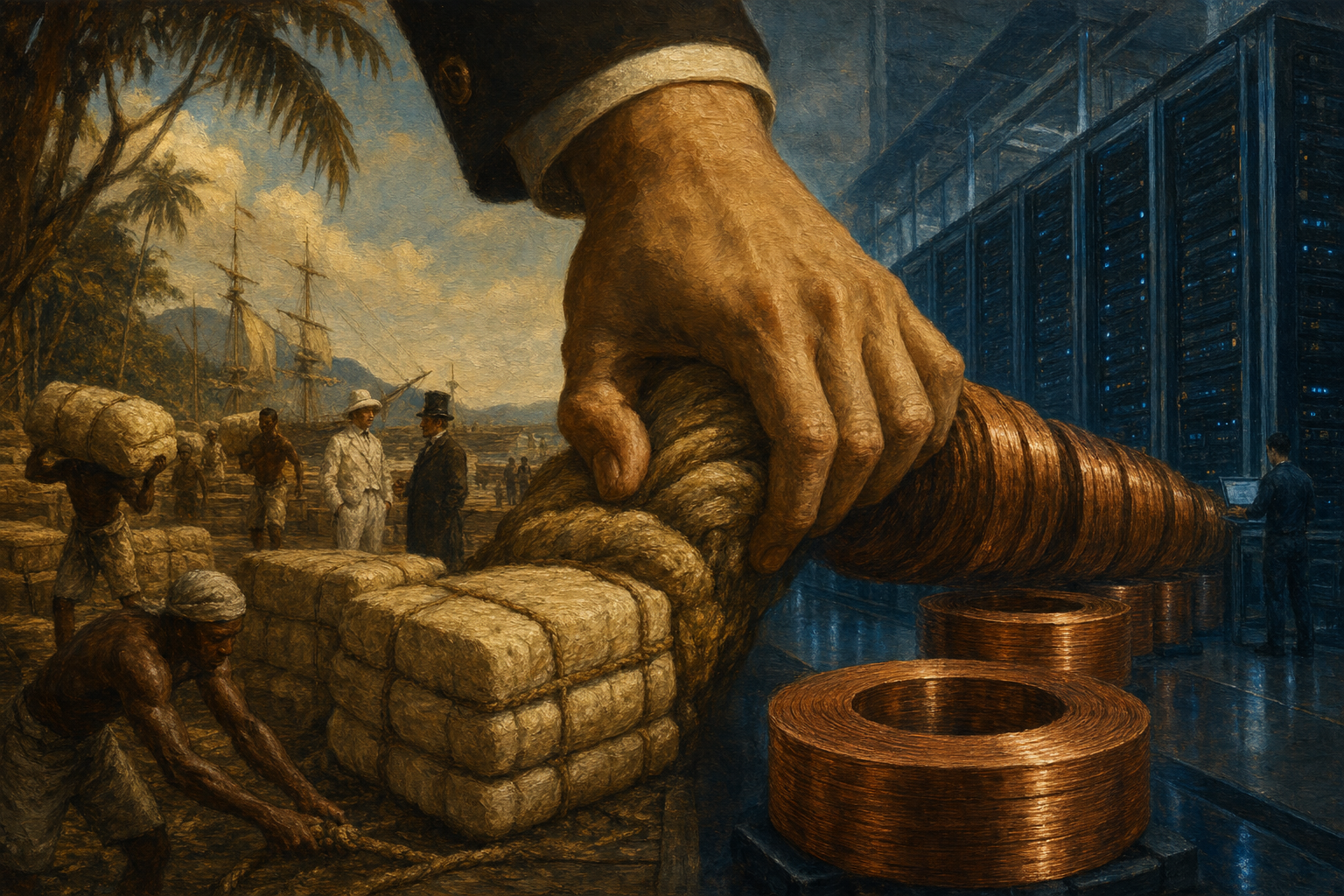
In 1925 the most valuable thing in America was a milky sap from trees on the far side of the world. Rubber ran every car, factory and phone line, Britain's colonies grew about three quarters of it, and Britain had just choked the supply: the Stevenson Plan restricted exports to drive the price from around thirteen cents a pound past a dollar. America, which bought most of the world's rubber, did not just pay. Commerce Secretary Herbert Hoover funded a global hunt for new supply, Harvey Firestone planted a million acres of Liberia, chemists chased synthetic rubber, and the cartel collapsed when the Dutch refused to join and flooded the market. Squeeze a customer hard enough and you do not make him pay; you teach him to never need you again. A century later it is copper for AI data centres and China's grip on rare earths, and the same scramble has begun.
•3 min readA century later the same dynamic has returned with metal instead of sap. The lifeblood of the AI age is copper (a single large AI-ready data centre can require up to about 50,000 tonnes) and rare earth elements used in magnets, motors and weapons. Analysts forecast a structural refined-copper deficit (J.P. Morgan projecting roughly 330,000 tonnes for 2026), with new mines averaging about 17.9 years from discovery to production. The choke point is as lopsided as rubber was in 1925: China processes around 90 percent of the world's rare earths and has used that control as leverage, prohibiting exports of gallium and germanium to the US from December 2024 and adding medium and heavy rare earths and magnets to its export-control list through 2025. Washington's response could have been written by Hoover: in February 2026 it launched a Strategic Critical Minerals Reserve (Project Vault), backed by a $10 billion EXIM loan, and pressed a global search for friendly supply, recycling and substitutes. The lesson of the rubber war is not that a choke point is permanent but the opposite: squeeze a customer hard enough and you teach him, and everyone watching, how to make sure he never needs you again.
Queen and worker bees hatch from identical eggs, yet one lives for years and lays a million eggs while the others live for weeks and never breed. For a century the textbook answer was a single food: royal jelly. In 2026 a team at UC Riverside showed the real answer is grander. Specialised worker bees build the queen a palace: a peanut-shaped 'royal crib' of custom wax with its own chemistry, and they cluster to keep it warm. Raise a would-be queen in ordinary wax instead and she develops poorly and often dies. The jelly feeds her; the crib crowns her. We love a story with one secret ingredient. Nature almost never works that way.
•3 min readIn 2026 a team at the University of California, Riverside (its Center for Integrative Bee Research) showed that royal jelly alone does not make a queen: the environment does much of the work. A specialised caste of young worker bees acts as royal builders, constructing the large peanut-shaped 'royal crib' from a custom wax that is softer, melts at a higher temperature, and carries a distinct chemical signature of fatty acids and signals, and they alter their own physiology to raise the temperature around the cell, like underfloor heating. Crucially, when would-be queens were raised in ordinary worker-cell wax instead of the royal crib, the larvae developed poorly and many died: they needed the 'smell and feel' of the royal wax to transform at all. So queen determination is a whole system, diet plus architecture, temperature and wax chemistry plus the labour of many bees, not a single ingredient. It is a recurring lesson in biology: we love single-cause stories (one gene, one molecule, one food), but nature's marvels are usually built from many small causes acting together. A queen is built, not dosed.
In 1868 Thomas Huxley held up a piece of ordinary chalk before a hall of working men and revealed that it was not a mineral at all but the packed skeletons of countless microscopic sea creatures: proof that life itself builds the rock and shapes the chemistry of the oceans. A century and a half later, scientists cutting open a common fish have found a hidden bacterial passenger helping it mint that same limestone, the smallest hands still quietly building and balancing the sea.
•5 min readA study published in PLOS Biology on 27 May 2026, 'Symbiotic bacteria may support calcium carbonate precipitation in the Gulf toadfish', led by Anthony Bonacolta at the University of Miami Rosenstiel School, found that the calcium carbonate pellets (ichthyocarbonates) which bony fish produce and excrete to handle the seawater they drink are not made by the fish alone. A gut bacterium, the vibrio Photobacterium damselae, is abundant in the fish gut and in the carbonate pellets and carries genetic machinery linked to carbonate production, suggesting a fish-microbe symbiosis. Fish carbonates, long studied by Martin Grosell's Miami group, are a recognised contributor to the ocean's carbonate budget and help buffer ocean chemistry as a carbon sink, a process that matters as rising atmospheric carbon dioxide drives ocean acidification. As senior author Martin Grosell put it, what was thought to be driven solely by the fish 'may actually reflect a close symbiosis between the fish and its gut microbial community.'
In 964 the warrior-emperor Nikephoros Phokas, conqueror of Crete, Cyprus and Antioch, tried to make the Byzantine Church share the burden of the empire's defence: he curbed the tax-exempt, service-exempt monasteries and asked that fallen soldiers be honoured as martyrs. The Church refused, he was murdered, and his law was undone. A thousand years later, Israel is fighting almost exactly the same battle over the ultra-Orthodox draft exemption, and history offers a sobering note: the exemption tends to outlive the reformer.
•4 min readIsrael's 2026 crisis over ending the ultra-Orthodox (Haredi) exemption from military conscription, pitting the Supreme Court and a war-weary public against the religious community and the parties that protect it.
In the late 1920s a Japanese weatherman named Kiyoo Wadati proved earthquakes happen hundreds of kilometres down, deep inside rock that was supposed to be too hot to break. The world ignored him for twenty years. A century later, beneath a quiet corner of Utah, scientists have confirmed nine earthquakes breaking ninety kilometres below a continent, where the rock should flow, not fracture, and where the explanation Wadati's deep quakes eventually earned does not apply at all.
•5 min readA 2026 study led by Keith Koper at the University of Utah, published in The Seismic Record, reanalysed a magnitude 3.8 earthquake recorded on 24 February 1979 near Randolph, Utah at a focal depth of about 90 km (first flagged as anomalously deep by then-postdoc George Zandt) together with eight other suspected deep events in northern Utah and southwestern Wyoming, and confirmed all nine as continental mantle earthquakes at 68 to 90 km depth, beneath the crust. At those depths temperatures exceed 700 degrees Celsius and rock is expected to flow ductilely rather than fracture, and crucially these events occur outside any subduction zone, so the cold-slab mechanisms that explain Wadati's deep earthquakes do not apply. The team proposes that soft mantle flowing around the cold deep root of the Wyoming Craton concentrates strain enough to break, but the fundamental physics, in the words of the researchers, remains a mystery: 'How in the world can these things happen?'
Around the year 410, with the legions gone, the Western emperor sent word that Rome could no longer defend Britain: see to your own defence. The abandoned province improvised, hiring Saxon mercenaries who soon turned on their employers and took the island. In 2026, as the United States pulls troops from Germany and floats a NATO without America, Europe is scrambling to build a defence of its own, and the oldest lesson of abandonment is waiting on the wall.
•4 min readPresident Trump's 2026 withdrawal of US forces from Germany and his floating of a NATO without the United States, and Europe's scramble to rearm and build a fallback defence it cannot quickly fully replace.
In 1917 a Quaker pacifist named Lewis Fry Richardson computed the weather by hand in an army billet, and gave turbulence its enduring image: big whirls feeding little whirls, energy tumbling forever downhill from large to small. In 1941 Kolmogorov made that one-way arrow a law of physics. For more than eighty years the direction of the flow looked like a fact about the universe. In 2026 four physicists, in a tray of salt water stirred by magnets, ran the arrow backwards.
•6 min readA study led by Lei Fang (University of Pittsburgh) with Xinyu Si, Filippo De Lillo and Guido Boffetta (University of Turin), 'Manipulating the direction of turbulent energy flux via tensor geometry in a two-dimensional flow' (Science Advances, 2025), drew wide science-press attention in early June 2026. By recasting the turbulent energy flux as a mechanical process and changing the geometry between the driving force and the flow in a thin layer of salt water driven electromagnetically, the team produced two-dimensional turbulence with either a forward (large to small) or an inverse (small to large) energy cascade. This challenges the assumption, standing since Kolmogorov in 1941, that the dimensionality of a system alone fixes the direction of its energy cascade, and the authors suggest it could eventually help steer ocean currents and improve climate forecasting.
Boston, June 1768: the Royal Navy tows a smuggling sloop called Liberty out of the harbour and lights a riot. For thirty years Britain had let the colonies smuggle in peace; the day it chose to enforce its trade laws, it began to lose them. In 2026, as Washington walls off Chinese goods and chases the trade as it reroutes through Vietnam and Mexico, the same lesson is waiting on the dock.
•4 min readThe US-China tariff war of 2026 and the rerouting of Chinese trade through third countries such as Vietnam and Mexico, with Washington escalating enforcement against transshipment.
Oklahoma City, 3 February 1964: the United States government begins dropping 1,253 sonic booms on half a million of its own citizens, eight a day for six months, to prove they could learn to love the coming supersonic age. The experiment helped kill the American supersonic dream. 62 years later, NASA's X-59 is about to cross Mach 1 by doing the opposite: engineering the boom out of the airplane entirely.
•6 min readNASA's X-59 quiet supersonic demonstrator was expected to cross Mach 1 for the first time in early June 2026, engineering the sonic boom down to a quiet thump in a bid to overturn the 1973 overland supersonic ban that Operation Bongo helped create.
July 1902 to December 1919, from Theodor Herzl's testimony before the British Royal Commission on Alien Immigration to the Aliens Restriction (Amendment) Act that sealed Britain's first peacetime immigration regime into permanent peacetime law
Brussels, 1 June 2026: the EU Commission, Council and Parliament conclude the trilogue on the Pact on Migration and Asylum, creating third-country return hubs and expanded deportation powers. Britain's Aliens Act 1905, the first general peacetime immigration control of the modern British state, built the same architecture for a different generation of refugees, and used it in the 1930s to refuse the children of the people it was first written to keep out.
•8 min readBrussels, 1 June 2026: EU concludes the trilogue on the Pact on Migration and Asylum (in force 12 June), creating third-country return hubs, expanded detention, biometric collection from children, a seven-state safe-country-of-origin list, and a €420M frontline fund.
March 1936 to September 1939, from the Rhineland remilitarisation to the German invasion of Poland
Galați, Romania, 29 May 2026: a Russian Shahed-136 drone detonated on the 10th floor of an apartment building, wounding two civilians. NATO declined to invoke Article 5. On 7 March 1936 the Wehrmacht crossed the Rhine bridges; Britain declined to call it a casus belli. The decision in each case is the precedent.
•6 min readGalați, Romania, 29 May 2026: Russian Shahed-136 drone detonates inside a NATO member's apartment building, wounding two. NATO declines to invoke Article 5. The structural mechanism is the British Cabinet's 11 March 1936 decision in Romanian.
Jena, 6 July 1924: a 51-year-old German psychiatrist named Hans Berger pushes two thin needle electrodes through a 17-year-old neurosurgery patient's skull defect and records the first human electroencephalogram. He tells no one for five years. 102 years later, the same physical signal lets a man with ALS speak by thinking.
•4 min readImplanted-electrode brain-computer interfaces let people with ALS speak and type by thinking; the 2026 Neuralink VOICE-trial update on Kenneth Shock is the latest in a string of 2023-2026 results.