Every day, we find the historical story hiding inside the headlines. Riveting narratives
that connect the past to the present, and make you wonder what happens next.
Choose your topics
You'll receive one email per topic, per day. Pick as many as you like.
Today's Echo · History & Current Events
1922 to 1928, the British Empire and the United States
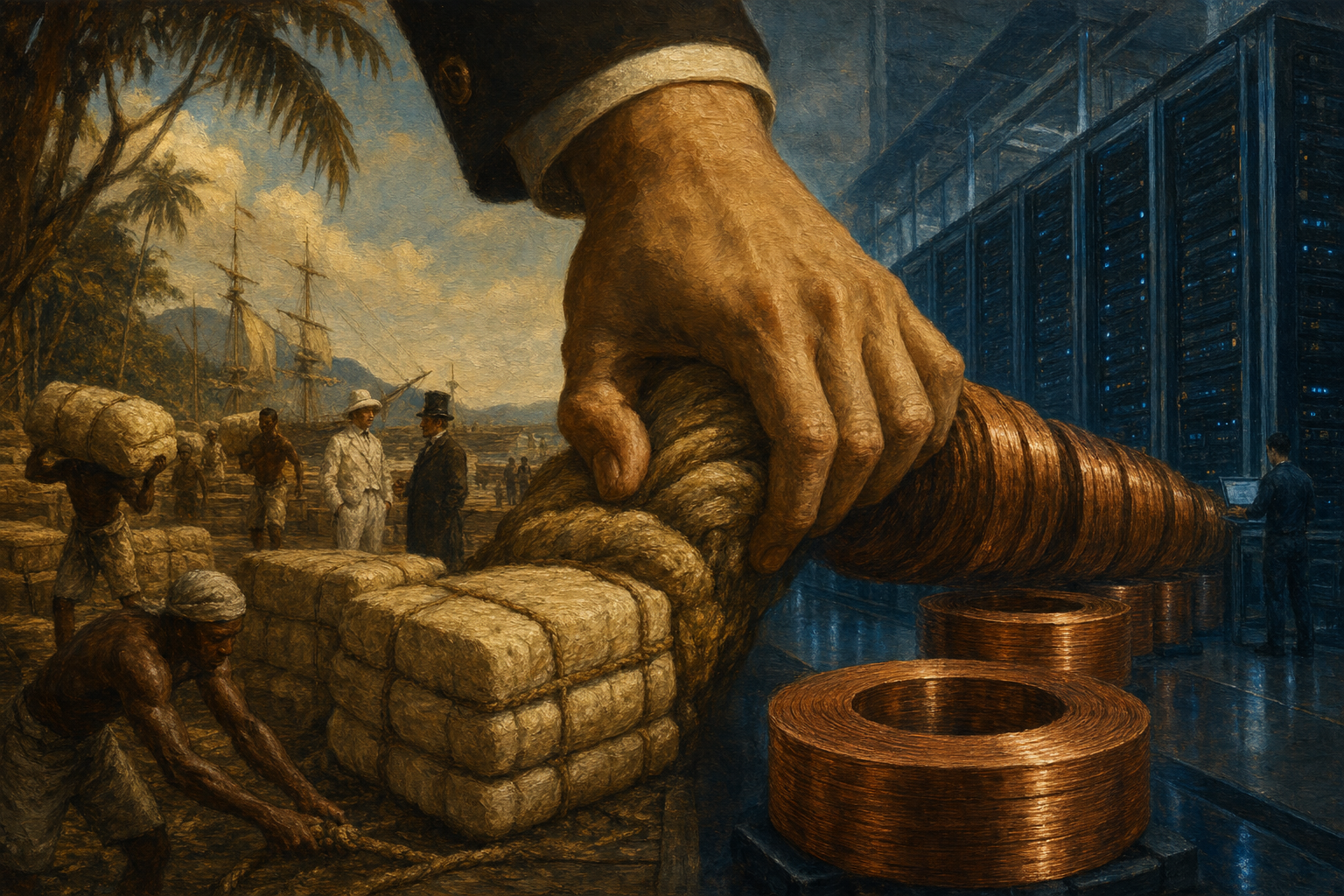
In 1925 the most valuable thing in America was a milky sap from trees on the far side of the world. Rubber ran every car, factory and phone line, Britain's colonies grew about three quarters of it, and Britain had just choked the supply: the Stevenson Plan restricted exports to drive the price from around thirteen cents a pound past a dollar. America, which bought most of the world's rubber, did not just pay. Commerce Secretary Herbert Hoover funded a global hunt for new supply, Harvey Firestone planted a million acres of Liberia, chemists chased synthetic rubber, and the cartel collapsed when the Dutch refused to join and flooded the market. Squeeze a customer hard enough and you do not make him pay; you teach him to never need you again. A century later it is copper for AI data centres and China's grip on rare earths, and the same scramble has begun.
•3 min readA century later the same dynamic has returned with metal instead of sap. The lifeblood of the AI age is copper (a single large AI-ready data centre can require up to about 50,000 tonnes) and rare earth elements used in magnets, motors and weapons. Analysts forecast a structural refined-copper deficit (J.P. Morgan projecting roughly 330,000 tonnes for 2026), with new mines averaging about 17.9 years from discovery to production. The choke point is as lopsided as rubber was in 1925: China processes around 90 percent of the world's rare earths and has used that control as leverage, prohibiting exports of gallium and germanium to the US from December 2024 and adding medium and heavy rare earths and magnets to its export-control list through 2025. Washington's response could have been written by Hoover: in February 2026 it launched a Strategic Critical Minerals Reserve (Project Vault), backed by a $10 billion EXIM loan, and pressed a global search for friendly supply, recycling and substitutes. The lesson of the rubber war is not that a choke point is permanent but the opposite: squeeze a customer hard enough and you teach him, and everyone watching, how to make sure he never needs you again.
Queen and worker bees hatch from identical eggs, yet one lives for years and lays a million eggs while the others live for weeks and never breed. For a century the textbook answer was a single food: royal jelly. In 2026 a team at UC Riverside showed the real answer is grander. Specialised worker bees build the queen a palace: a peanut-shaped 'royal crib' of custom wax with its own chemistry, and they cluster to keep it warm. Raise a would-be queen in ordinary wax instead and she develops poorly and often dies. The jelly feeds her; the crib crowns her. We love a story with one secret ingredient. Nature almost never works that way.
•3 min readIn 2026 a team at the University of California, Riverside (its Center for Integrative Bee Research) showed that royal jelly alone does not make a queen: the environment does much of the work. A specialised caste of young worker bees acts as royal builders, constructing the large peanut-shaped 'royal crib' from a custom wax that is softer, melts at a higher temperature, and carries a distinct chemical signature of fatty acids and signals, and they alter their own physiology to raise the temperature around the cell, like underfloor heating. Crucially, when would-be queens were raised in ordinary worker-cell wax instead of the royal crib, the larvae developed poorly and many died: they needed the 'smell and feel' of the royal wax to transform at all. So queen determination is a whole system, diet plus architecture, temperature and wax chemistry plus the labour of many bees, not a single ingredient. It is a recurring lesson in biology: we love single-cause stories (one gene, one molecule, one food), but nature's marvels are usually built from many small causes acting together. A queen is built, not dosed.
Across West Africa, a cheap checked plaid holdall has a name: the Ghana Must Go bag. It got it in 1983, when Nigeria, reeling from an oil-price crash, abruptly expelled more than two million West African migrants, around a million of them Ghanaians, giving them about two weeks to leave. Fourteen years earlier, Ghana had done the same to Nigerians. When an economy sours, the state reaches for the outsider. In 2026 the bag is being packed again, as South African vigilante movements set a June 30 deadline for undocumented migrants to leave, with shacks burned and people killed. The bag only ever changes its nationality.
•3 min readIn 2026 South Africa is living a version of the same story. With a stalled economy and some of the world's highest unemployment, anger has again found migrants. Vigilante movements, notably Operation Dudula (founded 2020) and March and March (founded 2025 by Jacinta Ngobese-Zuma), declared that all undocumented migrants must leave by 30 June 2026, a deadline no government imposed, framed in the language of law, order and democracy. The reality on the ground is violent: near Mossel Bay a mob destroyed about 55 shacks and two Mozambican nationals were killed; in another incident a Zimbabwean migrant was set alight and killed by a vigilante mob; thousands of migrants are leaving, with or without papers. The South African Human Rights Commission warned of a 'possible human rights crisis.' The script is more than forty years old: the same stalled economy, the same official shrug, the same conviction that a country's troubles are sitting in someone else's shack. The checked bag has been Ghanaian, Nigerian and now South African; the only constant is the hard year that goes looking for someone to fill it.
In 1970 the physicist Louis Neel won the Nobel Prize and, in the same breath, called his own discovery useless. He had found antiferromagnetism: a hidden kind of magnetism where atomic magnets cancel out, so the material shows almost no field. A magnet you cannot feel. Decades later, that very property made it the perfect immovable anchor inside the read heads of hard drives, and the useless magnet became part of why the world can store everything. In 2026 the plot repeats with a brand-new third class of magnetism, altermagnetism, read out by a single flaw in a diamond. The most useless thing in physics is usually just the most early.
•3 min readIn 2026 the same plot is unfolding with a brand-new kind of magnetism. For nearly a century there were only two recognised classes, ferromagnetism and Neel's antiferromagnetism; then physicists confirmed a third, altermagnetism, which was named a top physics breakthrough of 2024 after experimental demonstration (including work at Johannes Gutenberg University Mainz using a facility at DESY). An altermagnet looks externally quiet like an antiferromagnet but has an internal structure (alternating moments paired with a rotation of the surrounding crystal) that gives it some ferromagnet-like usefulness, of strong interest for faster, denser memory. The catch is Neel's catch: because it hides its order, an altermagnet is fiendishly hard to detect. In April 2026 a team led by Jamir Marino at the University at Buffalo, publishing in Physical Review Letters, proposed using a nitrogen-vacancy (NV) centre in diamond (a defect where a carbon atom is replaced by nitrogen with an adjacent vacancy) as a quantum sensor: by measuring how the defect's spin relaxes in different directions (quantum relaxometry), one can fingerprint an altermagnet less invasively than existing methods. A quiet, useless-looking material, read out by a flaw in a gemstone, that the memory industry is betting will be the next revolution, exactly as Neel's hidden magnet was.
We remember the Spitfire and the few. But the Battle of Britain was won by a system: the Dowding System, the world's first integrated air defence, which fused radar, ground observers and control rooms so a badly outnumbered Fighter Command could put its scarce planes in exactly the right place. The Germans never understood the invisible web, and it beat them. In 2026 the same idea is being rebuilt under fire, as Ukraine fields what many call the most combat-tested layered air-defence network on earth. The weapon everyone photographs is the missile. The thing that wins is the web behind it.
•3 min readIn 2026 Ukraine is widely described as having built one of the most combat-tested, effective layered air-defence networks in the world, born of the same arithmetic Dowding faced: Russia can launch far more missiles and drones than any stock of expensive interceptors can match. Ukraine's answer is a system in layers and an integrated picture: scarce, costly Patriot interceptors (the latest PAC-3 estimated around $4 million each) reserved for ballistic missiles; medium-range launchers such as the IRIS-T (a reported near-100 percent intercept rate across more than 250 engagements) for cruise missiles; and at the bottom swarms of cheap interceptor drones (often $1,000 to $2,500 each) that ram incoming Shaheds, downing over 70 percent of them over Kyiv and freeing the Patriots for the threats only they can stop. By killing a cheap drone with a cheap drone, Ukraine flipped the cost imbalance of the war. And like Britain after 1940, it is now exporting the capability itself, opening weapons-export offices across Europe and offering its full air-defence package to Gulf states. The thing that wins, then as now, is the integrated web behind the weapon.
circa 126 AD to 1824, Roman concrete and its rediscovery
The Pantheon's unreinforced concrete dome has stood for nineteen centuries; the concrete we pour today crumbles in fifty years, and making its cement is roughly 8 percent of all human carbon emissions. The Romans built a stone that healed its own cracks and grew stronger in seawater, then took the recipe to the grave for a thousand years. In 2023 MIT finally explained it. In 2026 a team at Worcester Polytechnic went further, using an enzyme from our own blood to build a material that locks carbon away as it sets. The ancients did not always know more than us. Sometimes they just did better, and left us to work out why.
•3 min readIn 2026 a team at Worcester Polytechnic Institute (WPI) in Massachusetts unveiled an enzymatic structural material (ESM) that does what concrete never could: it is carbon-negative. Its key ingredient is carbonic anhydrase, the same enzyme in human red blood cells that helps the body exhale carbon dioxide. In the material, the enzyme accelerates a reaction of CO2, water and calcium to form solid calcium carbonate (the mineral of limestone and seashells), which becomes the structural framework; the material hardens within a few hours. A cubic metre of conventional concrete emits around 330 kilograms of CO2 in production, whereas a cubic metre of the new material sequesters roughly 6 kilograms, turning a carbon source into a carbon sink. It is suited to roof decks, wall panels and modular components. The echo of Rome is exact: the Romans, by accident, made a durable mineral stone that healed itself and strengthened in the sea but could not explain it; we spent two millennia forgetting and then re-understanding it, and are now engineering the idea on purpose and better, a stone that not only lasts but pays back the carbon it took to make.
1763 to 1778, the road to the Franco-American alliance
A rebel state is only a claim until a great power says it is real, and great powers never grant recognition for free. In 1778, France became the first power to recognise the United States, not out of love for liberty but because the foreign minister Vergennes wanted to bleed Britain for the loss of Canada. In December 2025, Israel became the first country to recognise Somaliland, a place that had governed itself for thirty-four years, because it wanted a foothold on the Red Sea. Recognition is a weapon, handed to you by your enemy's enemy.
•3 min readOn 26 December 2025, Israel became the first country on earth to formally recognise Somaliland, which had declared independence from collapsing Somalia in May 1991 and built a functioning state (its own currency, competitive elections, relative stability) yet remained internationally unrecognised for thirty-four years because recognition would offend Somalia. The calculation changed when Somaliland's strategic value rose: it sits at the southern gate of the Bab el-Mandeb strait, near the rebuilt Berbera port (expanded with a roughly $442M DP World investment), on the sea-lane to Suez where Houthi missiles have threatened shipping. In March 2026 Bloomberg reported Israel was seeking a military base at Berbera. PM Netanyahu framed the recognition as in the spirit of the Abraham Accords. In a striking echo, Somaliland was briefly independent for five days in 1960, recognised by around 33 governments including Israel, before it united with Italian-administered Somaliland to form Somalia; so Israel's 2025 recognition revived one it had quietly extended 65 years earlier. Somalia condemned it as an attack on its sovereignty, the African Union rejected it, and Turkey (with a base in Mogadishu) denounced it. The lesson rhymes: a state becomes real when a powerful patron needs it to be, and recognition is spent where it costs a rival the most.
We have walked on the Moon, mapped it and brought its rocks home, yet in 2026 we still have no complete map of what it is made of. On 30 November 1609 Galileo turned a telescope on the Moon and saw mountains and craters, proving it was a rough world, not the flawless heavenly sphere doctrine demanded. Four centuries on, a team at Tokyo Metropolitan University has shown that a lunchbox-sized X-ray telescope under ten kilograms could make the first complete chemical map of the entire lunar surface in about two years.
•3 min readIn June 2026 a team at Tokyo Metropolitan University reported that a lightweight X-ray telescope, weighing under 10 kilograms and about the size of a lunchbox, placed in lunar orbit, could finally make the first complete chemical map of the Moon. It exploits X-ray fluorescence: the Sun constantly bathes the Moon in X-rays, and when these strike the surface each element fluoresces with its own signature, which the telescope reads from orbit. Their simulations show a single small telescope could map five key elements (oxygen, iron, magnesium, aluminium and silicon) across the entire Moon in about two years at 70-by-70-kilometre resolution, with a 5-by-5 array improving resolution and shortening the time. A full chemical map matters for reading the Moon's deep history (the giant-impact origin) and for the resources (metals, oxygen, ice) that a permanent lunar base will need, just as a new race to the Moon gets under way. The recurring lesson is Galileo's: every time we look at the Moon with a sharper instrument, it becomes less of a symbol and more of a world.
In 2026 the UN is warning that a coming El Nino could push parts of the world toward famine. But the deadliest famines in history were made by policy, not weather. When an El Nino failed the monsoon in 1876, British India under Viceroy Lord Lytton exported a record amount of wheat to England while six to ten million of its people starved; the same El Nino killed millions more in China and Brazil. As the historian Mike Davis argued, the drought was natural, the mass death was manufactured. Drought is nature. Famine is a decision.
•3 min readIn June 2026 the UN's World Food Programme and FAO warned that worsening hunger put 13 hotspots at risk, with a strong El Nino 61 to 87 percent likely by mid-year threatening harvests (rice could fall 20 to 50 percent in parts of South Asia and southern Africa) and the number facing acute hunger potentially returning to the levels of early 2022. But the echo of 1877 is exact: the danger is not only the weather. Funding for global food assistance has collapsed by nearly 60 percent since 2022; the Gulf war has driven up fuel and fertiliser prices (urea up about 46 percent in a month), raising the cost of growing food everywhere. Whether the 2026 El Nino becomes a famine, and where (Sudan, South Sudan, Yemen and Gaza are already at the edge), depends far less on rainfall than on choices: how much aid is funded, whether grain and fertiliser keep flowing, whether those in charge decide distant lives are worth saving. Drought is nature; famine is a decision.
For a century, the mystery of Stonehenge was not why it was built but how the stones got there. In 1923 the geologist Herbert Thomas matched the smaller bluestones to the Preseli Hills of Wales, over 200km away, proving Neolithic people hauled multi-tonne stones across southern Britain. The huge central Altar Stone was assumed Welsh too, until a 2024 study fingerprinted its mineral grains and traced it to northeast Scotland, more than 750km away and probably moved by sea: the longest journey of any stone in any known Neolithic monument.
•3 min readIn 2024 a team led by the geologist Anthony Clarke tested that assumption by fingerprinting the Altar Stone, not by appearance but by the radiometric ages of zircon, rutile and apatite grains locked inside it. The signature did not match Wales: it matched the Old Red Sandstone of the Orcadian Basin in northeast Scotland, more than 750 km away, with the stone probably transported in part by sea, the longest known journey of any stone in any Neolithic monument; it was likely placed around 2620 to 2480 BC, and follow-up work in 2025-26 has continued to narrow the precise source and debate the route. The finding rewrites the picture of Neolithic Britain: moving a six-tonne stone the length of the island implies not scattered, isolated farmers but a society laced by long-distance contact, seafaring, shared purpose and organisation capable of coordinating a project across the whole country without writing, metal tools or the everyday wheel. More broadly it is a lesson in how badly we underestimate the deep past: the instinct that assumed the nearest plausible source is the same instinct that imagines prehistoric people as simpler than they were, and it keeps being wrong.
This week occupied Crimea suspended civilian gasoline sales, the peninsula's worst fuel crisis since 2014, because Ukraine has spent a year striking Russia's refineries and depots from the air. It is the 1944 strategy reborn: the Allied oil campaign that bombed Ploiesti and the synthetic-fuel plants until the Luftwaffe was grounded and the panzers ran dry, and Hitler's own armaments minister told him the war was lost. The difference is scale: Germany was fuel-poor, Russia is a petro-superpower. You can bleed it. You cannot drain it.
•4 min readIn 2025-26 Ukraine has applied the same logic to Russia, opening a deep-strike front far behind the lines with long-range drones and missiles aimed at refineries, oil depots and pipelines. By 2026 one industry estimate put roughly a third of Russia's oil-refining capacity offline; Russia banned fuel exports (from April) and domestic stations began rationing; and on 21 June 2026 Russian-occupied Crimea suspended civilian gasoline sales altogether (drivers had already been held to 20 litres a week on coupons), the worst fuel crisis there since the 2014 annexation, after strikes the Kremlin-appointed head said killed four and wounded 28. As one analysis put it, long-range strikes are cutting how much fuel Russia can produce while shorter-range strikes are cutting its ability to move what it still makes. But the parallel is honest about its limits: Germany was uniquely fragile, a fuel-poor nation running on a few bombable synthetic plants, whereas Russia is one of the world's largest oil and gas producers with vast reserves and refining capacity spread across eleven time zones. Ukraine's campaign inflicts serious shortages and economic damage, a steady tax on the war, but it cannot ground a petro-superpower the way the Allies grounded the Wehrmacht.
In 1906 the psychiatrist Alois Alzheimer examined the brain of Auguste Deter, who had told him 'I have lost myself', and found the amyloid plaques and tau tangles that still define the disease. For 120 years we could see the plaques and do almost nothing to clear them. In June 2026 a Monash University team reported that a copper compound, Cu(ATSM), repaired the brain's clogged waste pump at the blood-brain barrier, cutting toxic amyloid about 42 percent and improving memory about 44 percent in mice. Preclinical, but a genuinely new approach: clearing the brain, not just blocking it.
•4 min readIn June 2026 a team at Monash University reported in ACS Chemical Neuroscience that the copper compound Cu(ATSM) takes a different approach from the failed drugs: rather than blocking amyloid production, it repairs the weakened P-glycoprotein pump at the blood-brain barrier, restoring the brain's own ability to clear amyloid. In mice bred to develop Alzheimer's, it reduced toxic amyloid-beta by about 42 percent and improved spatial learning by about 44 percent over roughly eight weeks, and may also activate microglia to degrade plaques. Two features make it notable: Cu(ATSM) has already passed human safety trials for Parkinson's disease and ALS (a potential fast track), and the strategy of restoring clearance is closer to the actual failure Alzheimer saw than a century of attempts to block production. The crucial caveat is that this is preclinical, in mice, and the history of Alzheimer's research is full of compounds that dazzled in mice and failed in humans, so it is a genuinely new mechanism and a reason for measured hope, not a cure.