Every day, we find the historical story hiding inside the headlines. Riveting narratives
that connect the past to the present, and make you wonder what happens next.
Choose your topics
You'll receive one email per topic, per day. Pick as many as you like.
Today's Echo · History & Current Events
1922 to 1928, the British Empire and the United States
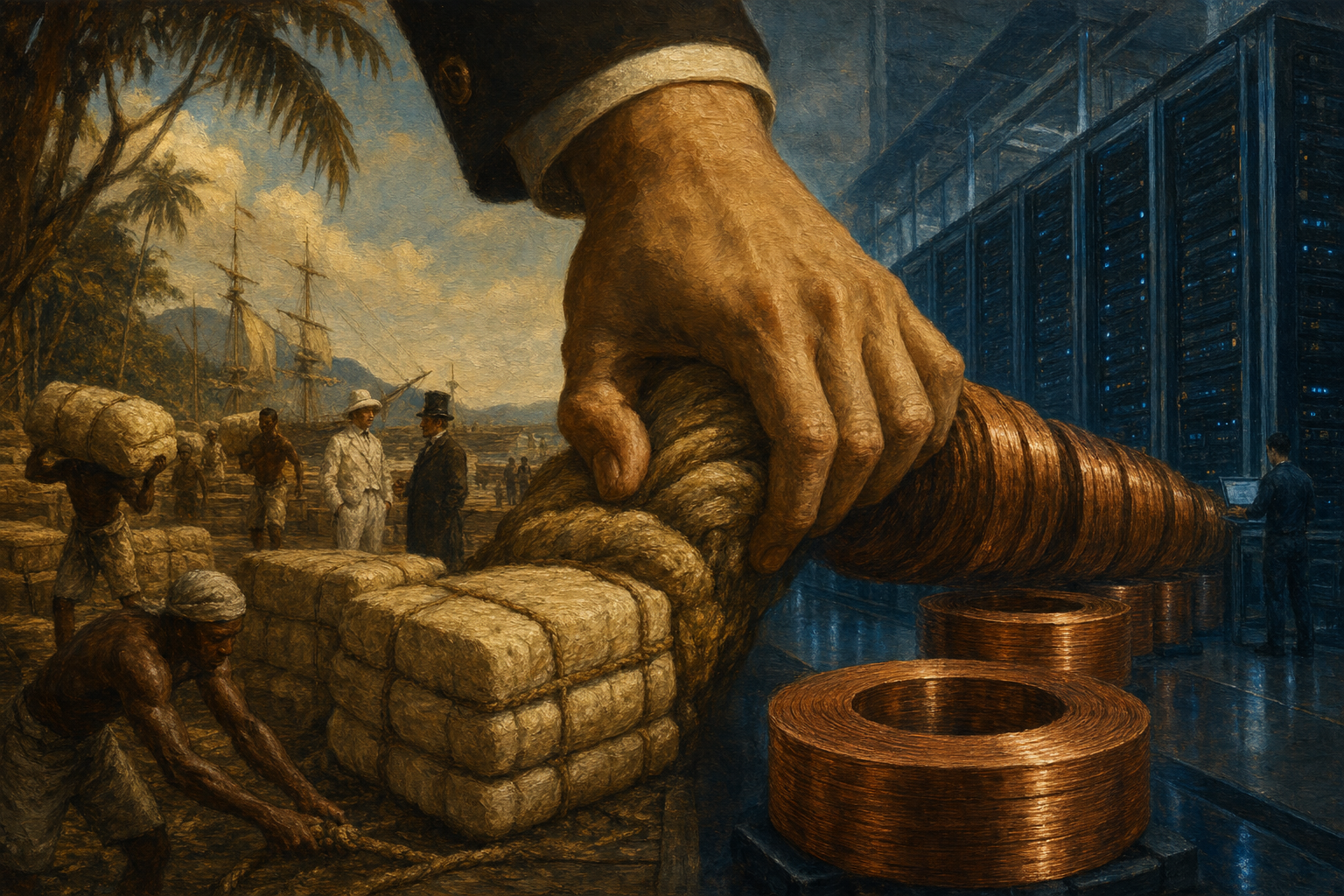
In 1925 the most valuable thing in America was a milky sap from trees on the far side of the world. Rubber ran every car, factory and phone line, Britain's colonies grew about three quarters of it, and Britain had just choked the supply: the Stevenson Plan restricted exports to drive the price from around thirteen cents a pound past a dollar. America, which bought most of the world's rubber, did not just pay. Commerce Secretary Herbert Hoover funded a global hunt for new supply, Harvey Firestone planted a million acres of Liberia, chemists chased synthetic rubber, and the cartel collapsed when the Dutch refused to join and flooded the market. Squeeze a customer hard enough and you do not make him pay; you teach him to never need you again. A century later it is copper for AI data centres and China's grip on rare earths, and the same scramble has begun.
•3 min readA century later the same dynamic has returned with metal instead of sap. The lifeblood of the AI age is copper (a single large AI-ready data centre can require up to about 50,000 tonnes) and rare earth elements used in magnets, motors and weapons. Analysts forecast a structural refined-copper deficit (J.P. Morgan projecting roughly 330,000 tonnes for 2026), with new mines averaging about 17.9 years from discovery to production. The choke point is as lopsided as rubber was in 1925: China processes around 90 percent of the world's rare earths and has used that control as leverage, prohibiting exports of gallium and germanium to the US from December 2024 and adding medium and heavy rare earths and magnets to its export-control list through 2025. Washington's response could have been written by Hoover: in February 2026 it launched a Strategic Critical Minerals Reserve (Project Vault), backed by a $10 billion EXIM loan, and pressed a global search for friendly supply, recycling and substitutes. The lesson of the rubber war is not that a choke point is permanent but the opposite: squeeze a customer hard enough and you teach him, and everyone watching, how to make sure he never needs you again.
Queen and worker bees hatch from identical eggs, yet one lives for years and lays a million eggs while the others live for weeks and never breed. For a century the textbook answer was a single food: royal jelly. In 2026 a team at UC Riverside showed the real answer is grander. Specialised worker bees build the queen a palace: a peanut-shaped 'royal crib' of custom wax with its own chemistry, and they cluster to keep it warm. Raise a would-be queen in ordinary wax instead and she develops poorly and often dies. The jelly feeds her; the crib crowns her. We love a story with one secret ingredient. Nature almost never works that way.
•3 min readIn 2026 a team at the University of California, Riverside (its Center for Integrative Bee Research) showed that royal jelly alone does not make a queen: the environment does much of the work. A specialised caste of young worker bees acts as royal builders, constructing the large peanut-shaped 'royal crib' from a custom wax that is softer, melts at a higher temperature, and carries a distinct chemical signature of fatty acids and signals, and they alter their own physiology to raise the temperature around the cell, like underfloor heating. Crucially, when would-be queens were raised in ordinary worker-cell wax instead of the royal crib, the larvae developed poorly and many died: they needed the 'smell and feel' of the royal wax to transform at all. So queen determination is a whole system, diet plus architecture, temperature and wax chemistry plus the labour of many bees, not a single ingredient. It is a recurring lesson in biology: we love single-cause stories (one gene, one molecule, one food), but nature's marvels are usually built from many small causes acting together. A queen is built, not dosed.
In 2026 a US president's demand to acquire Greenland is treated as bizarre and unprecedented. It is neither. In 1917 the US bought the Danish West Indies (now the US Virgin Islands) from Denmark for 25 million dollars in gold, a purely strategic purchase to deny the islands to Germany near the Panama Canal, pressed on a neutral nation under the implied threat of seizure. And in 1946 the Truman administration secretly offered Denmark 100 million dollars in gold for Greenland itself, and was refused. The strategic logic of 2026 is 160 years old.
•4 min readIn 2026 the US president revived the demand to acquire Greenland openly, calling for immediate negotiations, declining to rule out economic pressure (while disavowing force), and framing it as keeping Russia and China out of a strategically vital, warming Arctic of new shipping lanes and minerals. Denmark and Greenland have called their sovereignty a 'red line', allies are alarmed, and the demand for one NATO member to absorb another's territory has strained the alliance. The strategic logic is unchanged across 160 years: the US covets Greenland not for itself, just as it wanted the Danish West Indies not for their sugar, but for position and above all to deny it to a rival (Germany in 1917; the Soviet Union in 1946; Russia and China in 2026). The one real difference is agency: in 1917 a great power could pressure a small neutral into selling an inhabited colony over the heads of its people, who were simply told which flag they lived under, whereas in 2026 Greenland has its own elected government and is using its voice to refuse.
Newton's third law, every action has an equal and opposite reaction, has been bedrock physics since 1687. Yet a flock of starlings appears to break it constantly: a bird reacts to the neighbours ahead of and beside it but not those behind, so action and reaction stop balancing. In June 2026 physicists in Dresden published a way to model these 'non-reciprocal' living systems, by adding mathematical 'imaginary partners'. The law was never wrong. It just marks the border where passive matter ends and self-driven, living matter begins.
•4 min readIn June 2026 a team of physicists in Dresden working with the theorist Roderich Moessner published in Nature Physics a method for handling non-reciprocal interactions efficiently, by introducing carefully designed 'imaginary partners', phantom agents that restore a hidden symmetry in the equations, allowing flocks, crowds and living tissues to be simulated with unprecedented accuracy. The work belongs to the fast-growing physics of 'active matter', the study of systems whose components convert energy into their own motion, which spans the swarming of cells in a healing wound or a growing tumour, the dynamics of panicked crowds, the schooling of fish, and the design of swarms of small robots. The deeper point is that Newton's third law was never wrong, it simply has a domain: it reigns over passive matter that only reacts, and quietly bends at the threshold of matter that drives itself, marking the border beyond which the physics of living things begins.
In 1804 Haiti's enslaved people defeated Napoleon's army and founded the first Black republic. In 1825 France sent fourteen warships and forced them to pay an indemnity of 150 million gold francs, compensation to the former slaveholders for their lost 'property', as the price of recognition. Haiti borrowed to pay it, and serviced the resulting 'double debt' until 1947, shipping its wealth back to its former enslavers for 122 years. As the UN chief visits a collapsing, gang-ruled Haiti in 2026, the roots of that collapse run back to the ransom.
•4 min readIn mid-June 2026 UN Secretary-General Antonio Guterres visited a Haiti in near-total collapse: the armed coalition Viv Ansanm controlled roughly 70 percent of the capital, Port-au-Prince; about 2,300 people had been killed across the country in 2026 and some 1.5 million displaced (more than one Haitian in ten); and Haiti had had no president since Jovenel Moise's assassination in 2021, with a new internationally backed gang-suppression force only now preparing to deploy. It is tempting to read Haiti's collapse as simple state failure, but a country has no deep institutions, infrastructure or reservoir of public wealth to resist such a collapse partly because, for the first 122 years of its life as a free nation, it was financially bled, by treaty and at gunpoint, as the price of being allowed to exist. The double debt was not the only wound (a US occupation, dictatorships, coups and earthquakes followed) but it was the foundational one: Haiti began its independence already a century behind, paying for its own freedom rather than building on it.
On 15 October 1991 a detector in the Utah desert recorded a single subatomic particle carrying the energy of a fast-thrown baseball, about 51 joules in one speck: the 'Oh-My-God particle', still the most energetic cosmic ray ever observed. It should not have been able to reach us, and 35 years later no one can say what made it. In 2021 a second giant, the Amaterasu particle, did the same, and in 2026 the hunt for the source, a starburst galaxy or perhaps ultra-heavy nuclei, is sharper than ever.
•4 min readThe decades-old mystery is sharper than ever in 2026. New analysis is trying to trace the Amaterasu particle's path to a nearby starburst galaxy after all, arguing the apparently empty source region is an artifact of incomplete maps, while other physicists argue these record-breakers may be ultra-heavy atomic nuclei rather than lone protons, which would rewrite the calculation of where they can come from and how they survive the journey; next-generation observatories are being designed to settle the question. Beneath the competing theories lies a staggering fact: somewhere in the universe there is a natural particle accelerator that dwarfs everything humanity has built by a factor of tens of millions, it is operating right now, and we cannot say with confidence what it is or even where it is.
In 1966 Charles de Gaulle launched the Plan Calcul to build a French computer industry that could rival IBM, after the United States refused to sell France a supercomputer for its nuclear program and an American firm bought France's biggest computer maker. The crusade for technological independence largely failed: the French champion ran on American licenses and ended up merging with an American company. In June 2026 the EU unveiled its own Technological Sovereignty Package, making de Gaulle's argument again, sixty years on, with Europe dependent on foreign suppliers for over 80 percent of its key digital technology.
•4 min readOn 3 June 2026 the European Commission presented a European Technological Sovereignty Package, including a Chips Act 2.0, a Cloud and AI Development Act, an EU Open Source Strategy, and, for the first time, a formal EU definition of 'digital sovereignty'; France and Germany had launched a joint digital-sovereignty task force after a November 2025 summit. The driving fact is that the European Union depends on non-EU suppliers, overwhelmingly American and increasingly Chinese, for more than 80 percent of its key digital products, services and infrastructure. The argument is precisely de Gaulle's, scaled to a continent: a power that does not control its own chips, cloud, software and AI can be throttled or refused by whoever does, exactly as Washington once refused de Gaulle his supercomputer. And the difficulty is precisely his too, as the Plan Calcul warned: building a champion by decree against entrenched incumbents is a fight money and patriotism do not easily win, and the would-be escapee tends to end up partnered with the very power it meant to escape.
On 6 April 1938 a young DuPont chemist, Roy Plunkett, opened a gas cylinder that gave no gas yet weighed full, sawed it open, and found Teflon: a material so stable nothing could dissolve, burn or stick to it, thanks to the carbon-fluorine bond, one of the strongest in nature. That indestructibility made it a miracle and a curse. Its PFAS relatives are now 'forever chemicals' in the blood of almost everyone alive. In June 2026 scientists found the first real way to break them: hydrogen radicals split from water by ultraviolet light.
•4 min readIn June 2026 a research team reported in the journal Environmental Science & Technology the first credible route to destroying PFAS without exotic additives. They found that hydrogen radicals, extraordinarily reactive fragments generated from ordinary water by intense ultraviolet light (most effective below 300 nanometres), attack PFAS molecules and strip their fluorine atoms one by one, breaking the supposedly unbreakable chains into smaller, less persistent compounds. The finding overturns earlier assumptions about which reactive species drive PFAS breakdown, though the process is still slow and can leave intermediate byproducts, so it is not yet a complete solution. The deeper point is that the very property humanity celebrated in Teflon, its near-perfect stability, is the same property that turned its chemical family into permanent pollution inside our own bodies: the miracle and the curse were one property, embraced for decades before anyone asked what 'indestructible' would mean once the substances were loose in the world.
In November 1975, six leaders sat by a fire in the Château de Rambouillet, skipped the bureaucracy, and talked their way through the worst economic crisis since the Depression. It was meant to be a one-off. It became the G7. This week, fifty-one years almost to the day, the club is meeting again in France, at Évian, on the same dates of the month, its share of the world shrunk and its members fighting one another. The institution endures. The trust that made it work is the open question.
•4 min readThe 52nd G7 summit is being held at Évian-les-Bains, France, from 15 to 17 June 2026, the same dates of the month as Rambouillet and again on French soil, fifty-one years on. But the club's weight has changed: the G7's share of global output has fallen sharply as China, India and others have risen, and the larger BRICS grouping presents itself as an alternative. More corrosively, the trust that made the original fireside format work is fraying, with tariff disputes among the members themselves, an ongoing US-Israel-Iran war, and a US administration at odds with traditional allies, so that even agreeing a joint communiqué can be a struggle. The lesson of Rambouillet is that the summit worked not because of rules or size but because a handful of leaders trusted one another enough to talk plainly; the institution outlived its founders, but trust is the part that does not automatically renew.
In December 1930 Wolfgang Pauli proposed a particle he was ashamed of: neutral, almost massless, and, he feared, impossible to ever detect. He called it a desperate remedy and bet a case of champagne no one would find it. It took 26 years to catch, it turned out to have mass (cracking physics' best theory), and in June 2026 the largest detector ever built, deep under a hill in China, measured it more precisely than anyone in history.
•5 min readIn June 2026 the Jiangmen Underground Neutrino Observatory (JUNO), a 20,000 tonne liquid-scintillator detector about 700 metres underground in Guangdong, China, and the largest detector of its kind ever built, published its first physics result in Nature. From just 59 days of data (26 August to 2 November 2025) the collaboration measured two key neutrino-oscillation parameters to roughly 1.6 times the precision of all previous experiments combined, and demonstrated readiness to pursue its main goal: determining the neutrino mass ordering. That ordering feeds into one of the deepest open questions in physics, why the universe is made of matter rather than nothing. The particle Pauli was ashamed to invent, and was sure could never be found, has become the most-hunted ghost in physics, with cathedral-scale detectors built underground to study it, and at least three of its secrets (mass ordering, absolute mass, and whether it is its own antiparticle) still unclaimed.
1904 to 1962, Franco-Siamese Indochina and The Hague
An eleventh century Khmer temple, Preah Vihear, sits on a cliff in the Dangrek mountains. A French treaty in 1904 put the border along the watershed, which should have left the temple in Siam. But the 1907 map drew the line the other way, and Siam never objected. In 1962 the World Court gave the temple to Cambodia, not on the geography but on the silence: a country that says nothing for fifty years is taken to have agreed. In 2025 and 2026 Thailand and Cambodia fought a real war along that same line.
•4 min readThe old line became a full border war. After a fatal clash in spring 2025, Thailand and Cambodia fought a five-day conflict in July 2025 that killed at least a dozen people and displaced several hundred thousand civilians, including in Preah Vihear province, with all land border crossings closed from late June 2025. A ceasefire announced on 27 December 2025 was almost immediately disputed, each side accusing the other of violating it in early January 2026, and the frontier has remained sealed and tense through 2026. The conflict is a reminder that a border is not a fact of nature but a claim that hardened because, at the crucial moment, no one pushed back: the watershed never moved, but the line drawn around the temple in 1907, and left unchallenged, is still killing people more than a century later.
On 19 February 1881 the New York Times explained, deadpan, how the telegraph would seduce the earth's currents, shift the poles, tip the planet off its axis, and throw the solar system into catastrophe. It was mocking a prophecy made in earnest. For two thousand four hundred years, from Socrates on writing to a bandmaster on the phonograph, every new machine has arrived to the same announcement of the end of the world. Now it is artificial intelligence's turn, and some of the men who built it are the ones predicting extinction.
•6 min readThe 2025-2026 argument over artificial-intelligence 'doom' repeats the same apocalyptic register at maximum stakes. In October 2025 more than 2,000 people, including AI 'godfathers' Geoffrey Hinton and Yoshua Bengio and Apple co-founder Steve Wozniak, signed a public statement calling for a prohibition on developing superintelligence until it can be proven safe, citing the risk of human extinction. Hinton now puts the chance that AI causes human extinction within thirty years at 10 to 20 percent; Bengio warns the race for AI dominance could create machines with self-preservation goals of their own. The structural rhyme is exact: a new information technology met with the prediction that it will not merely disrupt us but end us. The historical record suggests the genre of total catastrophe is almost always wrong, while the quieter prediction that the technology will change us in unforeseen ways is almost always right.