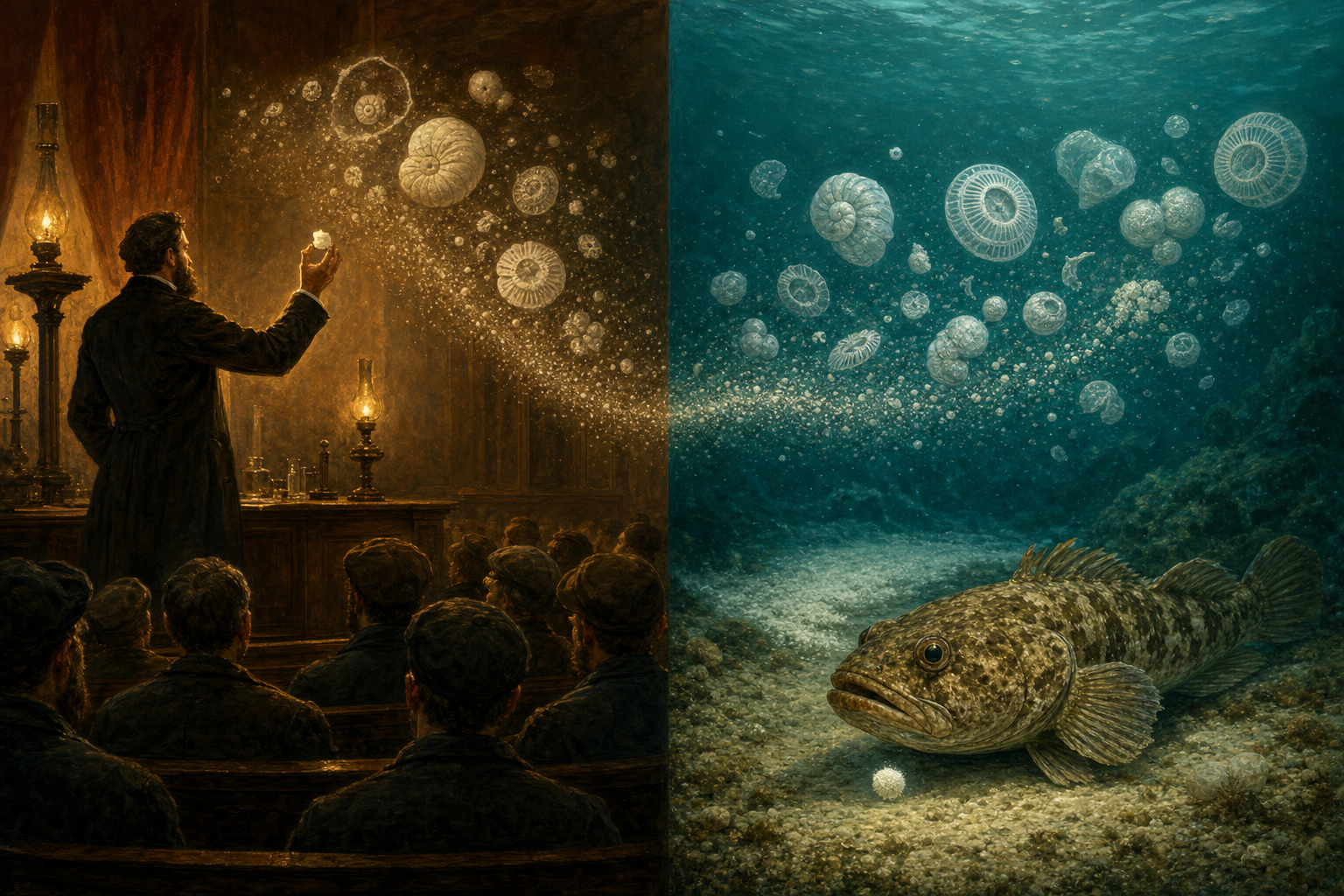
On the twenty-sixth of August 1868, in the city of Norwich, a famous scientist stood up in front of a hall full of working men, labourers and clerks and tradesmen, and held up a single piece of ordinary chalk. The kind you would find in any schoolroom, or crumbling out of any white cliff in the south of England.
His name was Thomas Henry Huxley, the biologist they called Darwin's bulldog for the ferocity with which he defended the new theory of evolution. But tonight he was not going to argue. He was going to read them the history of the world from a lump of chalk.
First he showed them what it was made of. A drop of weak acid on the chalk, and it fizzes and dissolves, breathing off carbon dioxide. The white stone is calcium carbonate, the same stuff as seashells and limestone. So far, ordinary chemistry.
Then came the turn that must have stopped the room. Put the chalk under a microscope, Huxley told them, and you find it is not really a mineral at all. It is made of bodies. Countless billions of the shells of once-living things, each one far too small to see, packed together into solid rock.
They were the remains of microscopic sea creatures: single-celled drifters called foraminifera, and the delicate plated algae we now call coccolithophores. The white cliffs of Dover, the chalk downs of England, the dust in a child's hand, all of it a graveyard of the unimaginably small.
And if the rock was once living things on a sea floor, Huxley said, then England itself was once the bottom of a vast warm ocean. For a stretch of time almost too long to hold in the mind, that sea had snowed shells, a slow drift of tiny skeletons settling into a blanket of white that would one day be lifted into cliffs and hills.
This was his real gift, and the reason the lecture is still famous. He could read an entire vanished world out of a stone. Science, he liked to say, is nothing but organized common sense. Look closely enough at the commonplace, and it opens like a door.
But Huxley saved the strangest part for the end. This chalk factory, he told them, never closed. Lower a dredge to the floor of the deep Atlantic today and you haul up a pale ooze, and in it the very same kinds of shells, still raining down, still settling, still slowly becoming stone. The making of the rock was not ancient history. It was happening at that very moment, in the dark, beneath every ocean on Earth.
That was the deep idea hiding in the chalk. Life is not just a passenger on this planet. It is a builder. The smallest organisms in the sea pull carbon out of the water and the air and lay it down as solid stone, and in doing so they have shaped the very ground we stand on and helped set the chemistry of the oceans.
For most of the century and a half since, the picture stayed much the same. The carbonate of the sea, the great drift of white, was the work of plankton, the tiny floating algae. The fish, the crabs, the larger life, they lived in that ocean. They were not thought to build it.
But the ocean keeps a delicate chemical balance, and there has always been carbonate in it that was not fully accounted for. Something else was quietly making stone.
Because the overlooked stonemason turns out to have been swimming in plain sight the whole time. It is the fish.
Bony fish live with a constant problem. To keep from drying out in salt water, they drink the sea, and the sea is full of calcium they do not want. So their guts gather up the excess and dump it overboard as tiny solid pellets of limestone, calcium carbonate, formed inside the fish and excreted into the water. Scientists call them ichthyocarbonates, fish stones, and there are a great many fish.
Researchers at the University of Miami, led for years by the physiologist Martin Grosell, had already shown that this makes ordinary fish a quiet, planet-scale source of carbonate, helping to buffer the ocean and keep its chemistry in balance. The fish were building the sea after all.
And then, this year, came the twist that rhymes straight back to Huxley. In a study published in the journal PLOS Biology in May 2026, a team led by Anthony Bonacolta at Miami looked closely at how the fish actually make their little stones, and found the fish were not doing it alone.
Inside the gut of the Gulf toadfish lives a bacterium, a vibrio called Photobacterium damselae, clustered in and around the very pellets of limestone. It carries the genetic machinery to tip the local chemistry toward forming carbonate. The fish stone, long credited to the fish, appears to be the work of a partnership, the fish and a hidden microbe, the smallest hands at work once again.
What we thought was the fish alone, Grosell said, may actually reflect a close symbiosis between the fish and its gut microbial community.
Look at the shape of it. In 1868 Huxley held up a stone and revealed a hidden multitude that had built the world. In 2026 we cut open a common fish and find a hidden passenger doing the very same thing, minting rock, helping balance the sea. The same truth, a century and a half apart, only deeper. The builder of the planet keeps turning out to be smaller than we thought, and never quite working alone.
And it is not a museum curiosity. Those carbonates are part of how the ocean copes with carbon and resists turning acid as we pour more and more of it into the sky. The smallest life in the sea may be quietly steadying a chemistry that we are pushing harder every year.
Huxley told the working men of Norwich that you could read the whole earth in a piece of chalk, that the commonplace is only a locked door. The cliff at Dover and the toadfish in a Florida bay are, in the end, the same story.
So pick up a piece of chalk. You are holding the work of the smallest hands on Earth. And they have never once stopped.