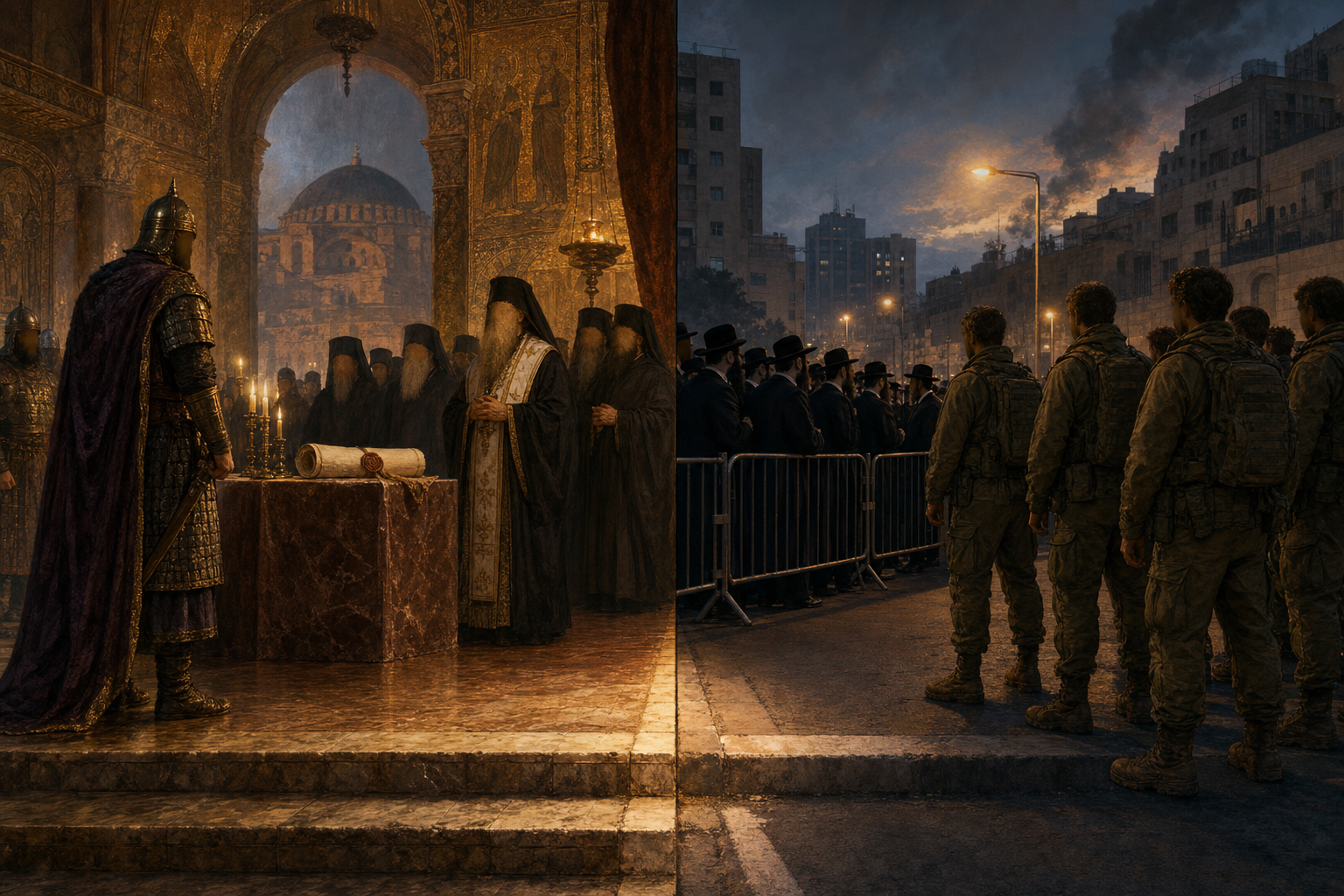
In the year 964, the most feared soldier in the world sat down in Constantinople and signed a law that had nothing to do with war. Nikephoros Phokas had just torn the island of Crete back from the Arabs after a century of Christian humiliation, and his enemies called him the White Death of the Saracens. He would go on to take Cilicia, Cyprus, and the great city of Antioch. But the document he signed that year was aimed not at an enemy abroad. It was aimed at the holiest institution at home. Nikephoros forbade the founding of any new monastery, and banned the gift of fresh land to the ones that already existed.
To understand why a conquering emperor would pick that fight, you have to understand the slow leak that was draining his empire.
Byzantium was a state permanently at war on its eastern frontier, and a state at war runs on two things: fighting men and the silver to pay them. Both were quietly disappearing into the same place. Pious Byzantines, anxious for their souls, poured land and sons into the monasteries, and monastic land was tax-exempt and monastic men did not serve. Every estate signed over to a religious house was a farm the treasury could no longer tax. Every young man who took vows was a soldier the army would never see. The holier the empire became, the harder it grew to defend, because holiness, as the law then stood, came with an exemption from the burden everyone else carried.
Nikephoros, a genuinely devout man who slept on the floor and wore a hair shirt under the purple, framed his law as a defence of true religion: it was not piety, he argued, to heap wealth upon wealth, and the monks should return to the bare poverty of their founders rather than become landlords. But the arithmetic underneath was unmistakable. The empire needed working fields and working men, and an ever-growing share of both had stepped outside the system into a tax-free, service-free sanctuary.
Then he pushed further, and here the story turns sharp. Nikephoros asked the Church to declare the soldiers who fell fighting the Muslims to be martyrs, with the same holy honour the enemy gave its own fallen. He wanted the men who died for the empire to be sanctified by the faith they died defending. The Patriarch of Constantinople, Polyeuktos, refused him flatly. The Church would not bless the killing, would not turn its soldiers into saints, and would not surrender its privileges to a man in armour. The line was drawn. The state could ask the holy class to share the burden, and the holy class could say no.
It said no, and it won. Nikephoros taxed the Church, debased the coinage, and squeezed the whole empire to feed his armies until the capital seethed and rioted against him. In December 969, his own nephew, John Tzimiskes, slipped into the palace with the help of the empress and murdered the White Death of the Saracens in his bedchamber. And his great law against the monasteries did not survive him by long. Within a generation, Basil II swept the restrictions away, the monasteries resumed swallowing land, and the holy mountain of Athos grew into one of the largest landowners in the Christian world. The conqueror was dead, and the exemption was immortal.
That is the buried lesson. A society can be a military superpower and still find that the one thing it cannot do is make its most revered, most protected class share the cost of the swords that keep it alive. Nikephoros could take Antioch. He could not draft a monk, and the attempt helped get him killed.
Now move the scene forward a thousand years, to a country that knows the eastern frontier just as well.
In 2026, Israel is tearing itself apart over almost exactly this question. When the state was founded in 1948, its leaders granted a handful of ultra-Orthodox men, a few hundred Torah scholars, an exemption from military service so that religious learning destroyed in the Holocaust could be rebuilt. That handful is now tens of thousands. In a country where most teenagers are conscripted and reservists have been called up again and again through a long war, a large and growing community studies and prays while its neighbours fight, and the resentment has become a national fault line.
The institutions are now colliding head on, just as they did in Constantinople. Israel's Supreme Court ruled in 2024 that the blanket exemption was unlawful and that the army must begin drafting ultra-Orthodox men. In late 2025 it ordered the government to actually enforce the ruling, and in 2026, finding the state dragging its feet, it ordered concrete penalties: cutting transport subsidies and tax discounts for those who refuse to enlist. The response was Polyeuktos's answer in modern dress. In early June 2026, tens of thousands of ultra-Orthodox Israelis poured into the streets, blocking roads and railways and burning cars, while their political parties threatened to bring down the government rather than accept conscription. The draft law has been shelved, picked up, and shelved again, too radioactive to pass and too costly to ignore, and it now hangs over the coming election.
The Byzantine rhyme is hard to miss. A state at war, a revered religious class outside the burden, a ruling power that tries to end the exemption on grounds both practical and moral, and a backlash so fierce it threatens whoever dares to touch it. Nikephoros lost his law and his life. Whether Israel's courts can succeed where a sword-emperor failed is the open question, and history offers a sobering note rather than a verdict: the exemption tends to outlive the reformer.
Nikephoros Phokas beat the Saracens, and the monasteries beat Nikephoros. A thousand years later, a different nation is testing whether anyone has learned to win that particular war at home.
The empire could conquer Crete. It could not conscript a monk.