Every day, we find the historical story hiding inside the headlines. Riveting narratives
that connect the past to the present, and make you wonder what happens next.
Choose your topics
You'll receive one email per topic, per day. Pick as many as you like.
Today's Echo · History & Current Events
1922 to 1928, the British Empire and the United States
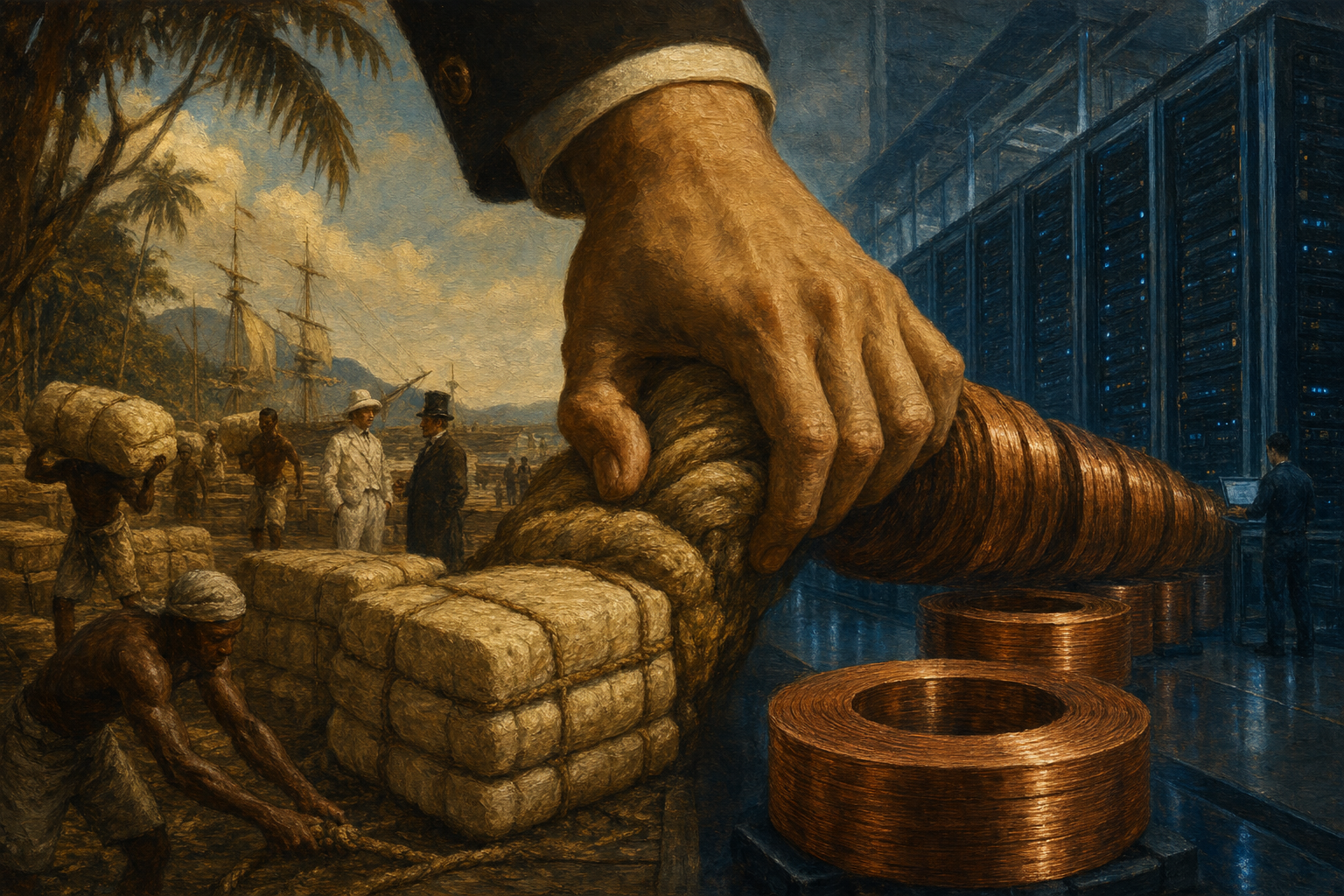
In 1925 the most valuable thing in America was a milky sap from trees on the far side of the world. Rubber ran every car, factory and phone line, Britain's colonies grew about three quarters of it, and Britain had just choked the supply: the Stevenson Plan restricted exports to drive the price from around thirteen cents a pound past a dollar. America, which bought most of the world's rubber, did not just pay. Commerce Secretary Herbert Hoover funded a global hunt for new supply, Harvey Firestone planted a million acres of Liberia, chemists chased synthetic rubber, and the cartel collapsed when the Dutch refused to join and flooded the market. Squeeze a customer hard enough and you do not make him pay; you teach him to never need you again. A century later it is copper for AI data centres and China's grip on rare earths, and the same scramble has begun.
•3 min readA century later the same dynamic has returned with metal instead of sap. The lifeblood of the AI age is copper (a single large AI-ready data centre can require up to about 50,000 tonnes) and rare earth elements used in magnets, motors and weapons. Analysts forecast a structural refined-copper deficit (J.P. Morgan projecting roughly 330,000 tonnes for 2026), with new mines averaging about 17.9 years from discovery to production. The choke point is as lopsided as rubber was in 1925: China processes around 90 percent of the world's rare earths and has used that control as leverage, prohibiting exports of gallium and germanium to the US from December 2024 and adding medium and heavy rare earths and magnets to its export-control list through 2025. Washington's response could have been written by Hoover: in February 2026 it launched a Strategic Critical Minerals Reserve (Project Vault), backed by a $10 billion EXIM loan, and pressed a global search for friendly supply, recycling and substitutes. The lesson of the rubber war is not that a choke point is permanent but the opposite: squeeze a customer hard enough and you teach him, and everyone watching, how to make sure he never needs you again.
Queen and worker bees hatch from identical eggs, yet one lives for years and lays a million eggs while the others live for weeks and never breed. For a century the textbook answer was a single food: royal jelly. In 2026 a team at UC Riverside showed the real answer is grander. Specialised worker bees build the queen a palace: a peanut-shaped 'royal crib' of custom wax with its own chemistry, and they cluster to keep it warm. Raise a would-be queen in ordinary wax instead and she develops poorly and often dies. The jelly feeds her; the crib crowns her. We love a story with one secret ingredient. Nature almost never works that way.
•3 min readIn 2026 a team at the University of California, Riverside (its Center for Integrative Bee Research) showed that royal jelly alone does not make a queen: the environment does much of the work. A specialised caste of young worker bees acts as royal builders, constructing the large peanut-shaped 'royal crib' from a custom wax that is softer, melts at a higher temperature, and carries a distinct chemical signature of fatty acids and signals, and they alter their own physiology to raise the temperature around the cell, like underfloor heating. Crucially, when would-be queens were raised in ordinary worker-cell wax instead of the royal crib, the larvae developed poorly and many died: they needed the 'smell and feel' of the royal wax to transform at all. So queen determination is a whole system, diet plus architecture, temperature and wax chemistry plus the labour of many bees, not a single ingredient. It is a recurring lesson in biology: we love single-cause stories (one gene, one molecule, one food), but nature's marvels are usually built from many small causes acting together. A queen is built, not dosed.
In 1909, a young Japanese scientist injected a rabbit with the six hundred and sixth compound in a numbered series, one his colleagues had already declared useless and shelved. By morning the syphilis was retreating. Paul Ehrlich's magic bullet was real, the first synthetic cure and the birth of chemotherapy. In June 2026, a drug called daraxonrasib finally hit KRAS, the cancer target everyone had called undruggable for forty years, using the very same logic.
•5 min readKRAS, first identified as a human oncogene in 1982, is mutated in more than 90 percent of pancreatic cancers (among the deadliest of cancers) and large fractions of lung and colorectal cancers. For roughly forty years it was considered the archetypal 'undruggable' target, because the RAS protein is structurally smooth and lacks the deep binding pockets that small-molecule drugs normally exploit; company after company tried and failed. In 2026 that changed. The Phase 3 RASolute 302 trial of daraxonrasib, a RAS(ON) inhibitor from Revolution Medicines, was presented at the ASCO Annual Meeting in late May 2026 and published in the New England Journal of Medicine: in previously treated metastatic pancreatic cancer it nearly doubled median overall survival, about 13.2 months versus roughly 6.7 months for chemotherapy. The drug works not by forcing a fit into a pocket that does not exist, but by binding the cellular helper protein cyclophilin A, which then clamps onto the active (ON-state) RAS protein and shuts down its signalling: a 'molecular glue' that reaches an unreachable target. It is Paul Ehrlich's magic-bullet logic, designing one molecule to find and stop one target, applied a hundred and sixteen years later to a target everyone had declared impossible.
In 421 BC, exhausted Athens and Sparta signed a peace meant to last fifty years. It lasted six, and the six years of peace destroyed Athens more thoroughly than the ten years of war that came before. In June 2026, the United States and Iran announced a sixty-day ceasefire to negotiate a final agreement. The Peace of Nicias is the warning about what a truce really is.
•5 min readOn 11 June 2026, after months of open war between the United States and Iran, President Trump announced a 60-day ceasefire intended to give the two sides time to negotiate the contentious issues toward a final agreement. The negotiations centre on the same kind of fault lines that doomed the Peace of Nicias: control of a vital chokepoint, the Strait of Hormuz (through which much of the world's oil passes), and the role of regional proxies, with Iran tying any broader agreement to a halt in Israeli operations in Lebanon. It is a truce between exhausted enemies who do not trust each other, whose allies and proxies are not bound by it, and who can use the quiet to rearm: structurally, the shape of the Peace of Nicias rather than the shape of a peace.
In the 1960s, David Hubel and Torsten Wiesel sewed shut one eye of a kitten and discovered that the brain has a season: a brief early 'critical period' when experience rewires it for life, and then a door that closes hard. It won them a Nobel Prize and explained the lazy eye. For sixty years that door looked one-way. In late May 2026, a Harvard team found the molecular lock that closes it, cortisol acting through astrocytes, and showed that in adult mice you can lift the latch and reopen the window.
•4 min readIn a study reported in late May 2026, a Harvard Medical School team found in mice that the stress hormone cortisol closes the critical period: rising cortisol switches on a gene program in astrocytes (the brain's support cells) that builds perineuronal nets, an extracellular-matrix lattice that locks neural circuitry in place. More strikingly, when the team genetically removed the glucocorticoid receptor (which detects cortisol) from adult mice, the closed critical periods reopened, restoring youthful plasticity. By examining an existing single-cell human brain dataset, they verified that the same astrocytic pathway emerges in human infancy and peaks around adolescence, suggesting the window that Hubel and Wiesel showed closes for life may have a latch that can be lifted, with implications for amblyopia, stroke recovery and adult learning.
In February 1948, Czechoslovakia, the last working democracy in Eastern Europe, was swallowed by the Soviet bloc in three weeks, without a single tank crossing the border. Two weeks later its foreign minister was found dead beneath a window. The lesson was brutal: a small state in a great power's orbit does not get to choose. On 7 June 2026, Armenia tried to vote the other way, steering out of Russia's orbit toward Europe despite a covert Russian campaign to stop it. The two stories run in opposite directions, which is exactly why they rhyme.
•4 min readOn 7 June 2026 Armenia, for a generation Russia's closest ally in the South Caucasus (hosting a Russian base and belonging to Moscow's security alliance), held a parliamentary election that became a referendum on its attempt to climb out of Russia's orbit toward the European Union, a pivot Prime Minister Nikol Pashinyan had accelerated after Moscow stood aside during Armenia's 2023 loss of Nagorno-Karabakh. Western intelligence officials and international observers described a broad Russian covert interference campaign, disinformation, money and support for pro-Russian candidates, and Putin had pressured Pashinyan in April 2026 to allow a jailed pro-Russian tycoon to run. This time the pressure did not fully work: Pashinyan's Civil Contract won about 49.8 percent and a majority of roughly 64 of 105 seats, but fell short of the two-thirds needed for the constitutional referendum tied to a lasting peace with Azerbaijan, leaving Armenia still caught in the same vice that crushed Czechoslovakia, a small democracy hemmed in by a larger neighbour that does not accept its right to choose its own friends.
London, 1838: a young Charles Darwin watched an orangutan named Jenny puzzle at her own reflection and filed the notes not under 'animals' but under 'Man.' The mirror became science's tool for asking the oldest question in biology: what is going on inside another mind? In June 2026, an octopus, a creature whose lineage split from ours over 500 million years ago, was shown using a mirror to find prey it could not see, the first invertebrate ever to do so, and the answer to Darwin's question got stranger.
•4 min readIn a study published in Current Biology in June 2026, Mary Kieseler and colleagues at Dartmouth showed that California two-spot octopuses (Octopus bimaculoides) can learn to use a mirror to locate a crab hidden outside their direct line of sight, ignoring the reflection, inferring the real prey's position, and going to it (correct about 73 percent of the time after training). It is the first invertebrate demonstrated to use a mirror to understand its environment. Because the octopus lineage diverged from the vertebrate line more than 500 million years ago and evolved its intelligence independently (with roughly two-thirds of its neurons in its arms), the result suggests the mirror may never have been measuring closeness to humans at all, but a capacity evolution can build more than once, by more than one route.
On 23 August 1958, Communist China opened fire on two specks of rock two miles off its coast, Quemoy and Matsu, and for a few weeks the world's first serious nuclear crisis turned on whether America would fight for them. Eisenhower found a way to answer without ending the world. Sixty-eight years later, China's largest war games yet sent the coast guard circling the very same islands, now spelled Kinmen and Matsu, rehearsing a blockade. History did not just rhyme. It chose the exact same two islands.
•4 min readAt the end of December 2025 China conducted its largest exercises yet around Taiwan (Justice Mission 2025), with the China Coast Guard patrolling and encircling the same outer islands of Kinmen (Quemoy) and Matsu, closing to within about 1.3 to 1.6 nautical miles, while all 84 scheduled flights between Taiwan and the islands were suspended, affecting roughly 6,000 travelers. Analysts assessed the drills as a rehearsal for a blockade meant to choke off Taiwan's shipping and energy and prevent outside aid, escalating the Fourth Taiwan Strait Crisis. The pressure is being applied first at the very islands Mao shelled in 1958, and the deliberate ambiguity that held the line for a generation is wearing thin.
Johns Hopkins, 1879: a twenty-three-year-old graduate student named Edwin Hall doubted a single sentence in Maxwell's textbook, ran a current through a leaf of gold, and found a voltage that was not supposed to exist. He had measured the sign of the electron eighteen years before anyone discovered it. 147 years later, in June 2026, physicists found a new version of his effect in a strange crystal that needs no magnet at all, and might quietly power the next generation of battery-free electronics.
•5 min readIn June 2026 a team led by Dongchen Qi (Queensland University of Technology) and Xiao Renshaw Wang (Nanyang Technological University, Singapore) published in the journal Newton a study of the nonlinear Hall effect in the topological insulator Bi2Te3, showing it produces a direct-current transverse voltage from an alternating current with no external magnetic field, survives at room temperature, and is controlled by skew scattering from impurities and phonons, pointing toward battery-free energy harvesting that rectifies ambient radio-frequency signals into usable power.
In 1847 a freshman congressman named Abraham Lincoln demanded that President Polk point to the exact spot where, as Polk claimed, Mexico had shed American blood on American soil to justify a war. The blood, Lincoln argued, was spilled on disputed ground the President had marched troops into on purpose. The gesture was ignored, it was mocked as Spotty Lincoln, and it helped end his career. In June 2026, the House voted 215 to 208 to limit the President's power to wage the undeclared war on Iran. He called it meaningless. So was the spot.
•5 min readOn 3 June 2026 the US House of Representatives voted 215 to 208 to pass a war powers resolution directing President Trump to end American hostilities with Iran, the first time such a measure cleared a chamber on a final vote since the war began in late February following US strikes on Iran's nuclear sites. Four Republicans (Thomas Massie, Brian Fitzpatrick, Tom Barrett and Warren Davidson) crossed the aisle. The vote is largely symbolic: the Senate has not passed its own version, a veto is expected, and the administration argues the 1973 War Powers Resolution is itself unconstitutional. Trump called the vote 'meaningless.' The episode revives a 178-year-old constitutional question about whether a president can take the country to war on his own judgment, and whether the legislature can stop him.
In 1880, four years after the telephone, Alexander Graham Bell sent a human voice 700 feet across the rooftops of Washington with no wire at all, riding on a beam of sunlight. He called the photophone the greatest invention he ever made, greater than the telephone. The world had no use for it for a century. In June 2026, a chip that generates, steers, and reads information carried by light finally brings Bell's beam to the frontier of computing.
•5 min readIn a study published in Nature Photonics on 2 June 2026 (DOI 10.1038/s41566-026-01916-0), a Monash University team in Australia led by Dr Chi Li reported a single integrated chip that can generate, steer/route, and read information carried by light, the first device to perform all three functions on one chip. It uses atomically thin (two-dimensional) materials with engineered nanostructures and encodes information in a quantum property of light called the valley degree of freedom, part of an emerging field known as valleytronics, and it works at room temperature. Computing and communicating with light rather than electrons promises to be faster and far more energy efficient, attractive for power-hungry artificial intelligence and quantum machines. As Dr Li put it, 'What we've built is a complete on-chip system that can create, route and read this information with very high precision.' It is, in effect, the on-chip realisation of the idea Bell glimpsed in 1880: information carried on light.
In 1881 revolutionaries killed Tsar Alexander II, the reformer who had freed the serfs and who had signed Russia's first proto-constitution that very morning, certain his death would open the door to freedom. Instead it brought his harder son, the secret police, and decades of reaction. In 2026, a regime-change war has killed Iran's supreme leader, and the Revolutionary Guards have installed his son and tightened a harder, more militarised grip. The lesson of the canal is cold: the surest way to empower a dead man's hardest heirs is to kill him.
•4 min readThe 2026 US-Israeli regime-change war on Iran, the killing of Supreme Leader Ali Khamenei, and the Revolutionary Guards' installation of his son Mojtaba amid a shift of power to the military-security apparatus.