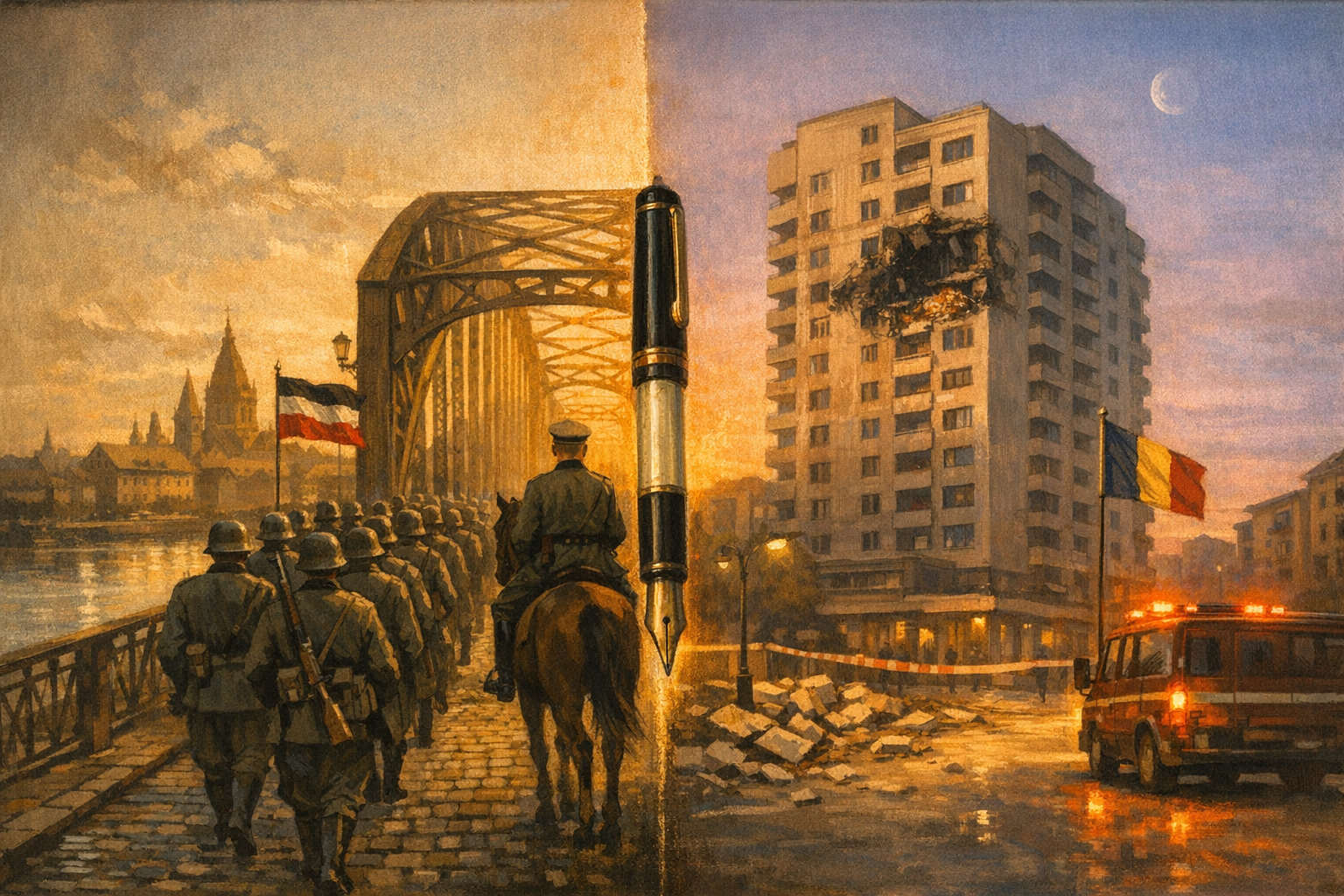
At ten minutes before noon on Saturday 7 March 1936, three German army battalions in field grey crossed the painted girder bridge at Mainz and entered the demilitarised left bank of the Rhine. Three more battalions crossed at Frankfurt. Two crossed at Koblenz. Two more at Trier. Nineteen in total, approximately twenty-two thousand men, with one cavalry regiment, six artillery batteries, and a small Luftwaffe air component flying overhead. They were the first German soldiers to enter the region west of the Rhine since 1919. Their orders, signed by Wehrmacht commander-in-chief Werner von Blomberg and sealed three days earlier, were absolutely clear. If French army units appeared on the bridges, the German troops were to retire across the Rhine and accept whatever consequences the French government chose to impose. Adolf Hitler, in the Chancellery in Berlin, listened to the field reports on a German radio set and said nothing for the next forty-eight hours. He had told his foreign minister Baron von Neurath that those forty-eight hours would be the most anxious of his political life. They were.
The treaty Hitler had violated was the Treaty of Versailles of 1919, which had imposed the demilitarisation of the Rhineland on Germany as a defeated power. But the relevant instrument by 1936 was not Versailles. It was the Locarno Pact of 16 October 1925, which Germany had voluntarily signed under Foreign Minister Gustav Stresemann, confirming the demilitarised status of the Rhineland and recognising Germany's western borders. Locarno was not a victor's treaty. It was a German treaty. Britain and Italy were the formal guarantors. France and Belgium were the protected parties. Stresemann had won the Nobel Peace Prize for it. Locarno was the document the Foreign Office in London believed had ended the European problem.
The French general staff knew on Saturday morning that they had a window of perhaps four to six days to reverse the German action. They had approximately one hundred regular divisions in metropolitan France. The Wehrmacht had nineteen battalions on the wrong side of the Rhine. The German army of March 1936 was still in the middle of its rearmament programme and had perhaps twelve operational divisions in total, almost all of them east of the Rhine. The French army could have driven the German battalions back across the river in less than a week. The French general staff calculated that any such action would require the order of general mobilisation. General mobilisation could not be ordered without the political support of the British government. The British government was that of Stanley Baldwin, with Anthony Eden as Foreign Secretary. Eden told the British Cabinet on 11 March 1936 that the German action was a grave technical breach of Locarno but that, in the judgment of His Majesty's Government, it did not "constitute a casus belli." The German troops had not crossed the French frontier. The German troops had not crossed the Belgian frontier. The German troops had entered the German Rhineland. The British public, Eden said, would not understand a French general mobilisation in response to Germans entering Germany.
That was the German trick. Hitler had calculated that the Rhineland operation would be politically legible to the British public as Germans walking on German soil, rather than as Germans tearing up the central security treaty of European interwar diplomacy. He was right. The French Cabinet met on Sunday 8 March, on Monday 9 March, and again on Wednesday 11 March. Foreign Minister Pierre-Étienne Flandin pressed for military action; Prime Minister Albert Sarraut, head of a caretaker government in the middle of a French election cycle, declined. The French government issued a strong diplomatic protest, requested an emergency meeting of the Locarno powers, and ordered no military movement of any kind. The League of Nations Council met in London between 14 and 24 March, condemned Germany formally, and proposed a multilateral negotiation that would replace Locarno with a new arrangement. Germany declined to participate. The condemnation produced no enforcement. Hitler, by Tuesday 10 March, had concluded that he had been right. He told his architect Albert Speer at lunch on 11 March that the Wehrmacht was now permanently across the Rhine and that the next operation would face an opposition weaker, not stronger, than this one had.
It did. The Anschluss with Austria followed in March 1938. The Sudetenland was surrendered to Germany at Munich on 30 September 1938. The remainder of Czechoslovakia was annexed in March 1939. Poland was invaded on 1 September 1939. The Locarno Pact, which Britain and Italy had jointly guaranteed in 1925, was not invoked in any of these crises by any party. The German foreign ministry filed the Locarno documents in March 1939 under a paper label reading "no longer relevant." The Foreign Office in London filed its own copies a year later, after the fall of France. The pattern that Hitler had read off the British Cabinet's 11 March 1936 decision was the pattern that the next three years confirmed. The treaty existed in form. The collective enforcement did not. Each successive violation was the precedent for a larger one. The fourth violation, in September 1939, was the one whose collective response could not be deferred.
This brings us to a Romanian apartment building.
At 11.47 on the evening of Thursday 28 May 2026, a Russian-manufactured Shahed-136 loitering munition, dispatched as part of an overnight Russian attack on Ukrainian power infrastructure, deviated from its intended course over the Danube delta and crossed approximately ten miles into Romanian airspace. At 12.04 on Friday 29 May, the drone detonated its forty-kilogramme warhead on the tenth floor of a fourteen-storey residential apartment block in the eastern Romanian city of Galați, on the south bank of the Danube directly opposite the Ukrainian city of Reni. Two civilians, an elderly Romanian couple in the apartment beneath the impact point, were wounded by glass and concrete fragments. The building was evacuated and burned for several hours. The Romanian Air Force scrambled F-16 fighters at 23.58 and confirmed Romanian radar contact with the drone at 23.59. No interception attempt was made. The Romanian Ministry of National Defence said in a public statement at 02.00 Friday morning that the drone had crossed Romanian airspace at low altitude over inhabited terrain and that "no opportunity to engage" had presented itself without endangering the civilian population beneath.
The North Atlantic Council met in extraordinary session in Brussels on Friday afternoon. NATO Secretary-General Mark Rutte gave a statement at the close of the meeting affirming the alliance's solidarity with Romania and its "readiness to defend allied territory." Article 5 of the North Atlantic Treaty, which commits members to treat an armed attack against any one of them as an armed attack against all and to come to the attacked party's aid, was not invoked. Article 4, which provides for consultation when a member considers its territorial integrity threatened, was invoked. The Romanian foreign ministry issued a statement on Friday evening describing the Galați drone strike as a serious incident requiring "a measured allied response" and explicitly distinguishing it from "an attack on Romania." It said Romania was "not facing an attack, but the effects of a conflict taking place right next to our border."
This is the British Cabinet's 11 March 1936 phrasing in Romanian. It is also defensible strategic judgment. Reasonable analysts can hold that a single drone strike, however armed and however clearly Russian-manufactured, does not warrant the alliance-wide commitment to direct military confrontation that Article 5 would activate. Escalation control is a legitimate strategic objective. Article 5 has never been invoked by NATO except once, by the United States in September 2001, against a non-state actor. The threshold for invocation is appropriately high.
But the historical lesson of the Rhineland is that the threshold for invocation is the precedent. Future violators will calibrate their behaviour against last week's NATO response. The next Russian munition that lands inside a NATO member's residential building will know in advance that the Galați strike did not trigger Article 5. The one after that will know what neither of these triggered. The casus belli is what a treaty's members decide to call one. Locarno did not fail because its language was unclear or its guarantors were absent. It failed because in March 1936 the people who had signed it concluded that the violation was not the kind of thing a treaty was for.
The forty-eight hours that Hitler considered the most anxious of his political life were the hours during which he discovered that they were not.