Every day, we find the historical story hiding inside the headlines. Riveting narratives
that connect the past to the present, and make you wonder what happens next.
Choose your topics
You'll receive one email per topic, per day. Pick as many as you like.
Today's Echo · History & Current Events
1922 to 1928, the British Empire and the United States
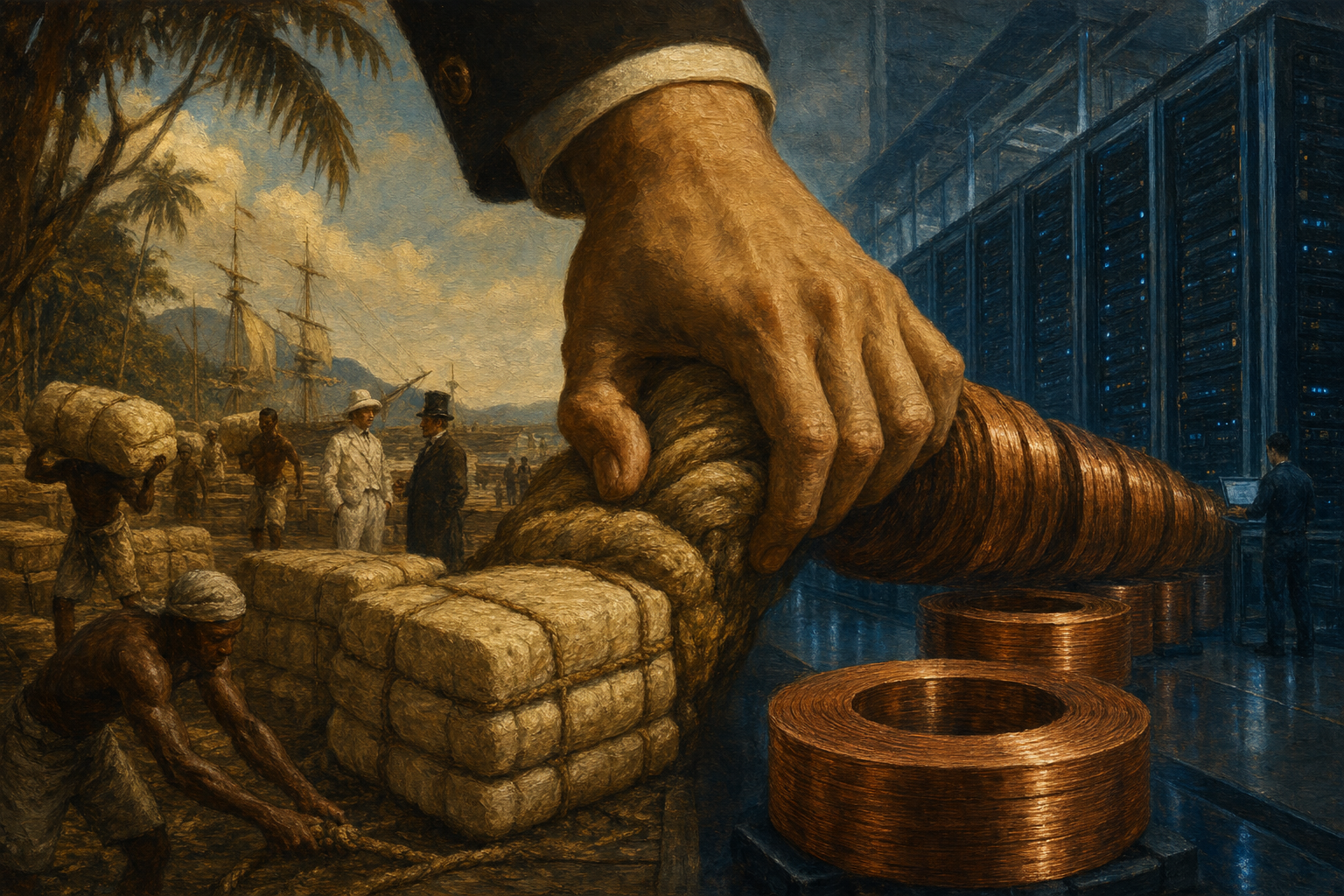
In 1925 the most valuable thing in America was a milky sap from trees on the far side of the world. Rubber ran every car, factory and phone line, Britain's colonies grew about three quarters of it, and Britain had just choked the supply: the Stevenson Plan restricted exports to drive the price from around thirteen cents a pound past a dollar. America, which bought most of the world's rubber, did not just pay. Commerce Secretary Herbert Hoover funded a global hunt for new supply, Harvey Firestone planted a million acres of Liberia, chemists chased synthetic rubber, and the cartel collapsed when the Dutch refused to join and flooded the market. Squeeze a customer hard enough and you do not make him pay; you teach him to never need you again. A century later it is copper for AI data centres and China's grip on rare earths, and the same scramble has begun.
•3 min readA century later the same dynamic has returned with metal instead of sap. The lifeblood of the AI age is copper (a single large AI-ready data centre can require up to about 50,000 tonnes) and rare earth elements used in magnets, motors and weapons. Analysts forecast a structural refined-copper deficit (J.P. Morgan projecting roughly 330,000 tonnes for 2026), with new mines averaging about 17.9 years from discovery to production. The choke point is as lopsided as rubber was in 1925: China processes around 90 percent of the world's rare earths and has used that control as leverage, prohibiting exports of gallium and germanium to the US from December 2024 and adding medium and heavy rare earths and magnets to its export-control list through 2025. Washington's response could have been written by Hoover: in February 2026 it launched a Strategic Critical Minerals Reserve (Project Vault), backed by a $10 billion EXIM loan, and pressed a global search for friendly supply, recycling and substitutes. The lesson of the rubber war is not that a choke point is permanent but the opposite: squeeze a customer hard enough and you teach him, and everyone watching, how to make sure he never needs you again.
Across West Africa, a cheap checked plaid holdall has a name: the Ghana Must Go bag. It got it in 1983, when Nigeria, reeling from an oil-price crash, abruptly expelled more than two million West African migrants, around a million of them Ghanaians, giving them about two weeks to leave. Fourteen years earlier, Ghana had done the same to Nigerians. When an economy sours, the state reaches for the outsider. In 2026 the bag is being packed again, as South African vigilante movements set a June 30 deadline for undocumented migrants to leave, with shacks burned and people killed. The bag only ever changes its nationality.
•3 min readIn 2026 South Africa is living a version of the same story. With a stalled economy and some of the world's highest unemployment, anger has again found migrants. Vigilante movements, notably Operation Dudula (founded 2020) and March and March (founded 2025 by Jacinta Ngobese-Zuma), declared that all undocumented migrants must leave by 30 June 2026, a deadline no government imposed, framed in the language of law, order and democracy. The reality on the ground is violent: near Mossel Bay a mob destroyed about 55 shacks and two Mozambican nationals were killed; in another incident a Zimbabwean migrant was set alight and killed by a vigilante mob; thousands of migrants are leaving, with or without papers. The South African Human Rights Commission warned of a 'possible human rights crisis.' The script is more than forty years old: the same stalled economy, the same official shrug, the same conviction that a country's troubles are sitting in someone else's shack. The checked bag has been Ghanaian, Nigerian and now South African; the only constant is the hard year that goes looking for someone to fill it.
We remember the Spitfire and the few. But the Battle of Britain was won by a system: the Dowding System, the world's first integrated air defence, which fused radar, ground observers and control rooms so a badly outnumbered Fighter Command could put its scarce planes in exactly the right place. The Germans never understood the invisible web, and it beat them. In 2026 the same idea is being rebuilt under fire, as Ukraine fields what many call the most combat-tested layered air-defence network on earth. The weapon everyone photographs is the missile. The thing that wins is the web behind it.
•3 min readIn 2026 Ukraine is widely described as having built one of the most combat-tested, effective layered air-defence networks in the world, born of the same arithmetic Dowding faced: Russia can launch far more missiles and drones than any stock of expensive interceptors can match. Ukraine's answer is a system in layers and an integrated picture: scarce, costly Patriot interceptors (the latest PAC-3 estimated around $4 million each) reserved for ballistic missiles; medium-range launchers such as the IRIS-T (a reported near-100 percent intercept rate across more than 250 engagements) for cruise missiles; and at the bottom swarms of cheap interceptor drones (often $1,000 to $2,500 each) that ram incoming Shaheds, downing over 70 percent of them over Kyiv and freeing the Patriots for the threats only they can stop. By killing a cheap drone with a cheap drone, Ukraine flipped the cost imbalance of the war. And like Britain after 1940, it is now exporting the capability itself, opening weapons-export offices across Europe and offering its full air-defence package to Gulf states. The thing that wins, then as now, is the integrated web behind the weapon.
1763 to 1778, the road to the Franco-American alliance
A rebel state is only a claim until a great power says it is real, and great powers never grant recognition for free. In 1778, France became the first power to recognise the United States, not out of love for liberty but because the foreign minister Vergennes wanted to bleed Britain for the loss of Canada. In December 2025, Israel became the first country to recognise Somaliland, a place that had governed itself for thirty-four years, because it wanted a foothold on the Red Sea. Recognition is a weapon, handed to you by your enemy's enemy.
•3 min readOn 26 December 2025, Israel became the first country on earth to formally recognise Somaliland, which had declared independence from collapsing Somalia in May 1991 and built a functioning state (its own currency, competitive elections, relative stability) yet remained internationally unrecognised for thirty-four years because recognition would offend Somalia. The calculation changed when Somaliland's strategic value rose: it sits at the southern gate of the Bab el-Mandeb strait, near the rebuilt Berbera port (expanded with a roughly $442M DP World investment), on the sea-lane to Suez where Houthi missiles have threatened shipping. In March 2026 Bloomberg reported Israel was seeking a military base at Berbera. PM Netanyahu framed the recognition as in the spirit of the Abraham Accords. In a striking echo, Somaliland was briefly independent for five days in 1960, recognised by around 33 governments including Israel, before it united with Italian-administered Somaliland to form Somalia; so Israel's 2025 recognition revived one it had quietly extended 65 years earlier. Somalia condemned it as an attack on its sovereignty, the African Union rejected it, and Turkey (with a base in Mogadishu) denounced it. The lesson rhymes: a state becomes real when a powerful patron needs it to be, and recognition is spent where it costs a rival the most.
In 2026 the UN is warning that a coming El Nino could push parts of the world toward famine. But the deadliest famines in history were made by policy, not weather. When an El Nino failed the monsoon in 1876, British India under Viceroy Lord Lytton exported a record amount of wheat to England while six to ten million of its people starved; the same El Nino killed millions more in China and Brazil. As the historian Mike Davis argued, the drought was natural, the mass death was manufactured. Drought is nature. Famine is a decision.
•3 min readIn June 2026 the UN's World Food Programme and FAO warned that worsening hunger put 13 hotspots at risk, with a strong El Nino 61 to 87 percent likely by mid-year threatening harvests (rice could fall 20 to 50 percent in parts of South Asia and southern Africa) and the number facing acute hunger potentially returning to the levels of early 2022. But the echo of 1877 is exact: the danger is not only the weather. Funding for global food assistance has collapsed by nearly 60 percent since 2022; the Gulf war has driven up fuel and fertiliser prices (urea up about 46 percent in a month), raising the cost of growing food everywhere. Whether the 2026 El Nino becomes a famine, and where (Sudan, South Sudan, Yemen and Gaza are already at the edge), depends far less on rainfall than on choices: how much aid is funded, whether grain and fertiliser keep flowing, whether those in charge decide distant lives are worth saving. Drought is nature; famine is a decision.
This week occupied Crimea suspended civilian gasoline sales, the peninsula's worst fuel crisis since 2014, because Ukraine has spent a year striking Russia's refineries and depots from the air. It is the 1944 strategy reborn: the Allied oil campaign that bombed Ploiesti and the synthetic-fuel plants until the Luftwaffe was grounded and the panzers ran dry, and Hitler's own armaments minister told him the war was lost. The difference is scale: Germany was fuel-poor, Russia is a petro-superpower. You can bleed it. You cannot drain it.
•4 min readIn 2025-26 Ukraine has applied the same logic to Russia, opening a deep-strike front far behind the lines with long-range drones and missiles aimed at refineries, oil depots and pipelines. By 2026 one industry estimate put roughly a third of Russia's oil-refining capacity offline; Russia banned fuel exports (from April) and domestic stations began rationing; and on 21 June 2026 Russian-occupied Crimea suspended civilian gasoline sales altogether (drivers had already been held to 20 litres a week on coupons), the worst fuel crisis there since the 2014 annexation, after strikes the Kremlin-appointed head said killed four and wounded 28. As one analysis put it, long-range strikes are cutting how much fuel Russia can produce while shorter-range strikes are cutting its ability to move what it still makes. But the parallel is honest about its limits: Germany was uniquely fragile, a fuel-poor nation running on a few bombable synthetic plants, whereas Russia is one of the world's largest oil and gas producers with vast reserves and refining capacity spread across eleven time zones. Ukraine's campaign inflicts serious shortages and economic damage, a steady tax on the war, but it cannot ground a petro-superpower the way the Allies grounded the Wehrmacht.
In 2026 a US president's demand to acquire Greenland is treated as bizarre and unprecedented. It is neither. In 1917 the US bought the Danish West Indies (now the US Virgin Islands) from Denmark for 25 million dollars in gold, a purely strategic purchase to deny the islands to Germany near the Panama Canal, pressed on a neutral nation under the implied threat of seizure. And in 1946 the Truman administration secretly offered Denmark 100 million dollars in gold for Greenland itself, and was refused. The strategic logic of 2026 is 160 years old.
•4 min readIn 2026 the US president revived the demand to acquire Greenland openly, calling for immediate negotiations, declining to rule out economic pressure (while disavowing force), and framing it as keeping Russia and China out of a strategically vital, warming Arctic of new shipping lanes and minerals. Denmark and Greenland have called their sovereignty a 'red line', allies are alarmed, and the demand for one NATO member to absorb another's territory has strained the alliance. The strategic logic is unchanged across 160 years: the US covets Greenland not for itself, just as it wanted the Danish West Indies not for their sugar, but for position and above all to deny it to a rival (Germany in 1917; the Soviet Union in 1946; Russia and China in 2026). The one real difference is agency: in 1917 a great power could pressure a small neutral into selling an inhabited colony over the heads of its people, who were simply told which flag they lived under, whereas in 2026 Greenland has its own elected government and is using its voice to refuse.
In 1804 Haiti's enslaved people defeated Napoleon's army and founded the first Black republic. In 1825 France sent fourteen warships and forced them to pay an indemnity of 150 million gold francs, compensation to the former slaveholders for their lost 'property', as the price of recognition. Haiti borrowed to pay it, and serviced the resulting 'double debt' until 1947, shipping its wealth back to its former enslavers for 122 years. As the UN chief visits a collapsing, gang-ruled Haiti in 2026, the roots of that collapse run back to the ransom.
•4 min readIn mid-June 2026 UN Secretary-General Antonio Guterres visited a Haiti in near-total collapse: the armed coalition Viv Ansanm controlled roughly 70 percent of the capital, Port-au-Prince; about 2,300 people had been killed across the country in 2026 and some 1.5 million displaced (more than one Haitian in ten); and Haiti had had no president since Jovenel Moise's assassination in 2021, with a new internationally backed gang-suppression force only now preparing to deploy. It is tempting to read Haiti's collapse as simple state failure, but a country has no deep institutions, infrastructure or reservoir of public wealth to resist such a collapse partly because, for the first 122 years of its life as a free nation, it was financially bled, by treaty and at gunpoint, as the price of being allowed to exist. The double debt was not the only wound (a US occupation, dictatorships, coups and earthquakes followed) but it was the foundational one: Haiti began its independence already a century behind, paying for its own freedom rather than building on it.
In 1966 Charles de Gaulle launched the Plan Calcul to build a French computer industry that could rival IBM, after the United States refused to sell France a supercomputer for its nuclear program and an American firm bought France's biggest computer maker. The crusade for technological independence largely failed: the French champion ran on American licenses and ended up merging with an American company. In June 2026 the EU unveiled its own Technological Sovereignty Package, making de Gaulle's argument again, sixty years on, with Europe dependent on foreign suppliers for over 80 percent of its key digital technology.
•4 min readOn 3 June 2026 the European Commission presented a European Technological Sovereignty Package, including a Chips Act 2.0, a Cloud and AI Development Act, an EU Open Source Strategy, and, for the first time, a formal EU definition of 'digital sovereignty'; France and Germany had launched a joint digital-sovereignty task force after a November 2025 summit. The driving fact is that the European Union depends on non-EU suppliers, overwhelmingly American and increasingly Chinese, for more than 80 percent of its key digital products, services and infrastructure. The argument is precisely de Gaulle's, scaled to a continent: a power that does not control its own chips, cloud, software and AI can be throttled or refused by whoever does, exactly as Washington once refused de Gaulle his supercomputer. And the difficulty is precisely his too, as the Plan Calcul warned: building a champion by decree against entrenched incumbents is a fight money and patriotism do not easily win, and the would-be escapee tends to end up partnered with the very power it meant to escape.
In November 1975, six leaders sat by a fire in the Château de Rambouillet, skipped the bureaucracy, and talked their way through the worst economic crisis since the Depression. It was meant to be a one-off. It became the G7. This week, fifty-one years almost to the day, the club is meeting again in France, at Évian, on the same dates of the month, its share of the world shrunk and its members fighting one another. The institution endures. The trust that made it work is the open question.
•4 min readThe 52nd G7 summit is being held at Évian-les-Bains, France, from 15 to 17 June 2026, the same dates of the month as Rambouillet and again on French soil, fifty-one years on. But the club's weight has changed: the G7's share of global output has fallen sharply as China, India and others have risen, and the larger BRICS grouping presents itself as an alternative. More corrosively, the trust that made the original fireside format work is fraying, with tariff disputes among the members themselves, an ongoing US-Israel-Iran war, and a US administration at odds with traditional allies, so that even agreeing a joint communiqué can be a struggle. The lesson of Rambouillet is that the summit worked not because of rules or size but because a handful of leaders trusted one another enough to talk plainly; the institution outlived its founders, but trust is the part that does not automatically renew.
1904 to 1962, Franco-Siamese Indochina and The Hague
An eleventh century Khmer temple, Preah Vihear, sits on a cliff in the Dangrek mountains. A French treaty in 1904 put the border along the watershed, which should have left the temple in Siam. But the 1907 map drew the line the other way, and Siam never objected. In 1962 the World Court gave the temple to Cambodia, not on the geography but on the silence: a country that says nothing for fifty years is taken to have agreed. In 2025 and 2026 Thailand and Cambodia fought a real war along that same line.
•4 min readThe old line became a full border war. After a fatal clash in spring 2025, Thailand and Cambodia fought a five-day conflict in July 2025 that killed at least a dozen people and displaced several hundred thousand civilians, including in Preah Vihear province, with all land border crossings closed from late June 2025. A ceasefire announced on 27 December 2025 was almost immediately disputed, each side accusing the other of violating it in early January 2026, and the frontier has remained sealed and tense through 2026. The conflict is a reminder that a border is not a fact of nature but a claim that hardened because, at the crucial moment, no one pushed back: the watershed never moved, but the line drawn around the temple in 1907, and left unchallenged, is still killing people more than a century later.