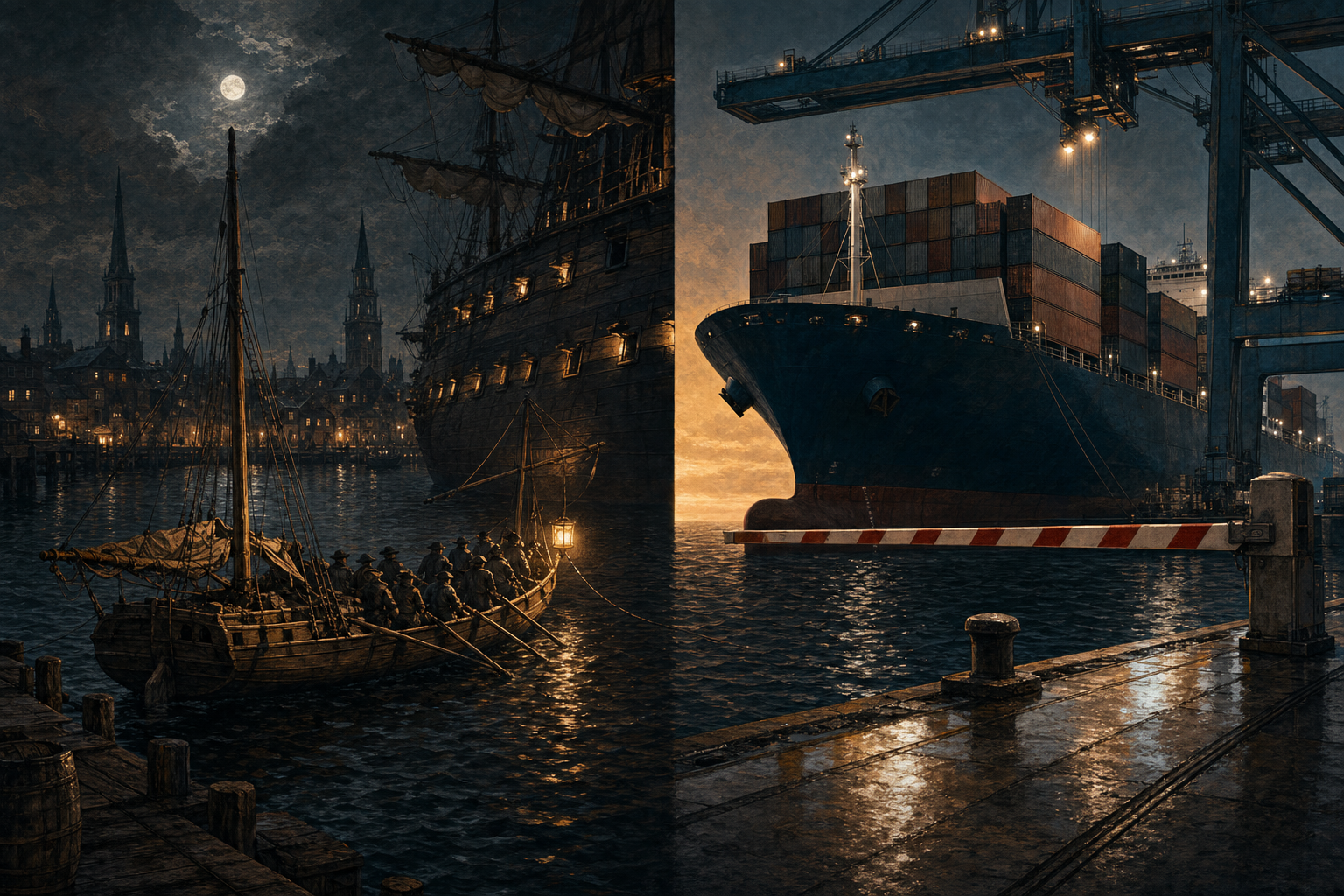
In June 1768, a Royal Navy warship in Boston harbour lowered its boats, rowed to a merchant sloop tied at Hancock's Wharf, cut her loose, and towed her out under the guns of HMS Romney. The ship had been seized for smuggling. Within an hour a crowd of perhaps three thousand had gathered on the waterfront, dragged a customs official's pleasure boat through the streets, and burned it on the Common. The collector of customs fled to a fort in the harbour and refused to come back. The sloop's name, as it happened, was Liberty.
To understand why a single confiscated boat could empty Boston into the streets, you have to understand that nearly everyone on that waterfront was, by the letter of British law, a criminal, and had been for two generations.
For more than a century Britain had governed its colonies by a thicket of trade laws called the Navigation Acts. The principle was mercantilism: the colonies existed to enrich the mother country, so colonial goods had to move in British ships, through British ports, buying from British suppliers. In 1733 Parliament tightened the screw with the Molasses Act, slapping a punishing six pence per gallon on molasses bought from the French sugar islands. Molasses was not a luxury. It was the raw material of the New England rum trade, the closest thing the northern colonies had to an export economy. The law, obeyed, would have strangled them.
So the law was not obeyed. New England simply kept buying cheaper French molasses and smuggled it in, and the smuggling was not some furtive midnight affair. It was the economy. Customs officers were paid a small fee to look at the wrong cargo, ships' manifests were works of fiction, and a duty designed to raise a fortune brought in almost nothing for thirty years. One royal official estimated the Molasses Act collected less than its own enforcement cost. Trade, told to take an expensive road, had quietly found a cheaper one, and everyone from the merchant prince to the dockhand had agreed not to notice.
This is the part that matters. For thirty years, the leak was tolerated. The wall existed on paper, the trade flowed underneath it, and the arrangement kept the peace. The Empire got its grand mercantile theory. Boston got its rum. Nobody pressed the contradiction.
Then, in the 1760s, a cash-strapped Britain fresh from an expensive war decided to press it. George Grenville's Sugar Act of 1764 actually cut the molasses duty in half, but it did something far more provocative than raise a tax. It announced the Crown would now collect one. Customs services were professionalised. The Royal Navy was turned into a tax-enforcement fleet. Accused smugglers were hauled before vice-admiralty courts with no juries, because colonial juries would never convict a neighbour. And customs men were armed with writs of assistance, general warrants that let them search any house, shop, or ship at will, with no specific cause. In 1761 a Boston lawyer named James Otis had argued for five hours against those writs. He lost. But a young John Adams, watching from the gallery, later wrote: then and there the child Independence was born.
Into this walked John Hancock, the richest merchant in Boston, who had inherited a fortune his uncle built partly by dodging the very molasses duty now being enforced. Whether Hancock was truly the prince of smugglers his enemies claimed, or merely a man whose ledgers had always been politely incomplete, hardly mattered to the Crown. They wanted to make an example of the biggest name on the wharf. They got a riot instead, then an occupation. By autumn 1768 British regulars were camped on Boston Common. Those soldiers would fire into a crowd in March 1770. The road from a seized sloop to a revolution was not long.
Britain did not lose its richest colonies because its trade laws were too loose. It lost them the moment it decided, after a century of looking away, to make the laws real. The enforcement, not the rule, was the spark.
Now look at the wharf today.
In the spring of 2026, the United States and China struck a truce on 12 May that froze American tariffs on Chinese goods at 30 percent: a wall, lowered slightly, but still a wall. And just as in Boston, the trade is not stopping; it is finding the cheaper road. Chinese goods are pouring through third countries, relabelled and reshipped. More than 8 billion dollars of them rerouted through Vietnam to American buyers in the first three quarters of 2025 alone, the molasses smuggling of our age, conducted in shipping containers instead of oak casks.
And Washington, like Grenville, has decided to enforce. The new trade deals threaten 40 percent tariffs on anything judged transshipped, even though no one can quite define the word, and customs are being told to trace the true origin of goods the way colonial officers once boarded ships hunting for French molasses. American officials lean on Vietnam and float a common tariff wall with Mexico, deputising the neighbours to police the leak. This is the Sugar Act's exact logic: the rule was survivable, but the campaign to enforce it falls hardest on the very partners whose cooperation you depend on, and it breeds the resentment that outlasts the dispute.
The smuggling was never really the danger. Boston had smuggled happily for decades, and the Empire had held. The danger was the crackdown: the searches, the seized ships, the warships in the harbour, the sense among ordinary traders that a distant power had decided their quiet workarounds were now treason. That is the moment a trade fight stops being about money and starts being about who rules whom.
Britain learned it one sloop at a time. Her name was Liberty, and they should have left her at the dock.