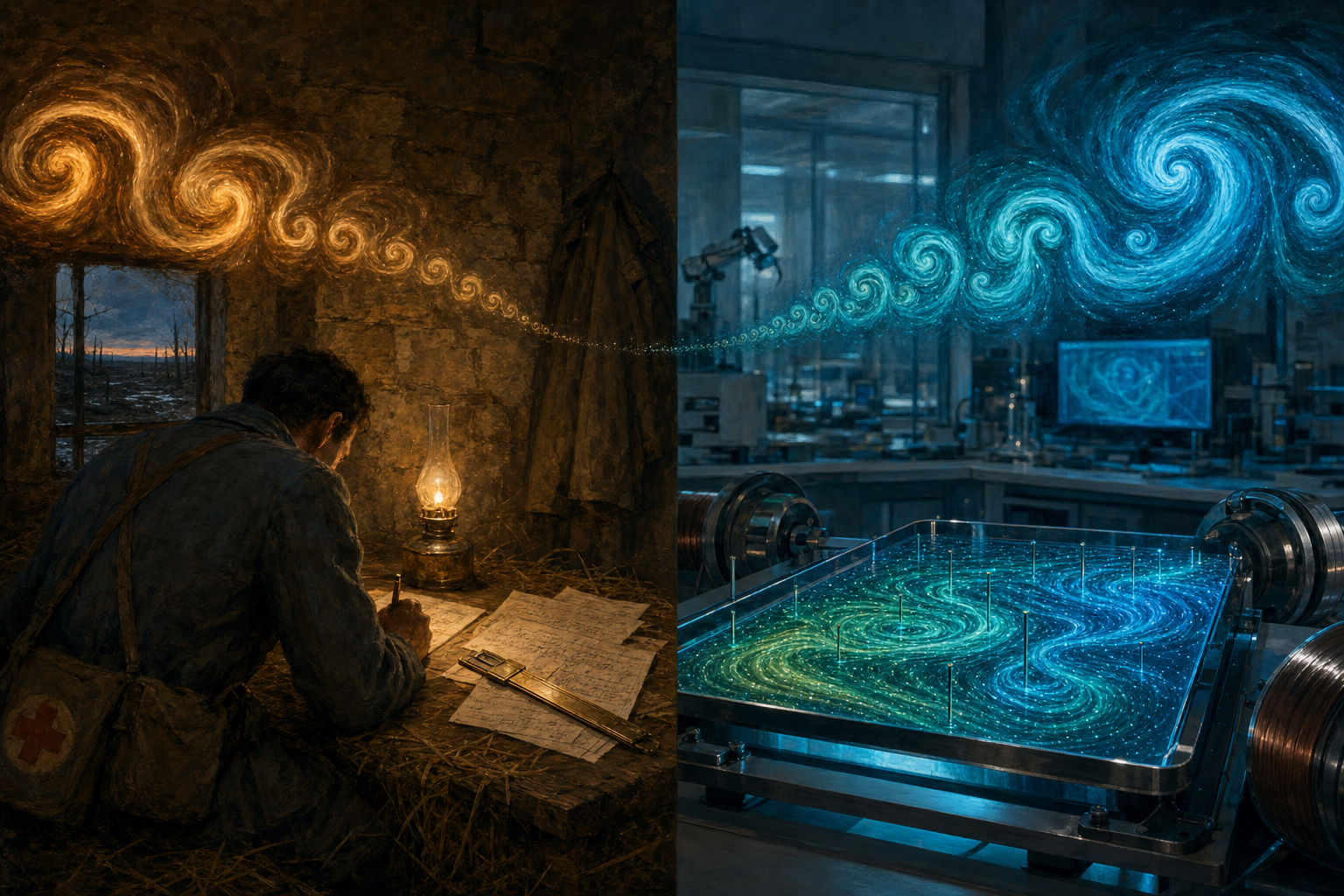
In the spring of 1917, in a billet behind the French lines near Champagne, a thin Englishman in the uniform of an ambulance driver sat with a slide rule and a stack of paper, computing the weather. Not tomorrow's weather. A single day from seven years earlier, the twentieth of May 1910. He wanted to know whether the sky could be predicted by arithmetic alone.
His name was Lewis Fry Richardson. He was a Quaker and a pacifist, a conscientious objector who would not carry a rifle, so he carried the wounded instead. Between runs to the front he worked on the most audacious calculation anyone had ever attempted: to take the measured state of the atmosphere at one moment, and by solving the equations of air and heat and pressure by hand, leap six hours into its future.
It took him the better part of six weeks. He filled page after page with sums, working on a heap of hay in a cold rest billet. When the manuscript was sent to the rear for safekeeping during the fighting, it vanished. It surfaced months later, by chance, buried under a heap of coal.
The forecast, when he finally finished it, was spectacularly wrong. Richardson's arithmetic predicted that the air pressure over central Europe would jump by 145 units in six hours, a swing so violent it would have meant the sky was falling. In reality the pressure barely moved. He was off by a factor of a hundred.
And yet Richardson had not really failed. He had simply come too early. The method was sound. The trouble was that grinding it out slowly, by hand, let tiny flaws in the starting numbers blow up into nonsense. To forecast the real sky, you would have to compute faster than the weather itself could change. In 1922 he published the whole attempt, errors and all, in a book called Weather Prediction by Numerical Process.
In its pages he imagined what winning would look like. He pictured a vast hall, a great theatre with a map of the whole Earth painted across its curving walls, and inside it sixty-four thousand people, each one a computer in the old sense of the word, each solving one small patch of sky and passing the answer to the next, a human supercomputer racing the storm in real time. It was a fantasy in 1922. It is, almost exactly, the weather centre that forecasts your tomorrow today.
But Richardson left something else in that book, something that would outlast even his dream factory. To explain why the air is so maddening to predict, he wrote a little rhyme. Big whirls have little whirls that feed on their velocity, and little whirls have lesser whirls, and so on to viscosity.
He was describing turbulence. The way a large swirl of moving fluid shatters into smaller swirls, which shatter into smaller ones still, the energy tumbling down from the big to the small until, at the very bottom, the tiniest eddies are smeared out into plain heat by the stickiness of the fluid itself. Energy pouring downhill, from large to small, always in one direction.
A generation later, in 1941, in the Soviet Union, the mathematician Andrey Kolmogorov took Richardson's rhyme and turned it into a law. He proved the cascade was not just poetry. It had a precise mathematical shape, the same in a teacup, a river, a hurricane, or a cloud of galactic gas. Energy entered at the largest scale and marched down to the smallest in a fixed, universal way.
For more than eighty years that downhill march was treated as one of the deepest truths in physics. The direction of the flow seemed written into the world. In three dimensions, energy always cascades from big to small. The arrow only ever pointed one way.
There was one strange exception. In 1967 the physicist Robert Kraichnan worked out that if you flatten the world into two dimensions, a thin sheet where the fluid cannot tumble up and down, the cascade runs backwards. Energy flows the other way, from small whirls into large ones, little storms merging into bigger ones. A soap film does it. So does the thin skin of atmosphere and ocean wrapped around the planet, vast and shallow.
So physicists settled into a comfortable belief. The arrow of the cascade was set by the shape of the space itself. Three dimensions, energy down. Two dimensions, energy up. The dimension you happened to live in chose the direction, and there was nothing anyone could do about it.
This is the belief that four physicists have just quietly overturned. Their result appeared in the journal Science Advances, and this spring it began to spread through the science world: the claim that the direction of the cascade is not fixed by the dimension of the world at all. It is a knob you can turn.
The team was led by Lei Fang at the University of Pittsburgh, with Xinyu Si, and in Turin with Filippo De Lillo and Guido Boffetta, one of the people who literally wrote the textbook on two-dimensional turbulence. Their laboratory was almost comically humble. A shallow tray holding a thin layer of salt water, a magnetic field laid across it, and a grid of small rods. Pass a current through salt water in a magnetic field and the liquid shoves itself around. They had built a controllable two-dimensional storm on a tabletop.
Fang's insight was to stop treating the cascade as a mysterious river of energy and start treating it as plain mechanics. A force pushing a fluid through a distance, no different from a hand shoving a box across a floor. And if it is only force and motion, then the direction the energy travels depends on the angle between them, on the geometry of how you push.
So they changed the geometry of the pushing. Lined up one way, the energy in their flat sheet of water ran the way a thick three dimensional fluid would, big to small. Lined up another way, it ran in reverse, small to large. In the same tray of water, with the same fluid, they made the arrow point either way at will.
Now hold that against Richardson's rhyme. For a hundred years his whirls only ever fed downward, big to little to viscosity, energy bleeding away into heat. Kolmogorov proved it. The textbooks enshrined it. And then, in a pan of salt water stirred by magnets, the whirls were made to feed upward, the small ones pouring their strength into the large.
The arrow Richardson drew was real. It was simply never the only way the river could run.
And the reason this is news, rather than a laboratory curiosity, is the very reason Richardson was computing the weather in the first place. The two dimensional flows where this matters are not soap films. They are the ocean and the atmosphere: thin, wide skins of fluid wrapped around a turning planet, where energy moving up the scale or down it decides where heat gathers, where storms grow, where currents and nutrients and pollutants pool or scatter.
The Pittsburgh team showed that a barrier only metres across, placed at the right angle, can reshape currents that run for kilometres. If the direction of the cascade can be steered, then in principle some of the great flows of the Earth might one day be nudged. Currents shaped. Heat redirected. The models that forecast our climate made truer to a world where the arrow was never fixed.
There is one last rhyme buried here. Richardson walked away from weather science when he discovered his equations were useful to the men designing poison gas, and he burned the work he had not yet published. He spent the rest of his life turning his mathematics on the causes of war instead, trying to measure it, predict it, and head it off. He wanted his science to push the world toward something better.
A century on, the descendants of his cascade are being turned, gently, on the ocean and the sky, not yet to predict the weather but perhaps one day to guide it. The pacifist in the ambulance drew an arrow he believed pointed only one way. It turns out the current can be reversed. And so the question history keeps handing back to us is the one Richardson spent his whole life asking. Now that we can push the flow, which way will we choose to point it?
Big whirls have little whirls. But which way they feed, it turns out, is up to us.