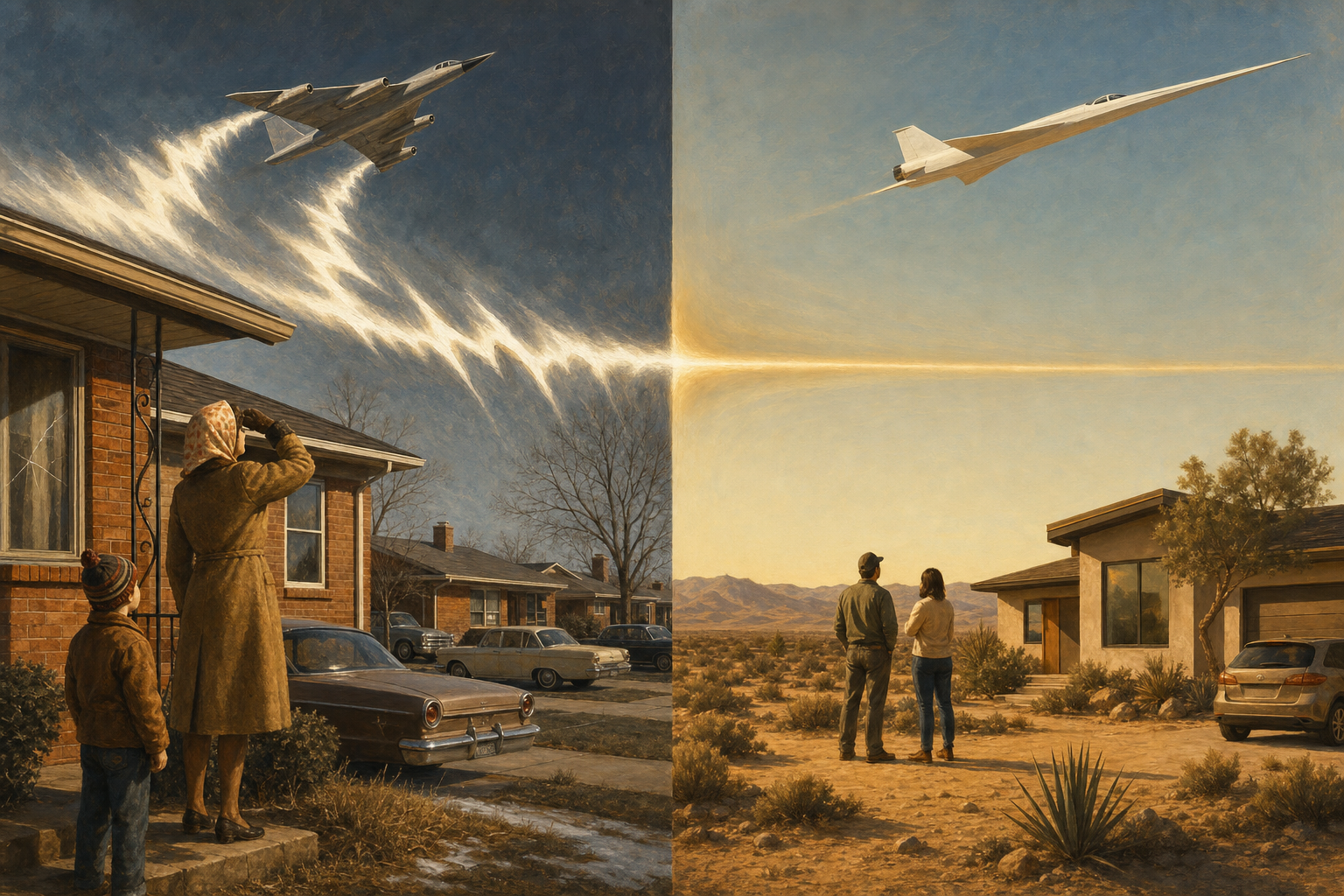
At seven o'clock on the morning of 3 February 1964, the sky over Oklahoma City cracked like a rifle shot fired an inch from your ear. Then, a beat later, it did it again. By that afternoon it had happened eight times. The next day, eight more. Windows shivered in their frames downtown. Plaster dust sifted from ceilings in the tidy suburbs of Nichols Hills. A baby that had finally gone down for its nap woke screaming, and its mother stood in the kitchen wondering what she had done to deserve a city that exploded on a timetable.
This was not a malfunction. It was the plan. The government of the United States had decided to drop a sonic boom on half a million of its own citizens, on schedule, eight times a day, for the next six months, to find out whether they could be taught to love it.
The man with the supersonic future
The man who believed they could was named Najeeb Halaby, and he was, in the early 1960s, one of the most glamorous figures in Washington. A former Navy test pilot of Lebanese descent, dark and charming, he ran the Federal Aviation Agency and he was in a hurry. The British and the French had joined forces to build a needle-nosed airliner called Concorde. The Soviets were racing toward their own machine, the Tupolev Tu-144. Halaby was certain that if America did not build a supersonic transport of its own, it would surrender the sky, and the prestige that came with it, to Europe and to Moscow.
The American answer would be the Boeing 2707: bigger than Concorde, faster than Concorde, designed to carry more than 270 passengers at nearly three times the speed of sound. It would cross the country in two hours. There was only one problem, and it was a problem no engineer in 1964 knew how to solve.
Physics. A jet flying faster than sound drags a cone of compressed air behind it the entire way, and wherever that cone sweeps across the ground it lands as a wall of pressure: the boom. A supersonic airliner could not slip quietly between cities. It would punch every town beneath its route, dozens of times a day, for as long as it flew. You could not engineer the boom away. So Halaby reached for the next best thing. Maybe, he reasoned, people would simply get used to it, the way they had gotten used to the railway, to the motorcar, to the roar of ordinary jets at the end of the runway.
There was a way to test the theory. You could take a real city and boom it, day after day, and measure what happened.
Operation Bongo
They chose Oklahoma City for its loyalty. It was central, patriotic, and steeped in aviation, home to Tinker Air Force Base and to the FAA's own training academy. If any city in America would take one for the team, it was this one. The program was called Operation Bongo II, and starting on 3 February 1964 the Air Force sent F-104 fighters and B-58 bombers screaming over the city to lay down 1,253 sonic booms across twenty-six weeks. The pressure was kept gentle at first, around one pound per square foot, then deliberately cranked higher through the spring, toward two.
For a while the FAA got the answer it wanted. It surveyed residents and announced, triumphantly, that 73 percent of them said they could live with the booms. What the press release did not lead with was the rest of the same data. More than a quarter said they could not stand it and never would. Forty percent reported that the booms were cracking their homes. The complaints arrived by the thousands: 9,594 reports of damage, and 4,629 formal claims for broken glass and split plaster and foundations gone wrong.
Then came the part that turned grievance into fury. The government acknowledged almost none of it. It paid out roughly 123,000 dollars, a token, and fought the rest. When Halaby himself flew to Oklahoma City to check on his experiment, he was met with death threats. The city took the United States to court, and years later, on 8 March 1969, the government lost its appeal.
Operation Bongo had set out to prove that Americans would absorb the boom. Instead it proved they would organize against it.
Nine people and a mailing list
The organizing did not start in Oklahoma. It started in a study in Cambridge, Massachusetts, where a Harvard physicist named William Shurcliff had done the arithmetic and frightened himself. In March 1967 he founded the Citizens League Against the Sonic Boom. It had, in total, nine members. Shurcliff mailed out pamphlets that translated Halaby's dream into plain numbers: a fleet of supersonic airliners would drag a "bang zone" some fifty miles wide across the entire country, booming the people inside it again and again, every single day. He sent the figures to anyone who would read them, and crucially he sent them to Congress.
The arithmetic won. By 1971 the mood had turned, the projected costs had ballooned, and new fears about the upper atmosphere had joined the chorus. In March the Senate stripped the SST's funding. In May the House finished the job, voting 215 to 204 to kill it outright. A billion dollars had been spent. Two prototypes had been built that would never fly. Boeing laid off more than 60,000 people. And in 1973 the FAA made the defeat permanent, writing into law a rule numbered 14 CFR 91.817: no civil aircraft may fly faster than sound over the United States. Concorde would eventually carry the rich across the Atlantic, beautiful and supersonic and confined to the open ocean, with nowhere over America it was allowed to stretch its legs.
Halaby had resigned in 1965, before the worst of it. His young daughter Lisa would grow up to become Queen Noor of Jordan. The airplane he loved never carried a paying passenger over American soil.
The lesson of Bongo, buried under all that broken glass, was simple. The boom was not a noise the public could be trained to tolerate. It was a blow. You cannot ask people to learn to enjoy being struck. The only way to fly supersonic over land was to stop the boom from ever reaching the ground. In 1964, nobody on earth knew how.
The thump
Sometime in the first days of June 2026, over the California desert, a very strange aircraft is expected to push past the speed of sound for the first time. It is called the X-59, NASA's quiet supersonic demonstrator, and almost a third of its length is nose, an absurd, knife-thin spear of an airframe. The shape is not styling. It is the answer to the problem that beat Najeeb Halaby. The long nose and sculpted body stretch the shock waves out and keep them from piling up into a single wall of pressure. What reaches the ground is not a boom but a thump, somewhere around 75 perceived decibels, less a thunderclap than the distant thud of a car door closing across the street. Concorde delivered something past 100.
NASA built the X-59 to overturn the very law that Bongo wrote. On 6 June 2025 the White House ordered the FAA to repeal its 52-year ban on overland supersonic flight and replace it with a standard based on noise, not speed. In March 2026 the House advanced a bill to do the same thing. The entire effort now rests on a single question, the same question Oklahoma City was asked sixty-two years ago: can you fly fast over a town without the people below flinching?
Here is what has changed, and it is everything. In 1964 the FAA asked a city to endure the boom and measured how much it would take before it broke. In 2026 NASA did the opposite. It took the boom out of the airplane, and now it will fly the X-59 over selected American communities and ask the people underneath, politely, what they heard. Same agency. Same skies. Same clipboard. The one variable they finally changed is the one Halaby never could: the boom itself.
Sixty-two years ago the government dropped a thunderclap on a city eight times a day and asked it to smile. This summer it will fly over your house and hope you do not look up. The question was never whether America could build a faster airplane. It was whether anyone on the ground would forgive it.