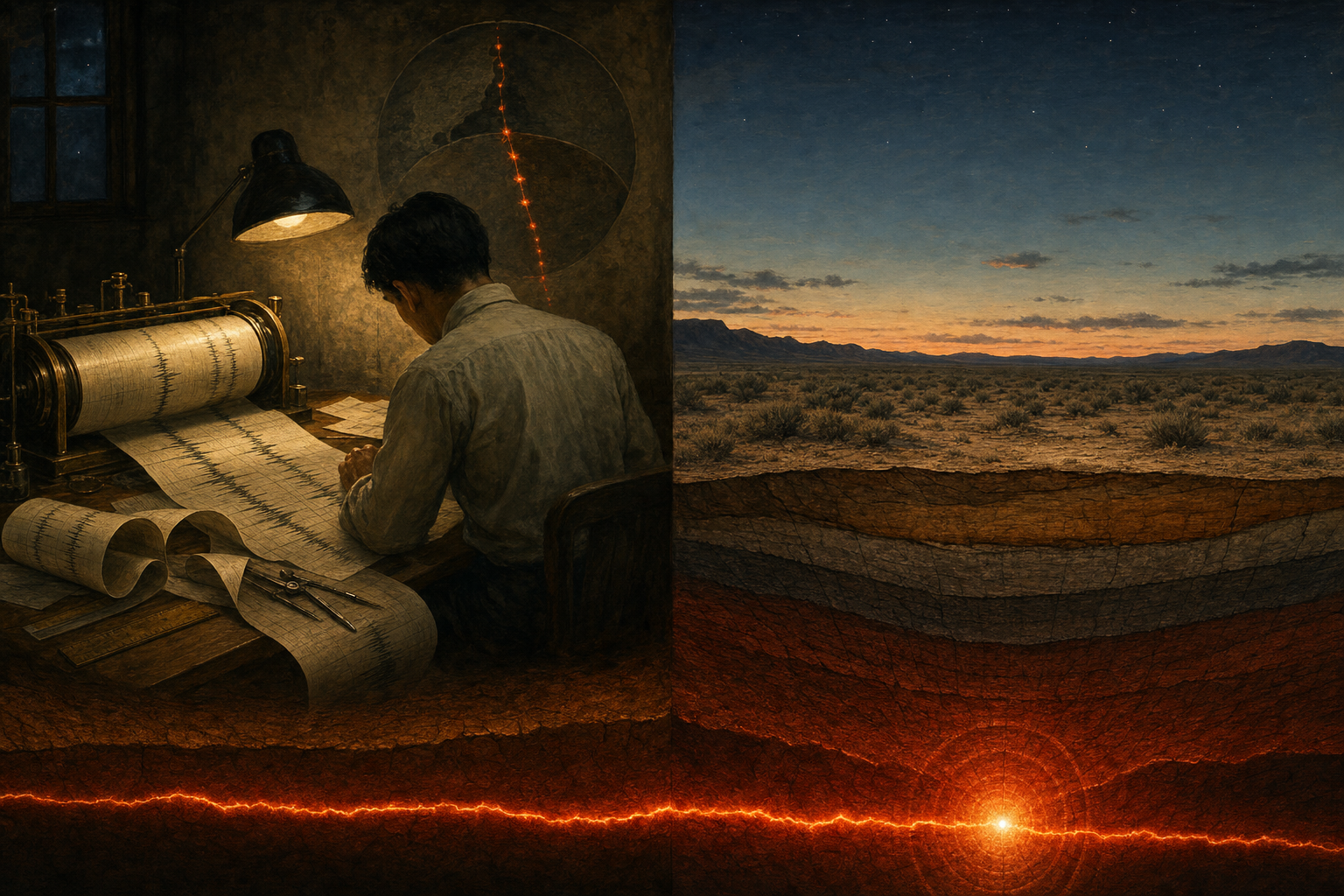
In a cramped office at the Central Meteorological Observatory in Tokyo, sometime in the late 1920s, a young man sat turning over long curls of smoked paper. They were seismograms, the scrawled signatures of distant earthquakes, and something about a handful of them was wrong. The wiggles arrived in the wrong order, spaced in a way that made no sense, if you believed what everyone believed about where earthquakes come from.
His name was Kiyoo Wadati. He was not a famous professor. He was a meteorologist, a weatherman by training, who had been handed the country's earthquakes to watch. And Japan gave him plenty to watch. What caught him was the gap between the two opening punches of every quake: the first fast tremor that arrives, the P wave, and the slower shudder behind it, the S wave.
Everyone knew where earthquakes lived. They lived in the crust, the thin cold brittle skin of the planet, the top few tens of kilometres. Below that the rock grew hot, and hot rock does not snap. It creeps and flows, slow as a glacier, slow as warm wax. An earthquake down in that hot deep rock was not just unlikely. It was a contradiction in terms, like a fire underwater.
But Wadati had a way to check. The gap between the P wave and the S wave is like the gap between a flash of lightning and its thunder. The longer the wait, the farther the source. Worked carefully across hundreds of records, that delay does not only tell you how far away a quake was. It tells you how deep.
And the answer his arithmetic kept giving him was impossible. Some of these Japanese earthquakes had begun three hundred, four hundred, nearly five hundred kilometres down. Far beneath the brittle crust. Deep inside the hot rock that was never supposed to be able to break at all.
In 1928 he laid it out in a paper with a plain title, "Shallow and deep earthquakes," more than seven hundred shocks sorted by depth. A weatherman had just discovered that the planet shakes from places science had ruled out entirely.
And the deep ones were not scattered at random. Wadati noticed they lined up. They fell along a surface that tilted downward beneath Japan, starting near the ocean trench offshore and sloping away into the Earth, a hidden ramp of earthquakes leading down into the dark.
The world mostly shrugged. Wadati published in Japanese, a meteorologist on the far side of the planet, and the idea was too strange to swallow. For twenty years his deep earthquakes sat in the literature like a rumour nobody had time to chase.
Then in 1949 an American seismologist, Hugo Benioff, described the very same tilted zones of deep quakes ringing the Pacific. For a while the feature carried his name alone. Only later did the textbooks correct themselves and call it the Wadati-Benioff zone, restoring the quiet man who had seen it first, two decades early.
Because that tilted ramp turned out to be one of the great clues of the century. In the 1960s it became hard evidence for plate tectonics. The dipping plane of earthquakes was the track of a cold slab of ocean floor, plunging back down into the mantle. Wadati's deep quakes were marking the grave of a sinking plate.
So the mystery looked solved. Deep earthquakes happen inside those cold slabs, slivers of old sea floor that sink faster than they can warm, staying brittle far below where loose rock would have softened. The diving slab carries the cold down with it. The cold lets the rock snap.
There was still a knot in it, though, one that has never fully come loose: how does any rock break at five hundred kilometres, under a pressure that should clamp every crack shut the instant it opens.
Generations of experiments offered answers for the slabs: minerals collapsing into denser forms and greasing a fault, or trapped water flashing free and making the rock brittle for an instant. Clever mechanisms, all of them leaning on one thing. They needed a cold slab to work.
Which brings us to Utah, and to a tremor that by every rule should never have happened. On the twenty-fourth of February 1979, the seismographs of the University of Utah caught a small earthquake, magnitude 3.8, near the little town of Randolph up by the Wyoming line.
A young researcher named George Zandt worked out how deep it had started and got a number no one would accept. Ninety kilometres down. Not in the crust. Deep in the upper mantle, beneath the solid old heart of a continent. For forty years it was quietly written off as a mistake.
This year a team led by Keith Koper at the University of Utah went back to that 1979 record, and to eight more suspicious tremors scattered across northern Utah and Wyoming, and confirmed every one of them. Nine earthquakes, sixty-eight to ninety kilometres down, deep in the mantle under a continent. They have a name for them now: continental mantle earthquakes.
And they bring Wadati's old shock back in its purest, hardest form. Because here there is no cold slab. No sea floor diving down to keep the rock brittle. Just hot mantle, well above seven hundred degrees, where rock is supposed to ooze like putty, not shatter like glass. The one ingredient every explanation relied on is missing.
The team's best idea is strange and beautiful. Deep beneath the region sits the ancient cold root of the continent, the Wyoming craton, a keel of old rock hanging down into the mantle. The soft mantle has to flow around that obstacle the way a river curls around a bridge piling, and the strain it piles up there may, somehow, be enough to break.
One of the scientists put it plainly. It is, he said, a mystery in terms of fundamental physics. How in the world can these things happen. It is almost word for word the question Wadati's smoked paper was asking a hundred years ago.
And it is not only a curiosity. If solid rock can rupture ninety kilometres beneath a continent, then our maps of where earthquakes can begin, and how large they might grow, may be quietly incomplete under places nobody thought to watch.
That was Wadati's real lesson, long before the slabs and the plates. A quiet weatherman with a slide rule and a heap of smoked paper showed that the Earth keeps its secrets deeper than we assume, and that the obvious limit, the rule that the rock simply cannot break down there, was a limit only in our heads.
A century on, beneath a quiet corner of Utah, the rock is breaking where it cannot break, again. The deepest question Wadati ever asked is still ringing, and we have not answered it. We have only learned to look further down.
The ground keeps breaking where the textbooks swear it can't. A hundred years on, we still do not know how. We have only learned how deep we have to go to be surprised.