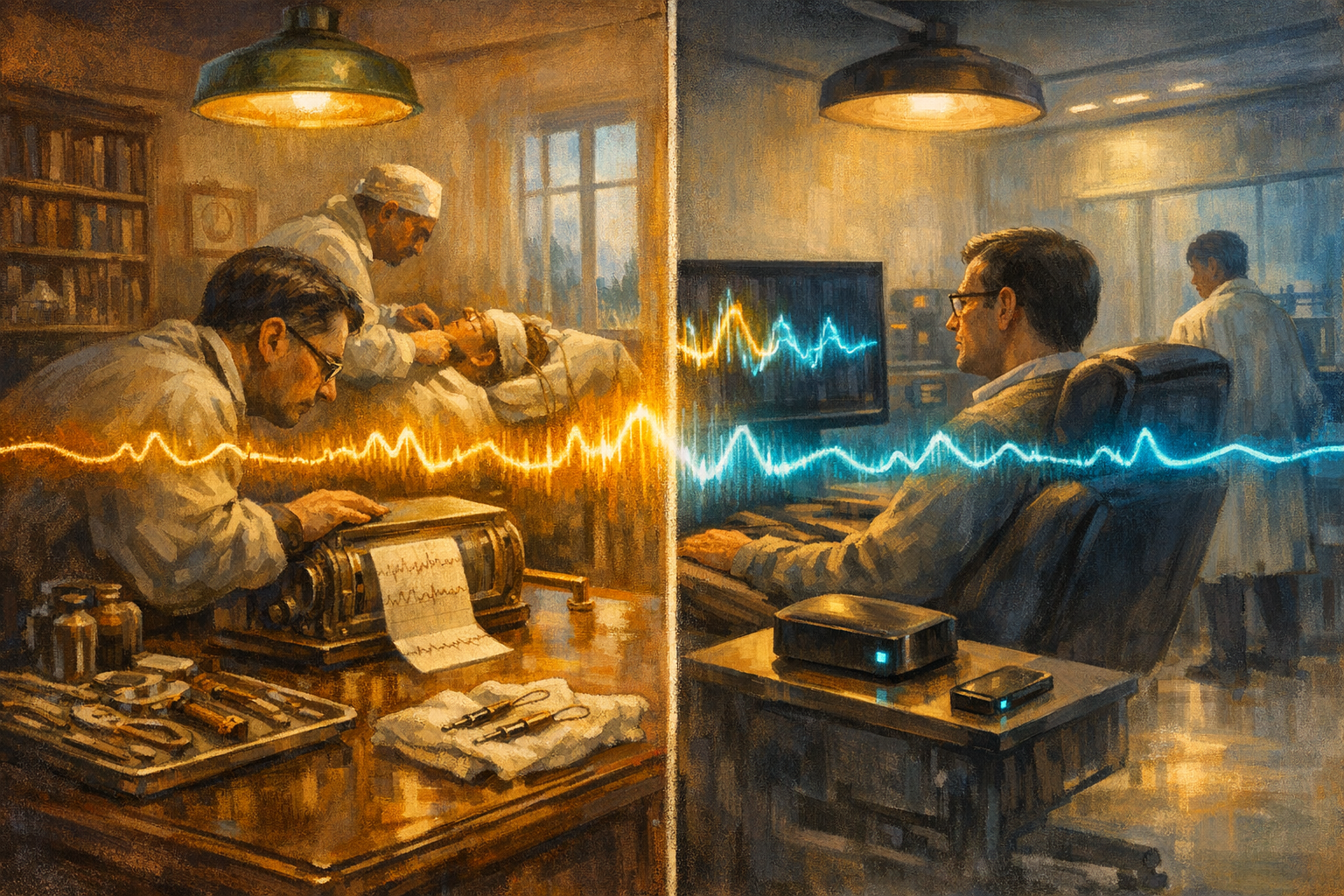
In the summer of 1892, a 19-year-old Prussian cavalry recruit named Hans Berger was thrown from his horse directly into the path of a horse-drawn artillery battery. The driver halted the team in time. That evening, in Coburg, his eldest sister Ursula was overcome by the certainty that her brother was in mortal danger and demanded that their father telegraph the regiment. The telegram arrived after the near-miss, but during the same hour. Berger spent the next fifty years trying to find the physical mechanism by which she had known.
He went into psychiatry to do it. He took his medical degree at the University of Jena in 1897 and never left. He became director of the psychiatric clinic in 1912 and held the chair of psychiatry from 1919 until the Nazi authorities removed him on 30 September 1938. The work that consumed him was a search for what he called "psychic energy": a measurable physical correlate of mental activity, the substrate by which one mind might influence another across distance. He studied cerebral blood flow. He measured skull temperature. He inferred metabolic balance. Nothing produced a clean signal. His colleagues thought him eccentric. He worked alone.
On 6 July 1924, in the operating theatre of the Jena psychiatric clinic, Berger pushed two thin needle electrodes through the open skull of a 17-year-old boy undergoing a trephination by the neurosurgeon Nikolai Guleke. He connected the electrodes to a string galvanometer borrowed from the physiology department. The galvanometer trace wobbled in a slow rhythm. Berger had recorded the first human electroencephalogram. He told no one.
He spent the next three years repeating the recording on his patients and, increasingly, on his son Klaus. He needed to prove the rhythm came from cortex, not from muscle, not from the scalp, not from the recording apparatus itself. The proof came on 14 October 1927, when Berger captured the same rhythm through Klaus's intact skull. Eighty-three further confirmation sessions followed.
He submitted his paper on 22 April 1929. He titled it "Über das Elektrenkephalogramm des Menschen": On the Electroencephalogram of Man. Archiv für Psychiatrie und Nervenkrankheiten ran it in volume 87, pages 527 to 570. The reception was almost total silence. Physiologists who read it assumed Berger had measured an artefact of his apparatus. Edgar Adrian, the Cambridge Nobel laureate who would eventually vindicate the work, later wrote that he had first regarded the recording with "open disbelief."
It took Adrian until 1934 to be convinced. With B.H.C. Matthews he replicated Berger's recordings at Cambridge, demonstrated them to the Physiological Society, and named the dominant 8 to 13 Hz oscillation the "Berger rhythm." Adrian's paper in Brain that year is the moment electroencephalography became real science. The technique passed quickly out of Berger's hands. The Nazi authorities pushed him into emeritus retirement four years later. He died by suicide at the Jena clinic on 1 June 1941, at sixty-eight.
He had not found telepathy. He had measured something better: the first physical signature of thought, on a strip of moving paper, in a German university clinic, by a man so doubtful of his own data that he sat on it for five years.
Almost to the day, eighty-five years after Berger's death, the brain-computer-interface company Neuralink published an update on its VOICE trial. The second participant, a man with amyotrophic lateral sclerosis named Kenneth Shock, had been implanted with a 1,024-electrode N1 array in his left motor cortex in January 2026. By late May the system was producing audible speech from his cortical activity through a synthetic voice played from a speaker on his lap. There is no peer-reviewed accuracy figure for the demonstration yet. Neuralink describes the latency between thought and audible word as a few seconds. Independent verification will arrive when the underlying data reach a journal.
The measured ground for what Shock did sits in a 2023 Nature paper from Stanford by Francis Willett and Jaimie Henderson. Their patient, Pat Bennett, also living with ALS, reached 62 words per minute on a 50-word vocabulary using two intracortical microelectrode arrays in her ventral premotor cortex. In 2024 the New England Journal of Medicine published a paper by Nicholas Card, Sergey Stavisky, and colleagues at UC Davis describing a similar speech decoder in the ALS patient Casey Harrell. The decoder reached 97.5 percent accuracy on a 125,000-word vocabulary in everyday use. In early 2026 the broader BrainGate consortium reported a 22-words-per-minute typing throughput via hand-motor cortex decoding, the highest published rate for an implanted-electrode BCI typing system to date.
The point of the numbers is not the words per minute. It is that the underlying signal, the thing the electrode is sensing, is exactly what Berger saw moving on his string galvanometer in 1924. The cortex's electrical activity carries enough structure that, with electrodes in the right place and an algorithm trained on the right person, the structure can be decoded into the speech the person intends to produce. Berger spent his career trying to broadcast that signal across miles. The Neuralink team, the Stanford and UC Davis groups, and a handful of others have spent the last decade learning to read it from a few square centimetres of motor cortex and pipe it back out through a speaker.
Berger's final published paper, written in 1938 just before his removal, was an attempt to derive the EEG from quantum-mechanical models of brain metabolism. He never did stop chasing the bigger theory. He died believing he had found something more modest than he had hoped for.
He had given the rest of us the tool that, eighty-five years later, lets Kenneth Shock speak.