Every day, we find the historical story hiding inside the headlines. Riveting narratives
that connect the past to the present, and make you wonder what happens next.
Choose your topics
You'll receive one email per topic, per day. Pick as many as you like.
Today's Echo · History & Current Events
1922 to 1928, the British Empire and the United States
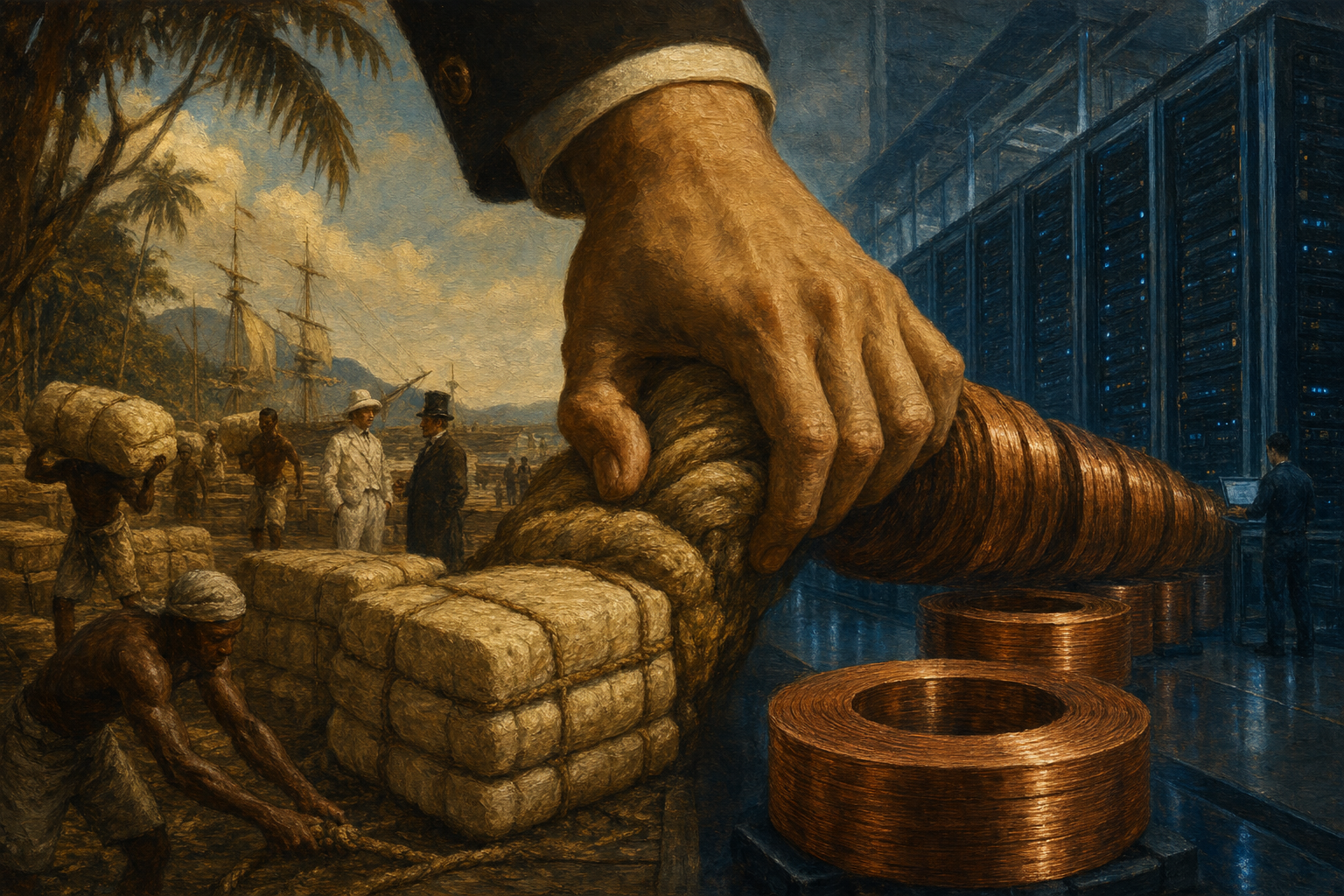
In 1925 the most valuable thing in America was a milky sap from trees on the far side of the world. Rubber ran every car, factory and phone line, Britain's colonies grew about three quarters of it, and Britain had just choked the supply: the Stevenson Plan restricted exports to drive the price from around thirteen cents a pound past a dollar. America, which bought most of the world's rubber, did not just pay. Commerce Secretary Herbert Hoover funded a global hunt for new supply, Harvey Firestone planted a million acres of Liberia, chemists chased synthetic rubber, and the cartel collapsed when the Dutch refused to join and flooded the market. Squeeze a customer hard enough and you do not make him pay; you teach him to never need you again. A century later it is copper for AI data centres and China's grip on rare earths, and the same scramble has begun.
•3 min readA century later the same dynamic has returned with metal instead of sap. The lifeblood of the AI age is copper (a single large AI-ready data centre can require up to about 50,000 tonnes) and rare earth elements used in magnets, motors and weapons. Analysts forecast a structural refined-copper deficit (J.P. Morgan projecting roughly 330,000 tonnes for 2026), with new mines averaging about 17.9 years from discovery to production. The choke point is as lopsided as rubber was in 1925: China processes around 90 percent of the world's rare earths and has used that control as leverage, prohibiting exports of gallium and germanium to the US from December 2024 and adding medium and heavy rare earths and magnets to its export-control list through 2025. Washington's response could have been written by Hoover: in February 2026 it launched a Strategic Critical Minerals Reserve (Project Vault), backed by a $10 billion EXIM loan, and pressed a global search for friendly supply, recycling and substitutes. The lesson of the rubber war is not that a choke point is permanent but the opposite: squeeze a customer hard enough and you teach him, and everyone watching, how to make sure he never needs you again.
Queen and worker bees hatch from identical eggs, yet one lives for years and lays a million eggs while the others live for weeks and never breed. For a century the textbook answer was a single food: royal jelly. In 2026 a team at UC Riverside showed the real answer is grander. Specialised worker bees build the queen a palace: a peanut-shaped 'royal crib' of custom wax with its own chemistry, and they cluster to keep it warm. Raise a would-be queen in ordinary wax instead and she develops poorly and often dies. The jelly feeds her; the crib crowns her. We love a story with one secret ingredient. Nature almost never works that way.
•3 min readIn 2026 a team at the University of California, Riverside (its Center for Integrative Bee Research) showed that royal jelly alone does not make a queen: the environment does much of the work. A specialised caste of young worker bees acts as royal builders, constructing the large peanut-shaped 'royal crib' from a custom wax that is softer, melts at a higher temperature, and carries a distinct chemical signature of fatty acids and signals, and they alter their own physiology to raise the temperature around the cell, like underfloor heating. Crucially, when would-be queens were raised in ordinary worker-cell wax instead of the royal crib, the larvae developed poorly and many died: they needed the 'smell and feel' of the royal wax to transform at all. So queen determination is a whole system, diet plus architecture, temperature and wax chemistry plus the labour of many bees, not a single ingredient. It is a recurring lesson in biology: we love single-cause stories (one gene, one molecule, one food), but nature's marvels are usually built from many small causes acting together. A queen is built, not dosed.
Colombia votes Sunday 31 May 2026 under armed-group drone-swarm attacks: 48 massacres in four months, 333 drone strikes last year. The closest historical parallel is the 30 January 2005 Iraqi election, when voters defied al-Qaeda's 'war on democracy' to produce 58 percent turnout, and then the constitution that followed bled the country for ten years.
•6 min readColombia votes Sunday 31 May 2026 with 14 candidates under sustained armed-group attack: 48 massacres in 4 months, 333 drone strikes in 2025, 386 at-risk municipalities. Cepeda leads at 44%. Iraq 2005 is the template.
1848 to 1862, the Bates and Wallace Amazon expedition and the Linnean Society of London
London, 21 November 1861: Henry Walter Bates reads a paper before the Linnean Society describing the strangest thing he saw in eleven years on the Amazon, unrelated butterflies converging on the same warning colours. He calls it mimicry. The mechanism takes 164 years to find: in May 2026 a Wellcome Sanger team identifies two genes, ivory and optix, that Lepidoptera have been re-using for the same job for 120 million years.
•5 min readOn 2 May 2026 an international team led by the Wellcome Sanger Institute and the University of York published in PLOS Biology 'Genetic parallelism underpins convergent mimicry coloration in Lepidoptera across 120 million years of evolution.' Working from whole-genome sequencing of seven species of Heliconius and Ithomiini butterflies and a day-flying Chetone moth, the team showed that across 120 million years of independent evolution Lepidoptera have re-used the same two genes, ivory and optix, to produce convergent warning-colour patterns. The protein-coding sequences are conserved; the evolution sits in the regulatory switches. One moth species deploys the genes via a chromosomal inversion identical in orientation to one independently evolved by a butterfly lineage millions of years earlier. The space of viable genomic solutions to the Batesian-mimicry problem is small, and lineages 120 million years apart reach for the same tools.
1987 to 2012, Bourakebougou village in southwestern Mali
Bourakebougou, Mali, 1987: a drilling crew sinks a water well, hits a gas they cannot identify, and accidentally lights it with a cigarette. The well is capped and forgotten for twenty-four years. Today it produces 98 percent pure hydrogen and powers a Malian village. Last week a Toronto team measured the same chemistry 2.4 kilometres beneath northern Ontario, suggesting a planet-scale clean-energy resource.
•4 min readOn 19 May 2026 a team led by Barbara Sherwood Lollar of the University of Toronto, with collaborators at the University of Ottawa, published in PNAS the first sustained, long-duration direct measurement of natural hydrogen discharging from billion-year-old Canadian Shield rocks. The monitoring instrument was parked 2.4 kilometres beneath the surface at the Kidd Creek copper-zinc mine in northern Ontario. The data show continuous geological hydrogen generation at depth, captured in fracture water and released at a stable rate over months. This re-classifies natural ('white' or 'gold') hydrogen from a Mali curiosity into a continuous planetary process operating wherever the geology is right, roughly 15 percent of Earth's continental crust. Active exploration leases are now pegged across Australia, France, Spain, Albania, the US Mid-Continent rift, the Canadian Shield, and parts of West Africa.
February 1988 to January 1990, the Noriega arc from Miami federal indictment to capture, conviction and Miami trial
Miami, 22 May 2026: a federal grand jury in the Southern District of Florida indicted 95-year-old Raúl Castro for the 1996 shootdown of two Brothers to the Rescue civilian aircraft. The same Miami court did the same thing to Manuel Noriega in 1988. Twenty-two months later, twenty-seven thousand US troops landed in Panama.
•6 min readMiami, 22 May 2026. The US Attorney unseals at the Freedom Tower a federal indictment of Raúl Castro for the 1996 Brothers to the Rescue shootdown. Díaz-Canel warns of a bloodbath. The Maduro capture template is four months old.
1866 to 1892, from Carl Culmann's Zurich engineering school to Julius Wolff's orthopaedic clinic in Berlin
Berlin, 1892: the Prussian surgeon Julius Wolff publishes a law claiming bones actively remodel themselves in response to mechanical load. The proposition was treated as a pretty analogy for nearly a century. Last month a laboratory in Trieste found the same principle, in a different organ, is the reason the heart almost never gets cancer.
•5 min readOn 24 April 2026 a team led by Giulio Ciucci at the International Centre for Genetic Engineering and Biotechnology in Trieste published in Science 'Mechanical load inhibits cancer growth in mouse and human hearts.' Using a heterotopic-heart-transplant model that separated blood supply from mechanical pumping, the team showed that cancer cells proliferate aggressively in non-beating hearts but replace only about 20 percent of the tissue in beating ones. The mechanism: Nesprin-2, a component of the LINC complex in the outer nuclear membrane, senses the pressure pulse of each heartbeat, transmits the signal to the nucleus, reduces histone methylation and chromatin compaction at proliferation-related genetic loci, and brakes cancer-cell division. The proposition that you might one day prescribe a heartbeat to a tumour is no longer absurd.
October 1962, the thirteen days of the Cuban Missile Crisis
Doha, expected Sunday 25 May 2026: a 60-day Iran-US Memorandum of Understanding ends the US Navy's 50-day blockade of the Strait of Hormuz, releases $12 billion in frozen Iranian funds, and opens negotiations on uranium enrichment. The legal-word substitution, the public-and-secret pairing, the time-limited window are the exact template that ended the Cuban Missile Crisis in October 1962.
•6 min readDoha, ~25 May 2026: Iran and the US sign a 60-day MOU ending the US blockade of the Strait of Hormuz, releasing $12bn in frozen Iranian funds, opening uranium-enrichment talks. Pakistan-led mediation, Qatar joined late.
October 2003 to November 2025, Bolivia from the Gas War to the first non-MAS president in two decades
Bolivia, 17 October 2003: a Chicago-educated technocratic president fled the country by helicopter after sixty-seven people were killed in two weeks of road blockades organised by a coca-grower congressman named Evo Morales. This week the streets of La Paz are blocked again. Morales is sixty-six, banned from running for office, and back at the architect's table.
•6 min readLa Paz under siege, May 2026. President Rodrigo Paz, six months in office, faces the same canyon-road blockades that brought down Sánchez de Lozada in 2003. Morales is barred from running for office. His networks are running the blockades.
1974 to 1978, Hadar and the Afar Triangle of northeastern Ethiopia
Hadar, Ethiopia, 24 November 1974: a 31-year-old American paleoanthropologist named Donald Johanson spotted a small arm-bone fragment in a dry watercourse in the Afar badlands and pulled forty per cent of Lucy out of the dust. For fifty years the textbook picture was a line from her species to ours. The new Ledi-Geraru and Mille-Logya fossils have turned the line into a small grove of cousins.
•5 min readIn August 2025 a team led by Brian Villmoare reported in Nature 13 hominin teeth from the Ledi-Geraru site in the Afar showing early Homo at 2.78 and 2.59 Mya and a previously unknown Australopithecus species at 2.63 Mya. In January 2026 a team led by Zeresenay Alemseged at the University of Chicago reported in Nature the first Paranthropus jaw ever recovered from the Afar (MLP-3000), 1,000 km north of the genus' previous northernmost occurrence. Up to four hominin lineages coexisted in eastern Africa between 3.0 and 2.5 million years ago. The line is now a tree.
June 1887 to June 1890, the German Empire under Bismarck and the early reign of Wilhelm II
Berlin, 18 June 1887: the German chancellor signed a secret three-year treaty with Russia at the same time he was bound by a public treaty against Russia. The arrangement held the European peace for three more years. Then his emperor died. Trump and Putin visited Beijing within a week of each other this month.
•7 min readBeijing, May 2026: Xi receives Trump (13-15 May) and Putin (19-20 May) at the Great Hall within a week. Energy and security joint statements with Russia; no treaty with the US; 'China holds the cards' framing.
1900 to 1930, the Institute of Pathological Anatomy in Vienna, Mount Sinai Hospital in New York, and the Karolinska Institutet in Stockholm
Vienna, 1900: a thirty-two-year-old physician named Karl Landsteiner pricked the fingers of his lab colleagues, mixed every serum with every set of red blood cells, and discovered that the chemistry the immune system was reading was sugar chemistry on the surfaces of cells. He had found the ABO blood groups. This month, the Max Planck Institute for the Science of Light has published the first nanometre-scale atlas of the entire sugar code on every kind of human cell.
•5 min readA May 2026 Nature Nanotechnology paper by Möckl and colleagues at the Max Planck Institute for the Science of Light in Erlangen introduces Glycan Atlasing, a technique that combines DNA-tagged lectins, metabolic oligosaccharide engineering and super-resolution microscopy to map every glycan on the surface of a cell at nanometre resolution; the technique distinguishes cancerous from healthy tissue and tracks immune-cell activation by the spatial pattern of sugars alone.