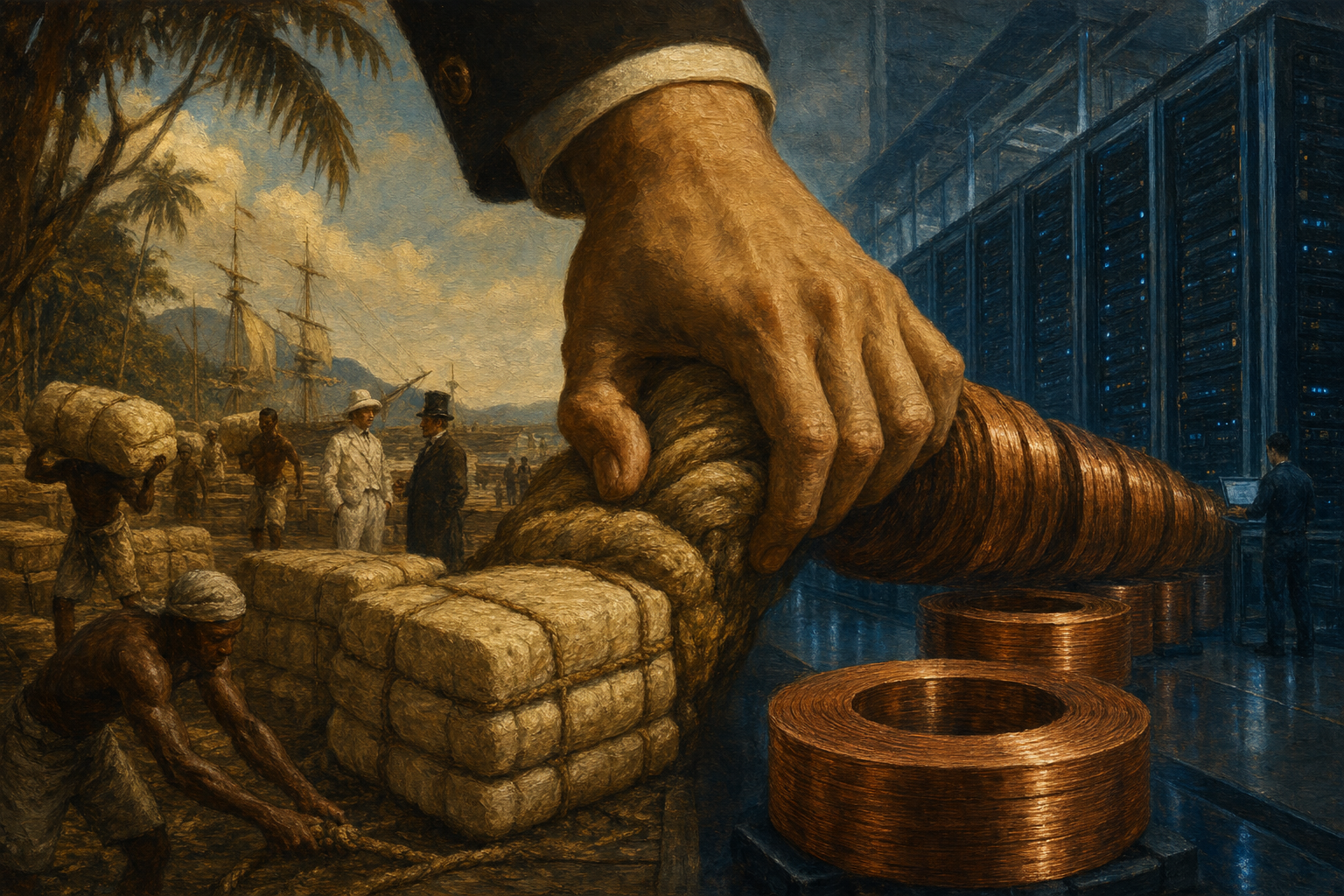
In 1925, the most valuable thing in America was not gold, and it was not oil. It was a milky sap that dripped from trees on the far side of the world. And a man in London had just worked out how to choke the supply.
Rubber. By the 1920s it was the lifeblood of the modern world. Every car rolled on it. Every factory belt was cut from it. Every telephone line was wrapped in it. And the trees that made it grew almost entirely in British colonies, in Malaya and in Ceylon. Britain controlled roughly three quarters of the world's rubber. America bought roughly three quarters of the world's rubber. One country grew it. The other could not live without it.
After the First World War, rubber prices collapsed, and the British planters were ruined. So they went to the Colonial Secretary, a rising politician named Winston Churchill, and asked him to save them. Churchill set up a committee, chaired by Sir James Stevenson. In November 1922 its plan became law. Britain would simply restrict how much rubber its colonies were allowed to export, and force the price back up.
It worked beyond anyone's dreams. Rubber that had sold for around thirteen cents a pound in 1920 climbed past a dollar by 1925, briefly touching a dollar twenty one. The planters were rich again. And across the Atlantic, America was being billed hundreds of millions of dollars a year for a product it could not make and could not do without.
One man took it personally. Herbert Hoover, the American Secretary of Commerce, called the scheme exactly what it was. A monopoly. A foreign hand in every American pocket. And Hoover did the one thing a cartel never expects its victims to do. Instead of just paying, and complaining, he went looking for a way out.
He told American manufacturers to reclaim old rubber and stretch every pound. He funded a survey of the whole tropical world to find somewhere, anywhere, that Americans could grow their own. The tyre magnate Harvey Firestone answered the call. In 1926 he signed a deal with the small West African republic of Liberia: a million acres, leased for ninety nine years, at six cents an acre. He hacked a vast plantation out of the jungle and named it Harbel, after himself and his wife. Henry Ford tried the same thing in the Amazon. And in laboratories, chemists began the long hunt for rubber that came from a test tube instead of a tree.
Here is how the story ends, and it is the part every cartel forgets. The Dutch had refused to join. Their own rubber colonies in the East Indies were free to plant as much as they liked, and they did. While Britain held its harvest back, Dutch rubber flooded in to fill the gap, and seized the very market Britain had vacated. The high prices meant to enrich Britain instead funded its rivals. By 1928 the scheme was a failure, and Britain scrapped it. The cartel had taught the whole world to live without it.
Now, a hundred years later, swap the trees for mines. The lifeblood of our age is not sap but metal: the copper that wires every data centre, and the rare earth elements buried inside every magnet, motor and missile. A single large AI data centre can swallow up to fifty thousand tonnes of copper. And the choke point is just as lopsided as it was in 1925. China now processes around ninety percent of the world's rare earths. And in recent years it has done exactly what Britain did with rubber: turned that control into a weapon, restricting exports of gallium, germanium and rare earth magnets to lean on the United States.
Washington's answer could have been written by Herbert Hoover himself. In February 2026 it stood up a strategic critical minerals reserve, a ten billion dollar buffer against the next squeeze, and began scouring the globe for friendly supply, for recycling, for substitutes. The same scramble. The same forgotten partners hauled back into the daylight. The same bet that you can engineer your way around a monopoly.
The lesson of the rubber war is not that the choke point is unbreakable. It is the opposite. Squeeze a customer hard enough, and you do not make him pay forever. You teach him, and everyone watching, exactly how to make sure he never needs you again.