Every day, we find the historical story hiding inside the headlines. Riveting narratives
that connect the past to the present, and make you wonder what happens next.
Choose your topics
You'll receive one email per topic, per day. Pick as many as you like.
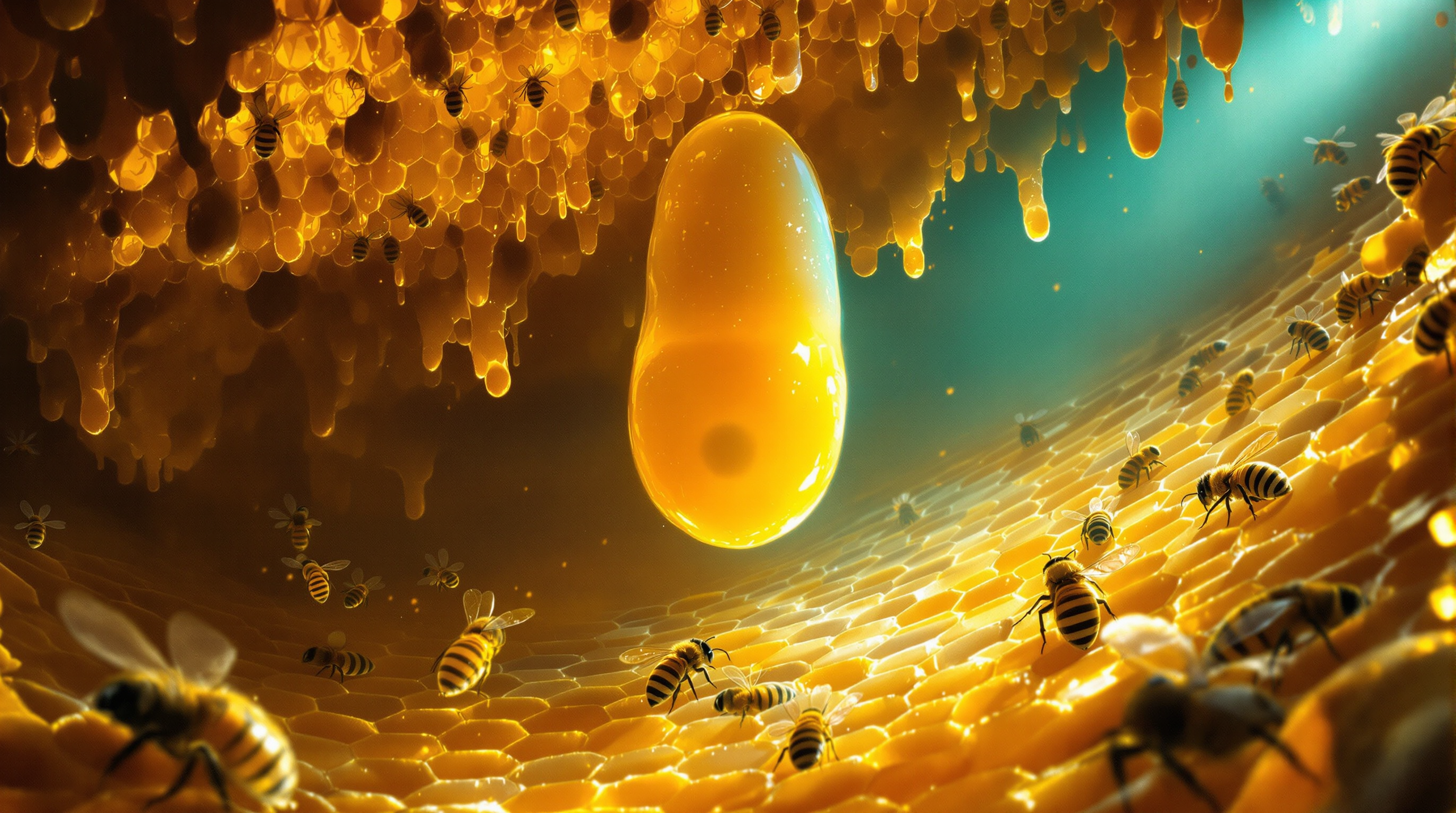
Queen and worker bees hatch from identical eggs, yet one lives for years and lays a million eggs while the others live for weeks and never breed. For a century the textbook answer was a single food: royal jelly. In 2026 a team at UC Riverside showed the real answer is grander. Specialised worker bees build the queen a palace: a peanut-shaped 'royal crib' of custom wax with its own chemistry, and they cluster to keep it warm. Raise a would-be queen in ordinary wax instead and she develops poorly and often dies. The jelly feeds her; the crib crowns her. We love a story with one secret ingredient. Nature almost never works that way.
•3 min readIn 2026 a team at the University of California, Riverside (its Center for Integrative Bee Research) showed that royal jelly alone does not make a queen: the environment does much of the work. A specialised caste of young worker bees acts as royal builders, constructing the large peanut-shaped 'royal crib' from a custom wax that is softer, melts at a higher temperature, and carries a distinct chemical signature of fatty acids and signals, and they alter their own physiology to raise the temperature around the cell, like underfloor heating. Crucially, when would-be queens were raised in ordinary worker-cell wax instead of the royal crib, the larvae developed poorly and many died: they needed the 'smell and feel' of the royal wax to transform at all. So queen determination is a whole system, diet plus architecture, temperature and wax chemistry plus the labour of many bees, not a single ingredient. It is a recurring lesson in biology: we love single-cause stories (one gene, one molecule, one food), but nature's marvels are usually built from many small causes acting together. A queen is built, not dosed.
In 1970 the physicist Louis Neel won the Nobel Prize and, in the same breath, called his own discovery useless. He had found antiferromagnetism: a hidden kind of magnetism where atomic magnets cancel out, so the material shows almost no field. A magnet you cannot feel. Decades later, that very property made it the perfect immovable anchor inside the read heads of hard drives, and the useless magnet became part of why the world can store everything. In 2026 the plot repeats with a brand-new third class of magnetism, altermagnetism, read out by a single flaw in a diamond. The most useless thing in physics is usually just the most early.
•3 min readIn 2026 the same plot is unfolding with a brand-new kind of magnetism. For nearly a century there were only two recognised classes, ferromagnetism and Neel's antiferromagnetism; then physicists confirmed a third, altermagnetism, which was named a top physics breakthrough of 2024 after experimental demonstration (including work at Johannes Gutenberg University Mainz using a facility at DESY). An altermagnet looks externally quiet like an antiferromagnet but has an internal structure (alternating moments paired with a rotation of the surrounding crystal) that gives it some ferromagnet-like usefulness, of strong interest for faster, denser memory. The catch is Neel's catch: because it hides its order, an altermagnet is fiendishly hard to detect. In April 2026 a team led by Jamir Marino at the University at Buffalo, publishing in Physical Review Letters, proposed using a nitrogen-vacancy (NV) centre in diamond (a defect where a carbon atom is replaced by nitrogen with an adjacent vacancy) as a quantum sensor: by measuring how the defect's spin relaxes in different directions (quantum relaxometry), one can fingerprint an altermagnet less invasively than existing methods. A quiet, useless-looking material, read out by a flaw in a gemstone, that the memory industry is betting will be the next revolution, exactly as Neel's hidden magnet was.
circa 126 AD to 1824, Roman concrete and its rediscovery
The Pantheon's unreinforced concrete dome has stood for nineteen centuries; the concrete we pour today crumbles in fifty years, and making its cement is roughly 8 percent of all human carbon emissions. The Romans built a stone that healed its own cracks and grew stronger in seawater, then took the recipe to the grave for a thousand years. In 2023 MIT finally explained it. In 2026 a team at Worcester Polytechnic went further, using an enzyme from our own blood to build a material that locks carbon away as it sets. The ancients did not always know more than us. Sometimes they just did better, and left us to work out why.
•3 min readIn 2026 a team at Worcester Polytechnic Institute (WPI) in Massachusetts unveiled an enzymatic structural material (ESM) that does what concrete never could: it is carbon-negative. Its key ingredient is carbonic anhydrase, the same enzyme in human red blood cells that helps the body exhale carbon dioxide. In the material, the enzyme accelerates a reaction of CO2, water and calcium to form solid calcium carbonate (the mineral of limestone and seashells), which becomes the structural framework; the material hardens within a few hours. A cubic metre of conventional concrete emits around 330 kilograms of CO2 in production, whereas a cubic metre of the new material sequesters roughly 6 kilograms, turning a carbon source into a carbon sink. It is suited to roof decks, wall panels and modular components. The echo of Rome is exact: the Romans, by accident, made a durable mineral stone that healed itself and strengthened in the sea but could not explain it; we spent two millennia forgetting and then re-understanding it, and are now engineering the idea on purpose and better, a stone that not only lasts but pays back the carbon it took to make.
We have walked on the Moon, mapped it and brought its rocks home, yet in 2026 we still have no complete map of what it is made of. On 30 November 1609 Galileo turned a telescope on the Moon and saw mountains and craters, proving it was a rough world, not the flawless heavenly sphere doctrine demanded. Four centuries on, a team at Tokyo Metropolitan University has shown that a lunchbox-sized X-ray telescope under ten kilograms could make the first complete chemical map of the entire lunar surface in about two years.
•3 min readIn June 2026 a team at Tokyo Metropolitan University reported that a lightweight X-ray telescope, weighing under 10 kilograms and about the size of a lunchbox, placed in lunar orbit, could finally make the first complete chemical map of the Moon. It exploits X-ray fluorescence: the Sun constantly bathes the Moon in X-rays, and when these strike the surface each element fluoresces with its own signature, which the telescope reads from orbit. Their simulations show a single small telescope could map five key elements (oxygen, iron, magnesium, aluminium and silicon) across the entire Moon in about two years at 70-by-70-kilometre resolution, with a 5-by-5 array improving resolution and shortening the time. A full chemical map matters for reading the Moon's deep history (the giant-impact origin) and for the resources (metals, oxygen, ice) that a permanent lunar base will need, just as a new race to the Moon gets under way. The recurring lesson is Galileo's: every time we look at the Moon with a sharper instrument, it becomes less of a symbol and more of a world.
For a century, the mystery of Stonehenge was not why it was built but how the stones got there. In 1923 the geologist Herbert Thomas matched the smaller bluestones to the Preseli Hills of Wales, over 200km away, proving Neolithic people hauled multi-tonne stones across southern Britain. The huge central Altar Stone was assumed Welsh too, until a 2024 study fingerprinted its mineral grains and traced it to northeast Scotland, more than 750km away and probably moved by sea: the longest journey of any stone in any known Neolithic monument.
•3 min readIn 2024 a team led by the geologist Anthony Clarke tested that assumption by fingerprinting the Altar Stone, not by appearance but by the radiometric ages of zircon, rutile and apatite grains locked inside it. The signature did not match Wales: it matched the Old Red Sandstone of the Orcadian Basin in northeast Scotland, more than 750 km away, with the stone probably transported in part by sea, the longest known journey of any stone in any Neolithic monument; it was likely placed around 2620 to 2480 BC, and follow-up work in 2025-26 has continued to narrow the precise source and debate the route. The finding rewrites the picture of Neolithic Britain: moving a six-tonne stone the length of the island implies not scattered, isolated farmers but a society laced by long-distance contact, seafaring, shared purpose and organisation capable of coordinating a project across the whole country without writing, metal tools or the everyday wheel. More broadly it is a lesson in how badly we underestimate the deep past: the instinct that assumed the nearest plausible source is the same instinct that imagines prehistoric people as simpler than they were, and it keeps being wrong.
In 1906 the psychiatrist Alois Alzheimer examined the brain of Auguste Deter, who had told him 'I have lost myself', and found the amyloid plaques and tau tangles that still define the disease. For 120 years we could see the plaques and do almost nothing to clear them. In June 2026 a Monash University team reported that a copper compound, Cu(ATSM), repaired the brain's clogged waste pump at the blood-brain barrier, cutting toxic amyloid about 42 percent and improving memory about 44 percent in mice. Preclinical, but a genuinely new approach: clearing the brain, not just blocking it.
•4 min readIn June 2026 a team at Monash University reported in ACS Chemical Neuroscience that the copper compound Cu(ATSM) takes a different approach from the failed drugs: rather than blocking amyloid production, it repairs the weakened P-glycoprotein pump at the blood-brain barrier, restoring the brain's own ability to clear amyloid. In mice bred to develop Alzheimer's, it reduced toxic amyloid-beta by about 42 percent and improved spatial learning by about 44 percent over roughly eight weeks, and may also activate microglia to degrade plaques. Two features make it notable: Cu(ATSM) has already passed human safety trials for Parkinson's disease and ALS (a potential fast track), and the strategy of restoring clearance is closer to the actual failure Alzheimer saw than a century of attempts to block production. The crucial caveat is that this is preclinical, in mice, and the history of Alzheimer's research is full of compounds that dazzled in mice and failed in humans, so it is a genuinely new mechanism and a reason for measured hope, not a cure.
Newton's third law, every action has an equal and opposite reaction, has been bedrock physics since 1687. Yet a flock of starlings appears to break it constantly: a bird reacts to the neighbours ahead of and beside it but not those behind, so action and reaction stop balancing. In June 2026 physicists in Dresden published a way to model these 'non-reciprocal' living systems, by adding mathematical 'imaginary partners'. The law was never wrong. It just marks the border where passive matter ends and self-driven, living matter begins.
•4 min readIn June 2026 a team of physicists in Dresden working with the theorist Roderich Moessner published in Nature Physics a method for handling non-reciprocal interactions efficiently, by introducing carefully designed 'imaginary partners', phantom agents that restore a hidden symmetry in the equations, allowing flocks, crowds and living tissues to be simulated with unprecedented accuracy. The work belongs to the fast-growing physics of 'active matter', the study of systems whose components convert energy into their own motion, which spans the swarming of cells in a healing wound or a growing tumour, the dynamics of panicked crowds, the schooling of fish, and the design of swarms of small robots. The deeper point is that Newton's third law was never wrong, it simply has a domain: it reigns over passive matter that only reacts, and quietly bends at the threshold of matter that drives itself, marking the border beyond which the physics of living things begins.
On 15 October 1991 a detector in the Utah desert recorded a single subatomic particle carrying the energy of a fast-thrown baseball, about 51 joules in one speck: the 'Oh-My-God particle', still the most energetic cosmic ray ever observed. It should not have been able to reach us, and 35 years later no one can say what made it. In 2021 a second giant, the Amaterasu particle, did the same, and in 2026 the hunt for the source, a starburst galaxy or perhaps ultra-heavy nuclei, is sharper than ever.
•4 min readThe decades-old mystery is sharper than ever in 2026. New analysis is trying to trace the Amaterasu particle's path to a nearby starburst galaxy after all, arguing the apparently empty source region is an artifact of incomplete maps, while other physicists argue these record-breakers may be ultra-heavy atomic nuclei rather than lone protons, which would rewrite the calculation of where they can come from and how they survive the journey; next-generation observatories are being designed to settle the question. Beneath the competing theories lies a staggering fact: somewhere in the universe there is a natural particle accelerator that dwarfs everything humanity has built by a factor of tens of millions, it is operating right now, and we cannot say with confidence what it is or even where it is.
On 6 April 1938 a young DuPont chemist, Roy Plunkett, opened a gas cylinder that gave no gas yet weighed full, sawed it open, and found Teflon: a material so stable nothing could dissolve, burn or stick to it, thanks to the carbon-fluorine bond, one of the strongest in nature. That indestructibility made it a miracle and a curse. Its PFAS relatives are now 'forever chemicals' in the blood of almost everyone alive. In June 2026 scientists found the first real way to break them: hydrogen radicals split from water by ultraviolet light.
•4 min readIn June 2026 a research team reported in the journal Environmental Science & Technology the first credible route to destroying PFAS without exotic additives. They found that hydrogen radicals, extraordinarily reactive fragments generated from ordinary water by intense ultraviolet light (most effective below 300 nanometres), attack PFAS molecules and strip their fluorine atoms one by one, breaking the supposedly unbreakable chains into smaller, less persistent compounds. The finding overturns earlier assumptions about which reactive species drive PFAS breakdown, though the process is still slow and can leave intermediate byproducts, so it is not yet a complete solution. The deeper point is that the very property humanity celebrated in Teflon, its near-perfect stability, is the same property that turned its chemical family into permanent pollution inside our own bodies: the miracle and the curse were one property, embraced for decades before anyone asked what 'indestructible' would mean once the substances were loose in the world.
In December 1930 Wolfgang Pauli proposed a particle he was ashamed of: neutral, almost massless, and, he feared, impossible to ever detect. He called it a desperate remedy and bet a case of champagne no one would find it. It took 26 years to catch, it turned out to have mass (cracking physics' best theory), and in June 2026 the largest detector ever built, deep under a hill in China, measured it more precisely than anyone in history.
•5 min readIn June 2026 the Jiangmen Underground Neutrino Observatory (JUNO), a 20,000 tonne liquid-scintillator detector about 700 metres underground in Guangdong, China, and the largest detector of its kind ever built, published its first physics result in Nature. From just 59 days of data (26 August to 2 November 2025) the collaboration measured two key neutrino-oscillation parameters to roughly 1.6 times the precision of all previous experiments combined, and demonstrated readiness to pursue its main goal: determining the neutrino mass ordering. That ordering feeds into one of the deepest open questions in physics, why the universe is made of matter rather than nothing. The particle Pauli was ashamed to invent, and was sure could never be found, has become the most-hunted ghost in physics, with cathedral-scale detectors built underground to study it, and at least three of its secrets (mass ordering, absolute mass, and whether it is its own antiparticle) still unclaimed.
In 1909, a young Japanese scientist injected a rabbit with the six hundred and sixth compound in a numbered series, one his colleagues had already declared useless and shelved. By morning the syphilis was retreating. Paul Ehrlich's magic bullet was real, the first synthetic cure and the birth of chemotherapy. In June 2026, a drug called daraxonrasib finally hit KRAS, the cancer target everyone had called undruggable for forty years, using the very same logic.
•5 min readKRAS, first identified as a human oncogene in 1982, is mutated in more than 90 percent of pancreatic cancers (among the deadliest of cancers) and large fractions of lung and colorectal cancers. For roughly forty years it was considered the archetypal 'undruggable' target, because the RAS protein is structurally smooth and lacks the deep binding pockets that small-molecule drugs normally exploit; company after company tried and failed. In 2026 that changed. The Phase 3 RASolute 302 trial of daraxonrasib, a RAS(ON) inhibitor from Revolution Medicines, was presented at the ASCO Annual Meeting in late May 2026 and published in the New England Journal of Medicine: in previously treated metastatic pancreatic cancer it nearly doubled median overall survival, about 13.2 months versus roughly 6.7 months for chemotherapy. The drug works not by forcing a fit into a pocket that does not exist, but by binding the cellular helper protein cyclophilin A, which then clamps onto the active (ON-state) RAS protein and shuts down its signalling: a 'molecular glue' that reaches an unreachable target. It is Paul Ehrlich's magic-bullet logic, designing one molecule to find and stop one target, applied a hundred and sixteen years later to a target everyone had declared impossible.