Every day, we find the historical story hiding inside the headlines. Riveting narratives
that connect the past to the present, and make you wonder what happens next.
Choose your topics
You'll receive one email per topic, per day. Pick as many as you like.
Today's Echo · History & Current Events
1922 to 1928, the British Empire and the United States
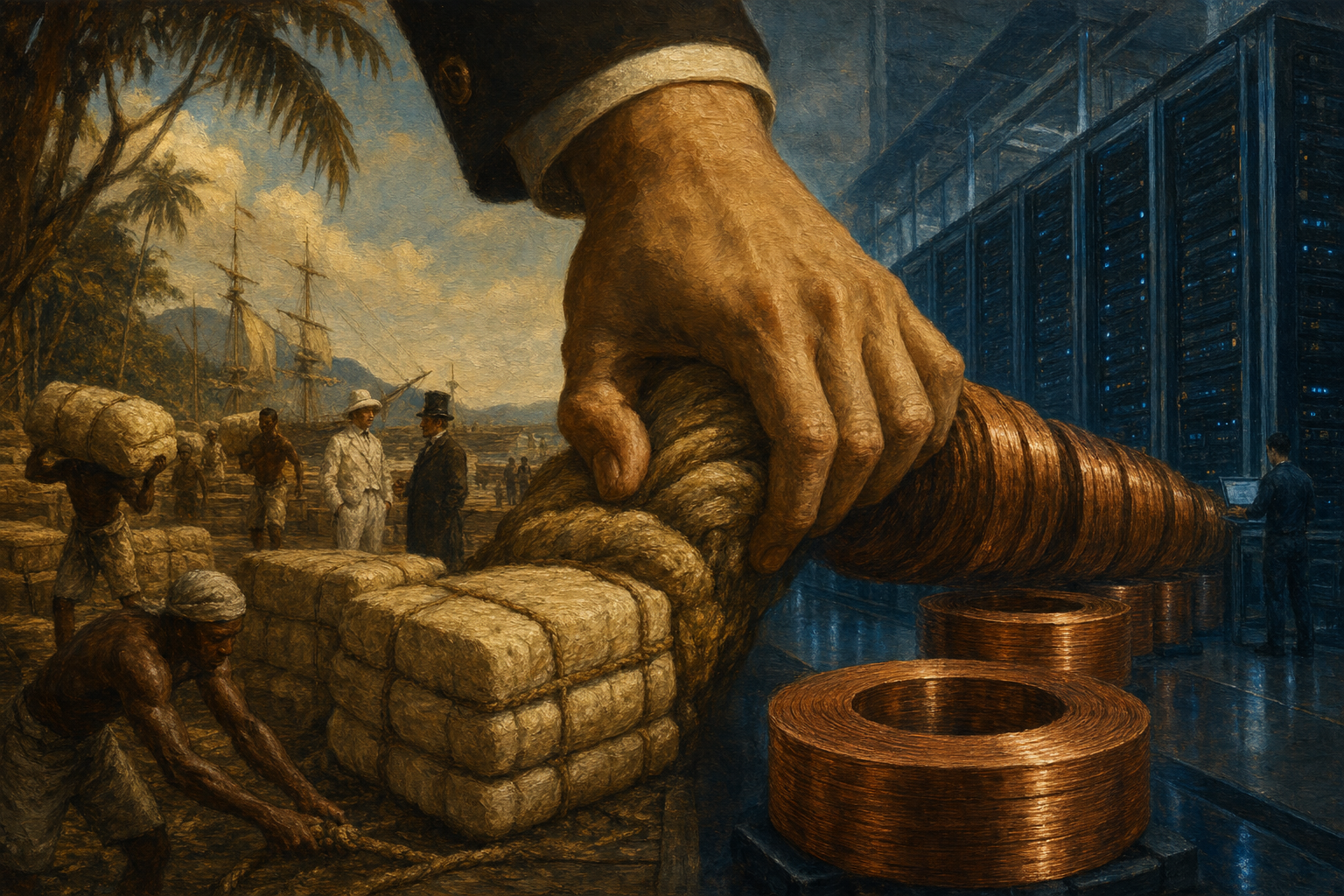
In 1925 the most valuable thing in America was a milky sap from trees on the far side of the world. Rubber ran every car, factory and phone line, Britain's colonies grew about three quarters of it, and Britain had just choked the supply: the Stevenson Plan restricted exports to drive the price from around thirteen cents a pound past a dollar. America, which bought most of the world's rubber, did not just pay. Commerce Secretary Herbert Hoover funded a global hunt for new supply, Harvey Firestone planted a million acres of Liberia, chemists chased synthetic rubber, and the cartel collapsed when the Dutch refused to join and flooded the market. Squeeze a customer hard enough and you do not make him pay; you teach him to never need you again. A century later it is copper for AI data centres and China's grip on rare earths, and the same scramble has begun.
•3 min readA century later the same dynamic has returned with metal instead of sap. The lifeblood of the AI age is copper (a single large AI-ready data centre can require up to about 50,000 tonnes) and rare earth elements used in magnets, motors and weapons. Analysts forecast a structural refined-copper deficit (J.P. Morgan projecting roughly 330,000 tonnes for 2026), with new mines averaging about 17.9 years from discovery to production. The choke point is as lopsided as rubber was in 1925: China processes around 90 percent of the world's rare earths and has used that control as leverage, prohibiting exports of gallium and germanium to the US from December 2024 and adding medium and heavy rare earths and magnets to its export-control list through 2025. Washington's response could have been written by Hoover: in February 2026 it launched a Strategic Critical Minerals Reserve (Project Vault), backed by a $10 billion EXIM loan, and pressed a global search for friendly supply, recycling and substitutes. The lesson of the rubber war is not that a choke point is permanent but the opposite: squeeze a customer hard enough and you teach him, and everyone watching, how to make sure he never needs you again.
Queen and worker bees hatch from identical eggs, yet one lives for years and lays a million eggs while the others live for weeks and never breed. For a century the textbook answer was a single food: royal jelly. In 2026 a team at UC Riverside showed the real answer is grander. Specialised worker bees build the queen a palace: a peanut-shaped 'royal crib' of custom wax with its own chemistry, and they cluster to keep it warm. Raise a would-be queen in ordinary wax instead and she develops poorly and often dies. The jelly feeds her; the crib crowns her. We love a story with one secret ingredient. Nature almost never works that way.
•3 min readIn 2026 a team at the University of California, Riverside (its Center for Integrative Bee Research) showed that royal jelly alone does not make a queen: the environment does much of the work. A specialised caste of young worker bees acts as royal builders, constructing the large peanut-shaped 'royal crib' from a custom wax that is softer, melts at a higher temperature, and carries a distinct chemical signature of fatty acids and signals, and they alter their own physiology to raise the temperature around the cell, like underfloor heating. Crucially, when would-be queens were raised in ordinary worker-cell wax instead of the royal crib, the larvae developed poorly and many died: they needed the 'smell and feel' of the royal wax to transform at all. So queen determination is a whole system, diet plus architecture, temperature and wax chemistry plus the labour of many bees, not a single ingredient. It is a recurring lesson in biology: we love single-cause stories (one gene, one molecule, one food), but nature's marvels are usually built from many small causes acting together. A queen is built, not dosed.
Cambridge MA, 1941: a 41-year-old Hungarian-American physical chemist named Maria Telkes is pulled from MIT onto a US Office of Scientific Research and Development emergency task to design a portable solar still for downed Navy airmen. By 1944 her inflatable plastic still is standard equipment on every US Navy lifeboat. 84 years later, a University of Rochester team runs the same thermodynamics on a femtosecond-laser-etched black-metal panel and proposes turning desalination plants into mineral mines.
•5 min readOn 30 May 2026, Light: Science and Applications (vol 15 article 246) published 'Mineral-rich additive-free solar desalination without brine,' led by Chunlei Guo at the University of Rochester Institute of Optics. The team's femtosecond-laser-etched, superwicking, black-metal panel runs Telkes's 1942 evaporation-condensation thermodynamics on a flat industrial-scale surface, with the additional engineering trick that the coffee-ring effect migrates salt deposits away from the working evaporation zone to a passive collection region of the panel. The team recovered approximately 100 percent of the dissolved salts in solid crystalline form, eliminating the hyper-saline brine waste stream that has constrained industrial desalination since the 1960s. The recovered salts were tested on seawater from three continents and are mineral-rich enough to be a candidate source of battery-grade lithium and rare-earth elements. The Rochester paper proposes turning desalination plants from marine-damage point sources into combined fresh-water and mineral-recovery operations.
April 1189 to April 1190, Saladin's year-long siege of Beaufort Castle and the post-Hattin Ayyubid reconquest of the Levant
Sunday 31 May 2026: the Israeli Golani Brigade raised the Israeli flag over Beaufort Castle in southern Lebanon for the first time in 26 years. The same limestone hilltop has changed hands between every regional power that has wanted to control southern Lebanon for 850 years. The castle has not changed. The wars at its foot have.
•6 min readSunday 31 May 2026: Israeli Golani Brigade raises the Israeli flag over Beaufort Castle in southern Lebanon, first time in 26 years. Same hilltop has changed hands every century since 1189. Castle has not changed. Wars at its foot have.
Late 1635 to spring 1637, the Dutch tulip mania and the Calvinist pamphlets that constructed its memory
Haarlem, spring 1637: a Calvinist printer publishes a satirical dialogue ridiculing tulip speculators. Two centuries later it is summarised by a Victorian journalist. May 2026: the IMF, the Bank of England, Goldman Sachs and JPMorgan all reach for the same metaphor to describe the AI capex cycle. The metaphor was built to do moral work, not financial diagnosis.
•6 min readMay 2026: Bank of England, IMF, Goldman Sachs and JPMorgan all weigh in on the AI capex cycle. The reflexive metaphor: tulip mania. The historical record of the 1637 tulip episode is not what the metaphor assumes.
May to October 1958, the Lebanese crisis and Operation Blue Bat
Khalde, 15 July 1958: the first US Marines of Operation Blue Bat landed on a Lebanese beach full of sunbathers and brokered a new president inside three months. Beirut, May 2026: the same constitution is again deadlocked, this time over expat voting and a parallel Israeli air campaign. The compromise being negotiated this month is the seventh round.
•7 min readBeirut, May 2026: Lebanon's elections deadlocked over expat voting; Western Quintet urging postponement; Israel intensifying southern Lebanon strikes (19 killed 28 May). Same machine that produced Operation Blue Bat, July 1958.
November 1973 to March 1975, the Mariner 10 mission to Venus and Mercury and the Mariner 10 imaging-team led by Bruce Murray at JPL
Pasadena, 29 March 1974: a 42-year-old Caltech geologist named Bruce Murray watches the first close-up photograph of Mercury appear frame-by-frame on the Mariner 10 imaging-team console at JPL. Mercury turns out to be a thoroughly cratered airless rock. Fifty-two years later, a Harvard-Smithsonian and Max Planck team using JWST mid-infrared spectroscopy looks at LHS 3844 b, a super-Earth 48 light-years away, and finds the same thing.
•5 min readOn 4 May 2026 a multi-institution team led by Sebastian Zieba (Harvard-Smithsonian Center for Astrophysics) and Laura Kreidberg (Max Planck Institute for Astronomy, Heidelberg) published in Nature Astronomy 'The dark and featureless surface of rocky exoplanet LHS 3844 b from JWST mid-infrared spectroscopy.' Using more than 100 hours of JWST MIRI thermal-emission spectroscopy at multiple orbital phases of the tidally-locked super-Earth, the team ruled out any thick atmosphere on LHS 3844 b (with 5-sigma upper limits of 100 mbar bulk gas and 3-sigma upper limits of 10 microbars on spectroscopically active species like SO2) and identified the surface as a dark, space-weathered basalt similar in spectral character to Mercury and the lunar maria. It is the first JWST result to directly characterise the surface of a rocky exoplanet rather than its atmosphere. Mariner 10's airless cratered Mercury, 52 years later, has become the first identifiable category of object in the small-rocky-exoplanet population.
April 1999 to September 2008, the exile and return of Benazir Bhutto
Panama City, 23 May 2026: María Corina Machado announces from exile that she will return to Venezuela and run again for the presidency by the end of the year. Karachi, 18 October 2007: Benazir Bhutto's truck inched along Sharae Faisal Road at less than a kilometre an hour. Two suicide vests detonated near midnight. The procession through the city is the dangerous part of the return.
•6 min readPanama City, 23 May 2026: Venezuelan Nobel laureate María Corina Machado announces from exile her return and renewed presidential bid by end-2026. Same geometry as Benazir Bhutto's October 2007 return to Karachi.
1890 to 1921, Viborg in central Jutland Denmark and the spread of bird ringing through northern Europe
Viborg, Denmark, the breeding season of 1899: a Danish classics master named Hans Christian Cornelius Mortensen fits 165 starlings with home-made aluminium leg rings, stamped with his school address and an individual number. It is the first scientific bird ringing. 127 years later a Royal Society Open Science paper reads the same principle off the natural fluke pigmentation of two humpback whales that crossed 14,000 km of ocean between Australia and Brazil.
•4 min readOn 1 May 2026, in Royal Society Open Science (vol 13 issue 5 article 260251), a multi-institution team led by Cristina Castro Ayala of the Instituto Aqualie in Brazil and Ted Cheeseman of the citizen-science platform Happy Whale published 'First evidence of bidirectional exchange between distant humpback whale breeding populations in eastern Australia and Brazil.' Working from a 19,283-photograph database of humpback whale tail-flukes collected between 1984 and 2025 and cross-matched by an automated image-recognition algorithm with manual confirmation, the team confirmed two individual humpback whales had each crossed approximately 14,200 km and 15,100 km of open ocean between sightings in the Australian and Brazilian breeding grounds. The crossings represent approximately 0.01 percent of identified individuals and are the first documented bidirectional exchange between those two populations. The underlying principle, that an individual animal's permanent unique mark (an aluminium ring in 1899, a natural fluke pigmentation pattern in 2026) can be used to track its movements at scale, is the principle Mortensen invented at his kitchen table.
September 1954 to June 1977, the lifespan of the Southeast Asia Treaty Organization
The Quad foreign ministers met in Delhi on 26 May 2026 and produced three concrete deliverables: a Fiji port, an undersea cable initiative, a critical-minerals framework. The same kind of public works the Southeast Asia Treaty Organization produced in 1955-62. SEATO was killed by a US president going to Beijing in 1972. The current US president has already been there.
•7 min readDelhi, 26 May 2026: Quad foreign ministers (Rubio, Wong, Motegi, Jaishankar) produce three concrete deliverables — Fiji port, undersea cable initiative, critical-minerals framework — the SEATO pattern, 72 years apart, same containment logic.
June 1944 to March 1945, the V-1 and V-2 Vergeltungswaffen campaign against London
Russia launched its largest attack of the war on Kyiv on 24 May 2026: 90 missiles, 600 drones, the third use of the Oreshnik ballistic missile. The historical pattern is the V-1 and V-2 Vergeltungswaffen on London 1944-45. The war ends anyway; the technology defines the next eighty years.
•6 min readKyiv, 24 May 2026: Russia's largest single attack of the war. 90 missiles, 600 drones over five hours. Third operational use of the Oreshnik IRBM. 12 dead, ~150 injured. The V-2 of 2026.
1665 to 1672, Woolsthorpe Manor in Lincolnshire and Trinity College Cambridge during and after the plague-year closure
Summer 1666, Woolsthorpe Manor in Lincolnshire: Cambridge is closed by plague and the 23-year-old Isaac Newton drills a hole in his bedroom shutter, puts a prism in the beam of sunlight, and concludes that white light contains all the colours. Three hundred and sixty years later, a Xiamen laboratory feeds the same sunlight through a different crystal and shows it also contains Bell-violating quantum entanglement.
•5 min readOn 24 April 2026 a team led by Wuhong Zhang and Lixiang Chen at the College of Physical Science and Technology at Xiamen University published in Advanced Photonics 'Sunlight-excited spontaneous parametric down-conversion for ghost imaging.' They used a sun-tracking heliostat and a 20-metre multimode optical fibre to feed ordinary incoherent sunlight into a periodically poled potassium titanyl phosphate (PPKTP) nonlinear crystal that split individual sunlight photons into entangled pairs. An independent team at the Max Planck Institute for the Science of Light and the University of Ottawa (including Robert W. Boyd) reported on arXiv that the sunlight-generated pairs violate Bell's inequality with S=2.54, comfortably above the classical bound. The sunlight Newton dispersed through a prism in 1666 turns out to also contain measurable Bell-violating quantum entanglement, free of charge, and has been arriving at Earth's surface for as long as the sun has been shining.