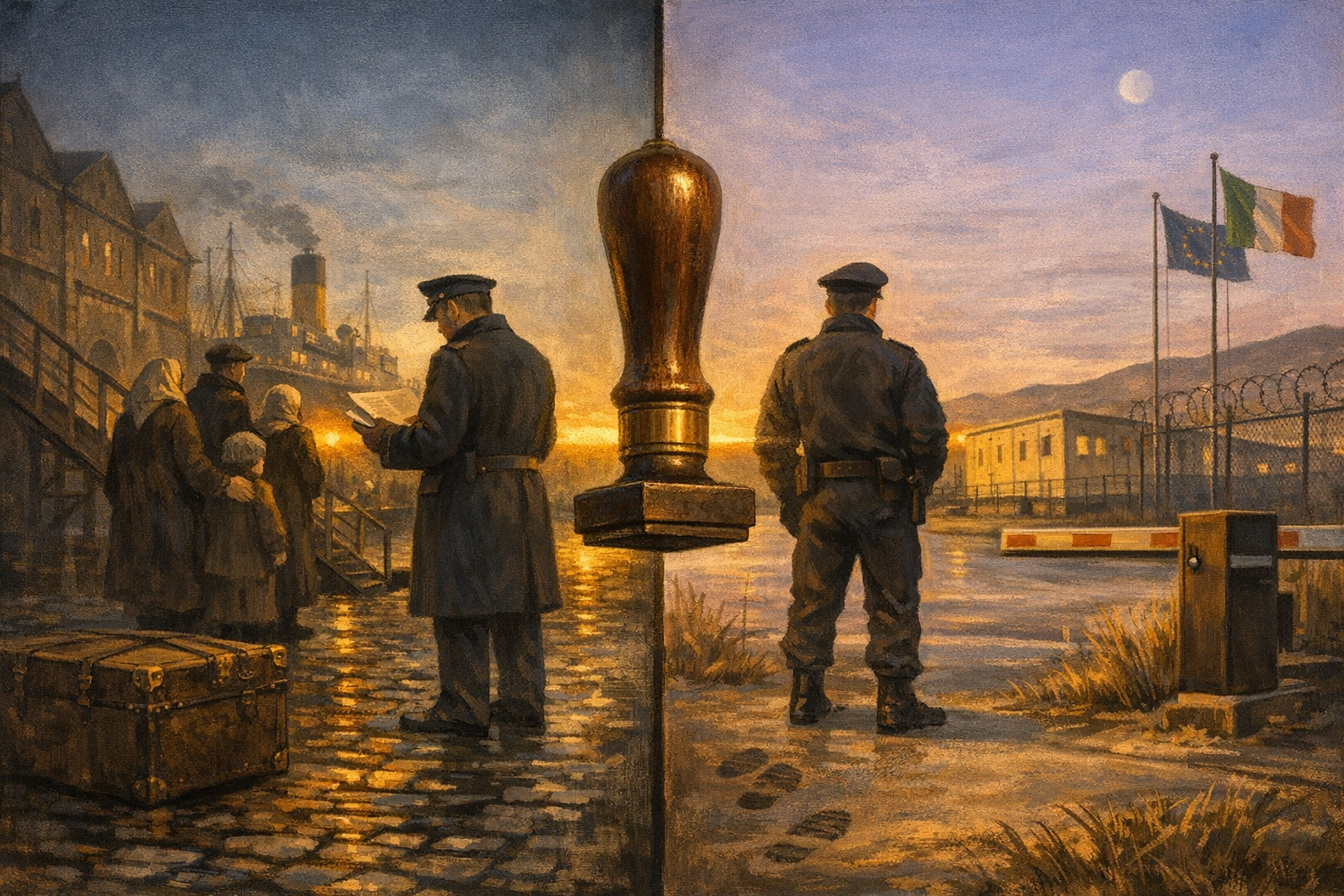
The London committee room, on a damp morning in July 1902. A man with the long black beard of a Viennese journalist took the witness chair, gave his name as Doctor Theodor Herzl, and waited to be questioned. He had paid his own passage from Vienna to give the British Royal Commission on Alien Immigration the unsolicited benefit of his views on what to do about the Jews flooding into the East End. He had come with a proposal.
He told the commissioners, with patient courtesy, that the Jews of Eastern Europe could not stay where they were. They would come west whether the British liked it or not. The British could pretend otherwise and pass laws to keep them out, but the laws would not work; and they would, by Herzl's prediction, generate antisemitism in Britain itself. There was a solution. Find the Jews a country of their own. Argentina would do. Palestine would be better.
The commissioners thanked him. The shorthand transcript survives. Three years later, the law he had warned against passed.
Britain had not had peacetime immigration controls since 1826. Anyone who could reach a British port could walk off the boat.
Then, on 13 March 1881, a People's Will bomb went off under Tsar Alexander II's carriage on the Catherine Canal in Saint Petersburg, and the Russian Empire's relationship with what was then the largest Jewish population on earth lurched, in the space of a season, from indifferent oppression to active malice. Within weeks the first pogroms began. They went on, intermittently, for two decades. The imperial centre officially condemned them. The local police did the killing's logistics.
Over the next quarter-century, roughly 120,000 Jewish refugees from Russian Poland, Lithuania and Ukraine left everything they owned, made the trek across the German plain to Hamburg or Bremen, and bought steerage tickets on the next boat going west. The 1901 British census found 95,425 of them living in the United Kingdom, almost all in two adjoining East London districts: Whitechapel and Stepney.
The East End was already poor. The newcomers took the worst housing, the longest hours, the lowest wages. Rents doubled in fifteen years. The tailoring sweatshops of Brick Lane filled with Yiddish. By 1900 the white working-class residents of Mile End and Bethnal Green had concluded that they had been replaced in their own city by people who would not even speak English in the public street.
In May 1901, a retired captain named William Stanley Shaw stood up at a thousand-strong meeting in the East End and founded the British Brothers' League. The slogan was simple: England for the English. The proposal was a law to keep the foreigners out. Within a year the League claimed ten thousand members and a rally cry that, recorded in the pages of The Times, sounds now as it sounded then.
Its parliamentary champion was a retired Indian-army major named William Evans-Gordon, elected Conservative MP for Stepney in 1900 on an explicitly anti-immigrant ticket. He wrote a book about his constituency called The Alien Immigrant and assembled a committee of fellow East End Tories pledged to vote for restriction. The Liberal opposition blocked everything he tried.
Then, in July 1902, Arthur Balfour became Prime Minister and the political weather changed. Balfour was a philosopher who had written two books on the metaphysics of religious doubt and an aristocrat who believed in inherited civilisations and their inherited limits. Within months his government set up a Royal Commission on Alien Immigration to consider whether the door should be shut.
The Commission sat through the winter of 1902 and into the summer of 1903. It heard Herzl. It heard the Anglo-Jewish establishment, who urged caution and feared a backlash. It heard East End landlords, charity workers, ship's captains. By April 1903 it was drafting its recommendations.
Then Kishinev happened.
In the Bessarabian capital, between 19 and 21 April 1903, on the last day of Passover and the first of Russian Easter, a mob spent the better part of three days hunting Jews through the streets. They killed forty-nine, raped many of the women they caught, and left around fifteen hundred Jewish homes wrecked. The local police did not intervene. The London papers ran photographs of the mortuary. The Commission's draft, presented in August, recommended restriction.
Balfour's first Bill, in 1904, was destroyed in committee by a coalition of Liberals and Labour men obstructing in every parliamentary form known to Erskine May. A young Oldham MP named Winston Churchill, that May about to cross the floor to the Liberals, made it his cause and won. The government withdrew the Bill.
They came back in 1905 with a softer one. An Immigration Officer would meet every steerage passenger at the dock. The passenger could be refused as an "undesirable alien" if he was a pauper, was diseased, or had a criminal record, and could appeal to an Immigration Board appointed by the Home Secretary. A clause inserted to buy Liberal votes preserved the right of asylum for those fleeing "religious or political persecution".
Balfour, opening the second reading, told the House that the country had suffered "the undoubted evils that had fallen upon it from an immigration which was largely Jewish". The Bill passed. Royal assent, 11 August 1905. The first general peacetime immigration control of the modern British state came into force on the first day of 1906.
It did not, as a piece of immigration restriction, work. The Immigration Boards turned away 7,594 people between 1906 and 1913, out of an annual flow of more than two hundred thousand alien steerage passengers. The peak rejection rate, in 1909, was six and a half per cent. The other ninety-three and a half per cent walked off the boats. Most of the East End Jewish migration of the Edwardian period happened after Balfour signed his Act.
What the Act did achieve, with quiet efficiency, was the strangling of the asylum exception. In 1906 the boards granted political asylum to 505 refugees. By 1908, twenty. By 1910, five. The Liberal saving clause held in form. It did not hold in practice.
What the Act did, perfectly, was build the apparatus. The Immigration Officer, the Immigration Board, the registration register, the deportation order, the category of "undesirable alien", the procedural standard of proof, the asylum exception narrowed by Order in Council to the vanishing point: all of it came into existence in August 1905 and never went away. The infrastructure was for the centuries.
On 5 August 1914, the day after the United Kingdom declared war on Germany, Parliament passed the Aliens Restriction Act in a single sitting. It used Balfour's 1905 architecture to intern every German and Austro-Hungarian national living on British soil. When the war ended, the wartime emergency was supposed to expire. It did not. The Lloyd George coalition passed the Aliens Restriction (Amendment) Act 1919, royal assent 23 December, which carried the wartime regime into peacetime, added a power to deport without right of appeal, and was renewed by Parliament every year for a generation. The door, shut in 1905, was now sealed.
In January 1933 Adolf Hitler became Chancellor of Germany, and the sealed door was the architecture available to the Jews of Berlin, Vienna and Prague who wanted out. It admitted some. Britain took in roughly seventy thousand refugees between 1933 and 1939, including the ten thousand children of the Kindertransport: a record that compares respectably to almost any other contemporary government, which is the same as saying that the world in those years was very small.
It refused a great many more. The aliens regime gave the Home Office an absolute discretion to refuse a visa to any applicant for any reason or for none. The Office used the discretion. The legal instrument it used was the law Balfour had signed in 1905 to keep out their parents.
On Monday evening, 1 June 2026, at the Berlaymont headquarters of the European Commission in Brussels, the negotiators for the Commission, the Council and the European Parliament closed the trilogue on the EU's new Pact on Migration and Asylum and shook hands for the photographers.
The Pact takes effect on Thursday 12 June. It permits any member state to deport rejected asylum-seekers to "return hubs" in third countries, extends maximum administrative detention, expands entry bans, authorises seizure of migrants' personal property, and allows compulsory biometric collection, including from children. It designates Bangladesh, Colombia, Egypt, India, Kosovo, Morocco and Tunisia as "safe countries of origin" against which an asylum claim is presumed inadmissible. A €420 million fund will help Greece and Italy hold the southern frontier.
"We will ensure that those who have no right to stay in the EU are actually returned," said the Pact's principal author, Magnus Brunner, the Austrian centre-right politician who sits in the Berlaymont as the EU's home affairs commissioner.
Brunner's prototype has been running for over a year. Giorgia Meloni opened two centres on the northern Albanian coast, at Shëngjin and Gjadër, designed to process up to thirty-six thousand asylum cases a year. They hold fewer than a hundred people. Italian courts have ordered them emptied repeatedly on procedural grounds. The infrastructure is a costly Italian embarrassment. The EU has decided to scale it.
Rights groups and the UN High Commissioner for Refugees have warned that the new architecture will endanger lives. They are probably right. They are also making the wrong objection. Most of the people the Pact is sold as a wall against will still come. The Tunisian arrangement leaks. The Egyptian one leaks. The Albanian centres are nearly empty. The numbers refused at the formal door will be a small fraction of those who arrive. The architecture is for the centuries.
Arthur Balfour was a clever and rather a cold man. He did not believe his Aliens Act would solve the question of where Europe's Jews would, in the end, have to go. He had a second plan.
On 2 November 1917, as Lloyd George's Foreign Secretary, he signed a 67-word letter to Lord Walter Rothschild declaring that His Majesty's Government viewed with favour "the establishment in Palestine of a national home for the Jewish people".
The same statesman who had shut the British door in 1905 had now opened a different one, in the Eastern Mediterranean, for the same applicants. Balfour wrote in 1919 that the Zionist movement would mitigate the "age-long miseries" created for Western civilization by the presence in its midst of a body it could "neither expel nor absorb." It is the most antisemitic argument ever made for Zionism, and it was made by its most consequential British supporter.
Theodor Herzl, who had told the Royal Commission this conclusion would be reached, was thirteen years dead.
The Pact takes effect on Thursday. The people for whom its return hubs will, in the end, be used are not in any newspaper yet. We do not know their names. We do not yet know what they will be fleeing. We do know that, when they arrive, the apparatus we built last week will be waiting.