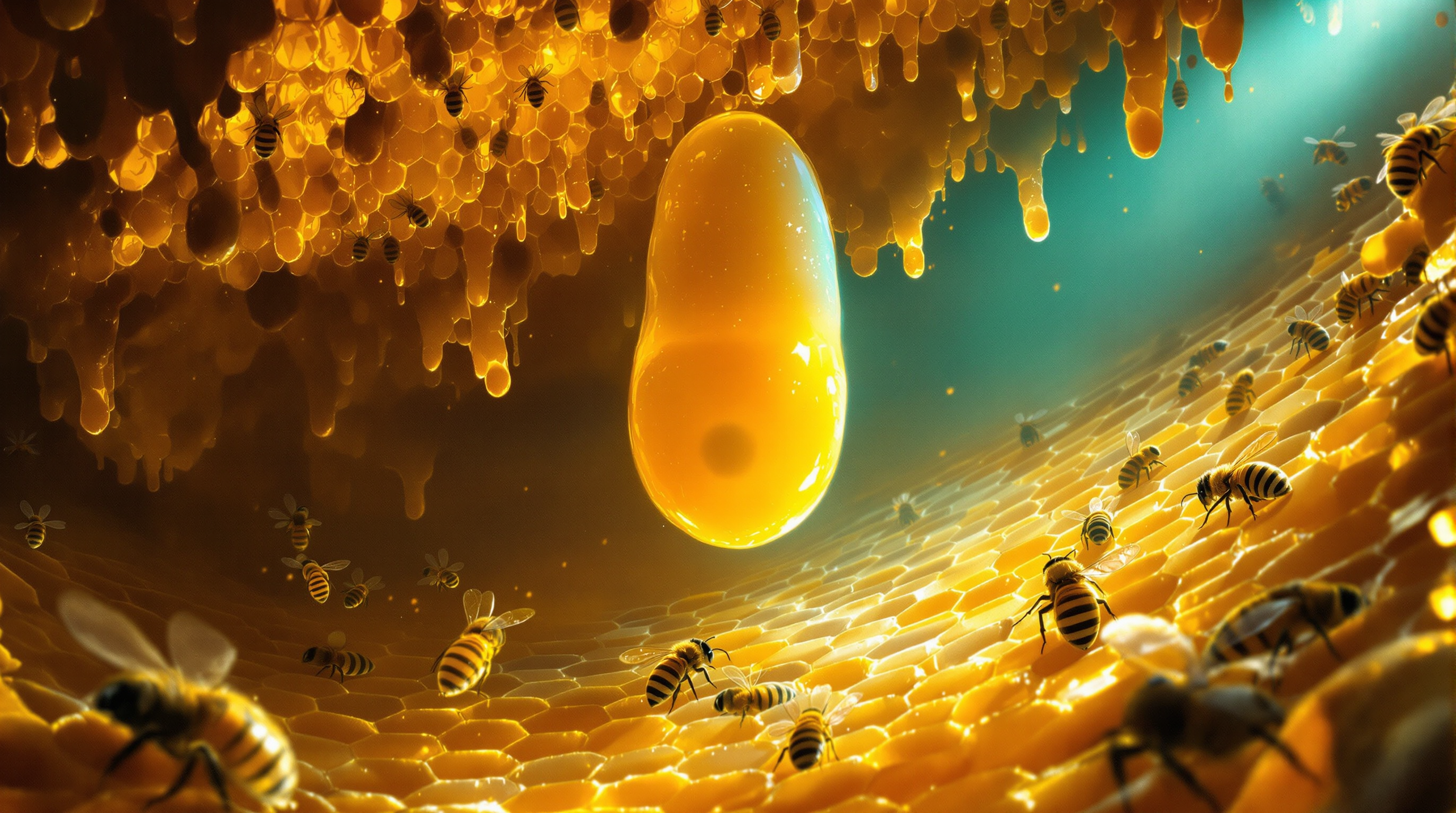
Deep inside a beehive hangs a single cell shaped like a peanut, bigger than all the others, and inside it a grub is becoming a queen. Around her, in the ordinary little six-sided rooms, her sisters are becoming workers. They hatched from identical eggs. Their genes are the same. And yet one will live for years and lay a million eggs, and the others will live for weeks and never breed at all. For a hundred years, we thought we knew the one thing that made the difference.
The answer everyone learned was royal jelly. Nurse bees feed a chosen larva enormous amounts of this rich, milky food, and that flood of royal jelly, the story went, switches her onto the path to royalty. Feed a larva less of it, and she stays a worker. One food, one fate. It was tidy, it was teachable, and it turned royal jelly into a health-shop legend sold in little jars.
The science seemed to seal it. In 2011 a researcher named Masaki Kamakura reported that a single protein in royal jelly, which he called royalactin, could by itself drive a larva to become queen-like. Here, it seemed, was the magic ingredient, named and bottled. One molecule to make a monarch.
But it never quite held together. Other labs struggled to repeat the clean result. And the more biologists looked, the harder it was to believe that turning one genome into two utterly different animals could come down to a single spoonful of anything.
In 2026, a team at the University of California, Riverside finally showed what else is going on, and it is far stranger and grander than a special food. The secret is not just what the queen eats. It is the house she is raised in.
The researchers found that a specialised group of young worker bees act as royal builders. They do not merely feed the chosen larva. They construct her a palace: that peanut-shaped cell, the queen crib, made from a custom wax quite unlike the wax of an ordinary room. It is softer, it melts at a higher temperature, and it carries its own chemical signature of special fatty acids and signals. The builders even change their own bodies to crank up the warmth around the royal cell, raising the temperature like underfloor heating in a nursery.
And the house turns out to matter as much as the food. When the team raised would-be queens in ordinary worker wax instead of the royal crib, the larvae developed poorly and many of them simply died. They needed the smell and the feel and the warmth of the royal wax to make the transformation at all. The jelly feeds her. The crib crowns her.
So the famous one-ingredient story was never the whole truth. A queen is not made by a magic food poured into a passive grub. She is made by a whole system: the diet, yes, but also the architecture, the temperature, the chemistry of the walls, the labour of dozens of bees building and heating and tending. Take away any part of it and the queen does not appear.
It is a lesson biology keeps teaching and we keep forgetting. We love a story with a single secret ingredient, one gene, one molecule, one food that explains the whole wonder. Nature almost never works that way. The marvels around us are usually built, not dosed, assembled by many small causes acting at once.
We spent a century crediting the jelly. All along, the bees were also building a palace, and warming it with their own bodies, for a queen who could not have become one without it.