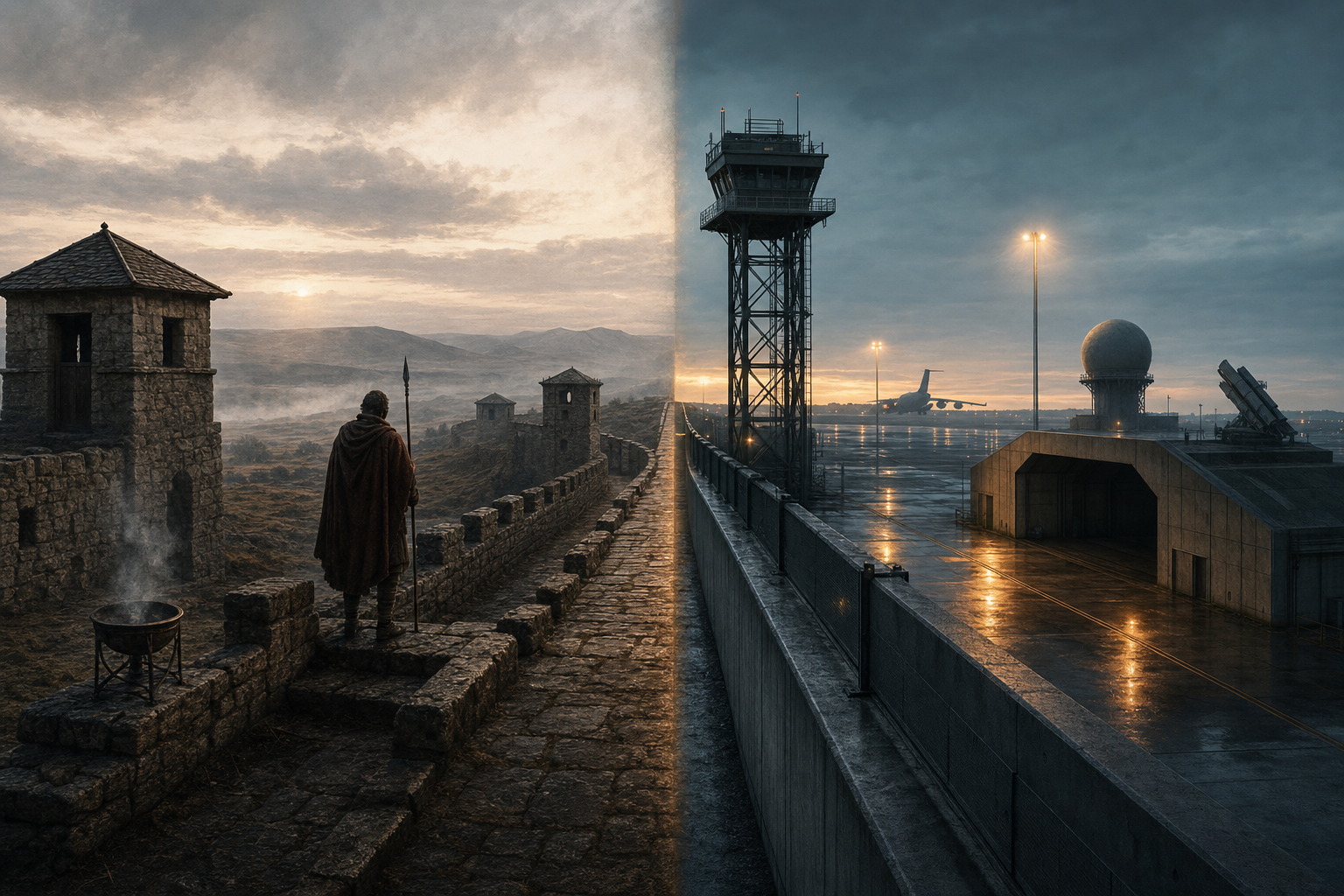
Sometime around the year 410, a reply reached Britain that nobody had wanted to read. For years the towns of the province had been writing to the emperor the way a frightened tenant writes to a distant landlord, begging for soldiers to hold back the Picts spilling over the northern wall and the Saxon raiders coming out of the grey sea. This time the answer came back from Honorius, the young emperor barricaded in the marshes of Ravenna while a Gothic army sacked Rome itself. The cities of Britain, he wrote, should see to their own defence.
Three and a half centuries of Roman Britain ended not with a battle but with that shrug.
For thirteen generations the legions had been the spine of everything on the island. They built the roads and the walls, they paid for the towns in silver, they were the reason a farmer in Kent could sleep without a sword. Then the spine was pulled out, piece by piece, to fight other men's wars. In 407 a soldier in Britain named Constantine had the troops proclaim him emperor, and he promptly took the best of the garrison across the Channel to chase his claim through Gaul. The island was left thin. When the raiders came and the towns cried out to Honorius, there was simply nothing left to send, and an emperor who could not save Rome was never going to save Britain.
Historians still argue about that famous letter. The one surviving source, the Greek writer Zosimus, drops the line into a passage otherwise about Italy, and some scholars insist he meant a town in the south called Bruttium, not Britannia, and that a copyist's slip turned an Italian backwater into the end of Roman Britain. Maybe. But the argument hardly matters, because everything that followed proves the substance true whether or not the letter was ever sealed. The help stopped coming. The Britons were on their own.
For a while they managed. Then the pressure mounted, and around the year 446 they tried one last time, writing to the Roman general Aetius in Gaul a letter so desperate it earned its own name: the Groans of the Britons. The barbarians drive us to the sea, it read, the sea drives us back to the barbarians; between these two forms of death we are either slain or drowned. Aetius, fighting Attila's Huns with everything he had, sent nothing. There was no cavalry coming over the hill, because there was no longer an empire behind the hill.
So the Britons did what abandoned people do. They improvised a defence. According to the monk Gildas, a British leader remembered as Vortigern made a bargain. He hired Saxon mercenaries, fierce seaborne fighters, and paid them in land in Kent to drive off the other raiders. It worked, briefly. Then the hired men looked around at a wealthy, defenceless island and saw no reason to keep serving the people who had let them in. The shield became the sword. The Saxons sent for their kin, rose against their employers, and over the next two centuries the mercenaries became the masters. The country they conquered would eventually be named after them: Angle-land. England.
Here is the lesson buried in the ruin. The raiders had always been there. Britain had been raided by Picts and Saxons for generations while the legions stood, and it survived, because behind every frightened town stood the invisible architecture of a superpower: the roads, the supply, the command, the certainty that help would come. The catastrophe was not the barbarians. It was the day the guarantee was withdrawn, and the desperate stopgap that replaced it turned out to have ambitions of its own.
Now look across the same grey Channel, sixteen centuries on.
In the spring of 2026, the United States is signalling, more openly than ever, that it may not always come. President Trump has ordered 5,000 American troops out of Germany and cancelled a planned missile deployment, and he has floated aloud a future for NATO in which the United States is no longer truly in it. The reaction in Europe reads like a passage from Gildas. According to reporting this month, European governments are quietly accelerating a fallback plan for a NATO without America: Europeans moved into the top command seats, European weapons bought to replace the departing American ones. Germany, of all countries, is rearming on a scale not seen since the war, its chancellor pledging hundreds of billions of euros to build the strongest conventional army on the continent, with a target of 260,000 soldiers under arms.
And in the fine print sits the Vortigern problem. What Europe cannot quickly buy or build is exactly the invisible architecture the Britons lost: the satellite surveillance, the missile defence, the strategic airlift, the integrated command that quietly holds an alliance together. Those were the legions. They do not show up at a parade, and you only notice they are gone when the raiders are at the wall and the letter comes back saying: see to your own defence. The hard question is not whether Europe can find soldiers. It is who, and what, a suddenly unguarded continent reaches for in the scramble, and whether the stopgap keeps serving the people who called it in.
Rome did not lose Britain in a battle. It lost Britain in a letter, and then spent no further thought on a province it had abandoned. The Britons spent the next two hundred years finding out what the letter had cost them.
The barbarians were never the emergency. The empty wall was.