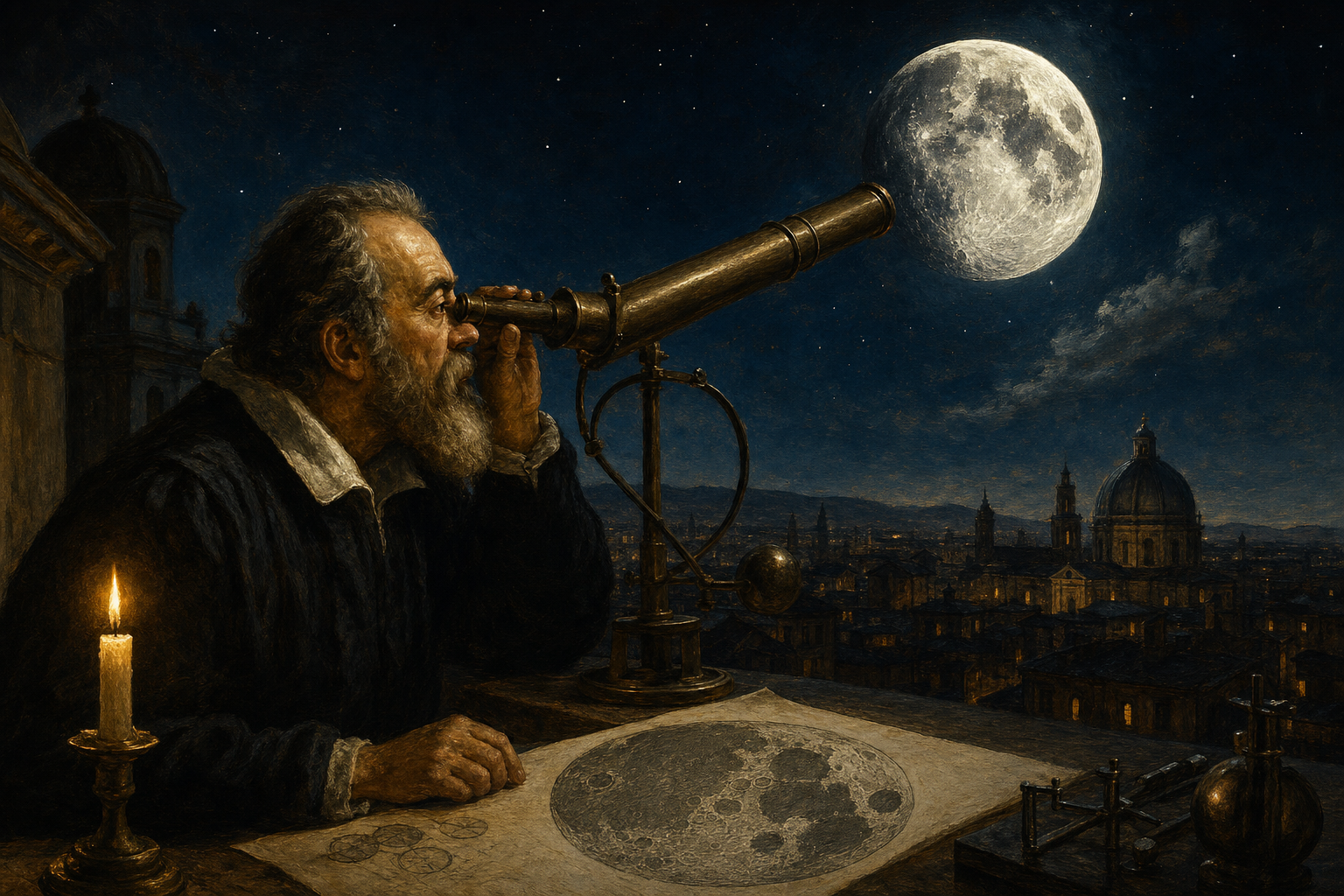
We have walked on the Moon. We have mapped its surface, named its seas, and carried its rocks back to Earth. And yet, in 2026, we still do not have a complete map of what the Moon is actually made of. A telescope the size of a lunchbox is about to fix that, finishing a job that began the night Galileo first pointed a lens at the Moon and saw that it was not what everyone believed.
For most of human history, the heavens were held to be perfect. The Moon, in the reigning view inherited from Aristotle, was a flawless polished sphere, smooth and unblemished and divine, utterly unlike the lumpy, corruptible Earth.
On the thirtieth of November, 1609, Galileo Galilei turned his new telescope on the Moon, and that doctrine began to crack. He saw shadows strung along the line between the lit and the dark part of the Moon, shadows that shifted from night to night, that fell exactly the way the shadows of mountains fall at sunset. Galileo had trained as an artist, he understood light and shade, and he grasped at once what he was seeing. Those were peaks. Those were pits. The Moon had mountains. It had craters. It was rough and broken and ordinary: a world, not a jewel.
An Englishman, Thomas Harriot, had actually drawn the Moon through a telescope four months earlier, but he recorded only a "strange spottedness" and did not see what it meant. Galileo saw what it meant. He rushed it into print in 1610, in a slim and electrifying little book called Sidereus Nuncius, the Starry Messenger. The perfect heavens were over. The Moon was a place.
And for four centuries since, we have kept making it more of a place. We charted its features and named its seas. We sent spacecraft. Twelve men walked on it. We brought home nearly four hundred kilograms of Moon rock, and learned in fine detail what those few landing sites were made of.
But here is the strange gap that remains. Even now, we do not have a complete chemical map of the whole Moon. We know the composition of the handful of spots we visited, and roughly what orbiting instruments could sense, but not, element by element, across the entire surface, what our nearest neighbour is actually made of.
In June 2026, a team at Tokyo Metropolitan University showed how to finish the map, and the instrument they propose is almost comically small. A lightweight X-ray telescope, weighing under ten kilograms, about the size of a lunchbox, placed in orbit around the Moon. It works on an elegant trick. The Sun constantly bathes the Moon in X-rays, and when those X-rays strike the lunar soil, each chemical element fluoresces, glowing back with its own unmistakable signature. Read that glow from orbit, and you can map what the ground is made of. Their simulations show that a single small telescope could chart five key elements, oxygen, iron, magnesium, aluminium and silicon, across the entire Moon in about two years.
Why does that matter? Because a full chemical map is how you read the Moon's deep history, where it came from, the giant collision we think created it, and what is actually there to use: the metals, the oxygen, the ice that any permanent lunar base will depend on, just as a new race back to the Moon is getting under way.
And the deeper echo is that Galileo's lesson simply keeps repeating. Every single time we look at the Moon with a sharper instrument, it becomes a little less of a symbol and a little more of a world, with geology, with resources, with a history we can read. A glass lens in 1609 turned a perfect heavenly sphere into a landscape of mountains. A lunchbox-sized telescope in 2026 is about to turn that landscape into a detailed map of rock and metal and ore.
We have looked at the Moon for as long as there have been eyes to look. We have sung to it, sworn by it, navigated by it, and worshipped it. And only now, more than four hundred years after Galileo proved it was a real place, are we finally about to learn, completely, what that place is made of.