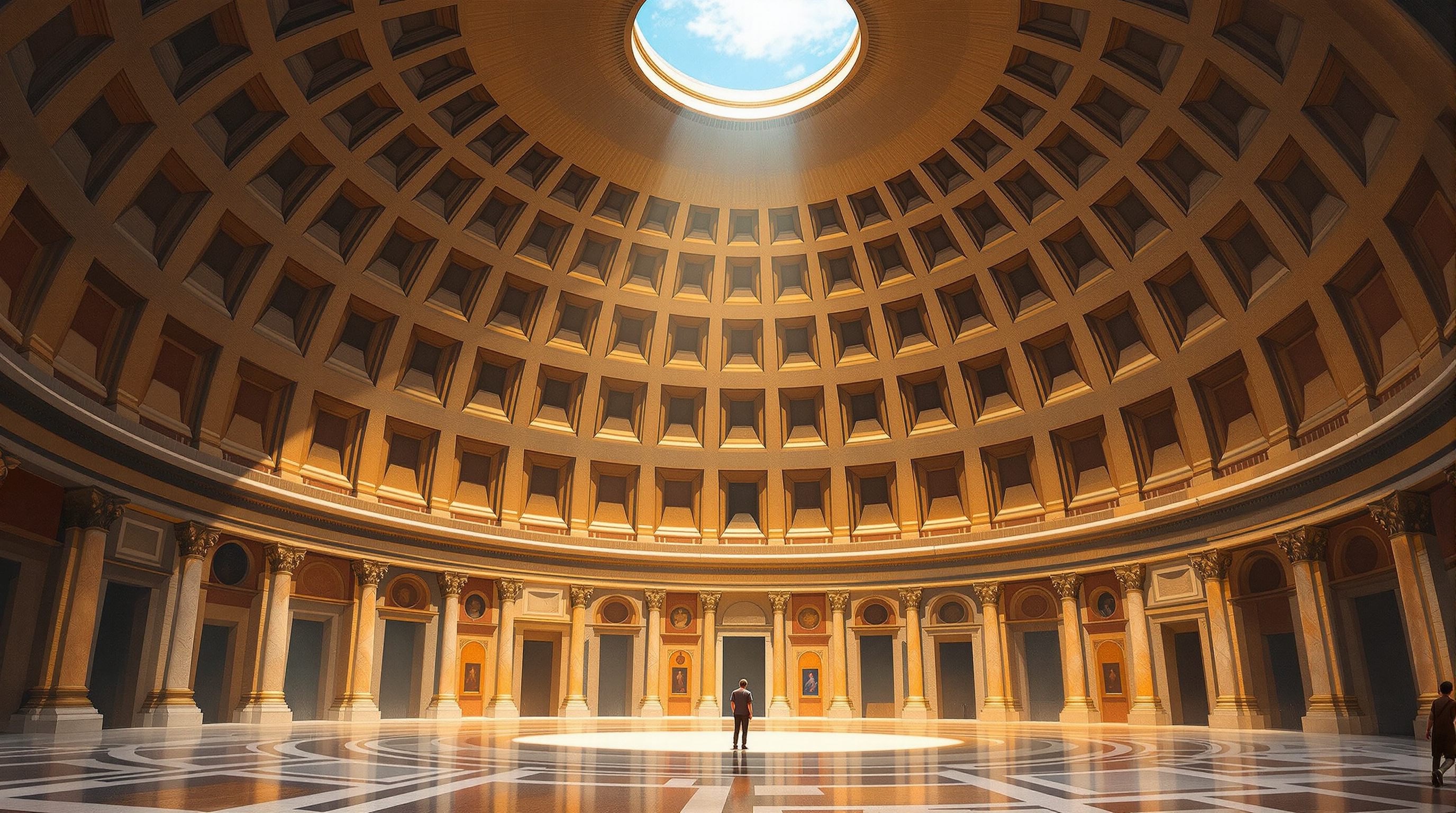
In Rome there is a dome that has no business standing. The Pantheon's roof is forty-three metres of unreinforced concrete, cast in a single great pour around the year 126. It has held up the largest unreinforced concrete dome on earth for nineteen centuries, through earthquakes, floods, and the fall of the empire that built it. There is no steel inside it. By every rule of modern engineering, it should have cracked and fallen long ago.
The concrete we pour today is not so lucky. A motorway bridge, a car park, a sea wall: we build them to last fifty years, and many of them are crumbling before they get there. The Romans built for millennia and did not seem to be trying. And then they took the recipe to the grave.
When the Western empire fell, the knowledge of how to make their concrete fell with it. For roughly a thousand years, Europe simply could not do it. The secret was a mix the Romans had stumbled into: a volcanic ash they called pozzolana, from the slopes near Vesuvius, blended with lime and, for harbours, with seawater itself. It was not rediscovered until 1824, when an English bricklayer named Joseph Aspdin patented Portland cement by burning chalk and clay in a kiln. That cement built the modern world. It also became one of the dirtiest things we make. Producing it accounts for something like eight percent of all the carbon dioxide humanity emits, more than every aeroplane in the sky.
So engineers went back to the Pantheon and asked the obvious question: how did they do it, and why does ours fail when theirs did not?
The answer came in 2023, from a team at MIT led by Admir Masic. Under the microscope, Roman concrete is freckled with tiny white lumps of lime that scholars had long dismissed as sloppy mixing. They are not sloppy. The Romans mixed their lime hot, and those lumps are a built-in repair kit. When a crack opens and water seeps in, it dissolves the lime, which flows into the crack and recrystallises, gluing it shut. The concrete heals itself. A geologist named Marie Jackson found the seawater trick was stranger still: in Roman harbours, saltwater reacts with the ash to grow rare crystals through the concrete over centuries, so the structure does not merely survive the sea, it grows stronger in it.
This year a team at Worcester Polytechnic Institute in Massachusetts unveiled a building material that does the one thing concrete never could. They borrowed an enzyme called carbonic anhydrase. It is the same molecule in your own red blood cells that lets you breathe out carbon dioxide. In their material, that enzyme grabs carbon dioxide from air and water and locks it into solid calcium carbonate, the very stuff of limestone and seashells. The material hardens in hours, and instead of belching carbon the way cement does, it swallows it.
The numbers are the whole story. A cubic metre of ordinary concrete throws off around 330 kilograms of carbon dioxide. The same volume of the new material locks away about six. One is a source. The other is a sink. They have made a structural stone that cleans the air as it sets.
It is, in a sense, the Roman trick finished. The Romans made a stone that healed itself and grew stronger in the sea. They did it by accident, and could not explain it. We spent two thousand years first forgetting it, then crawling back to understand it, and now we are trying to do it on purpose and better: not just a stone that lasts, but a stone that pays back the carbon it took to make.
The Pantheon has stood for nineteen centuries. For most of them, we could not even have rebuilt it. Now we are not just trying to match Roman concrete. We are trying to beat it.
The ancients did not always know more than us. Sometimes they just did better, and left us to work out why.