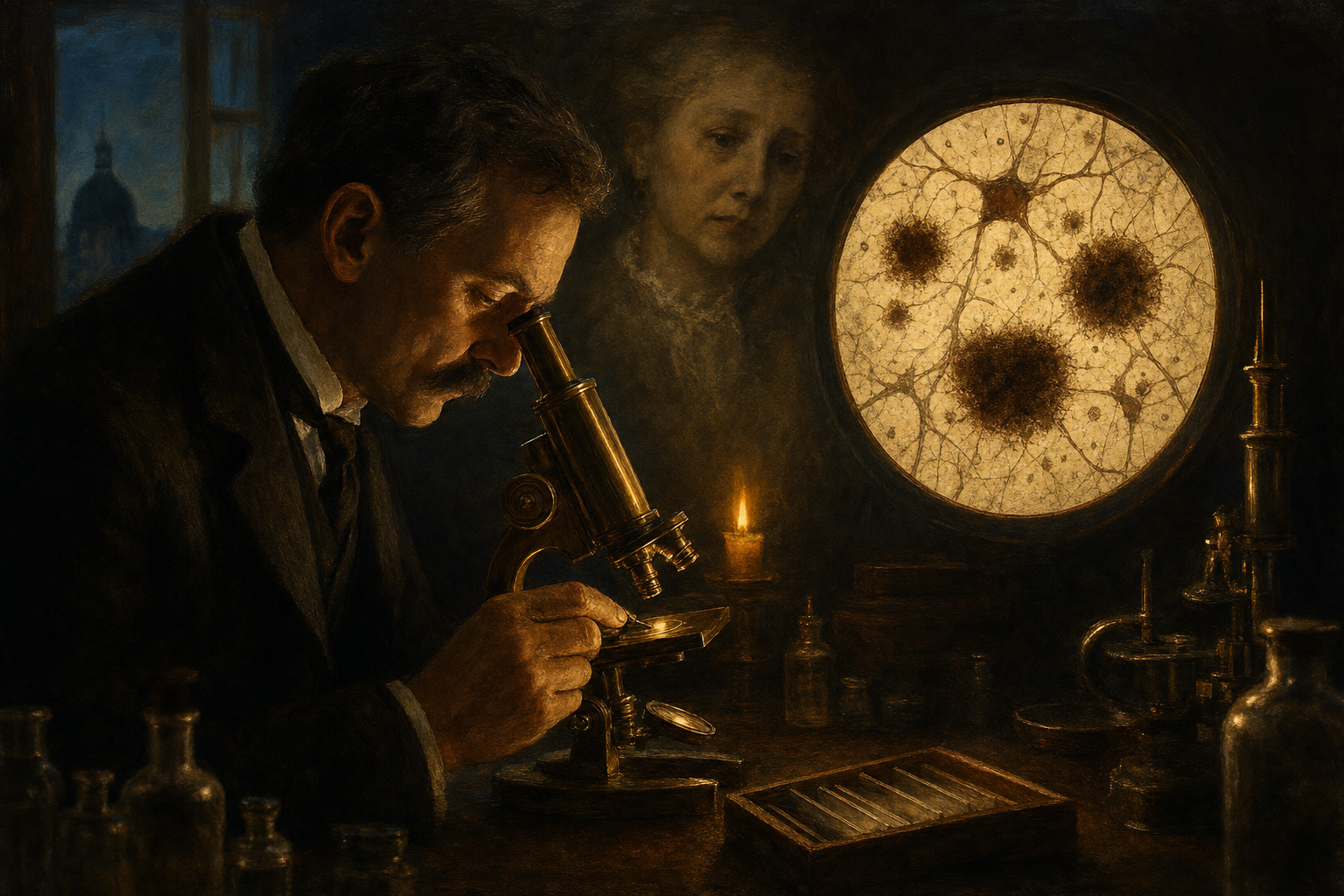
In 1906, a German doctor looked into the brain of a woman who had told him, in life, that she had lost herself. He saw the strange clumps that had eaten her mind. For the next hundred and twenty years, doctors could see those clumps, name them, and do almost nothing about them. This month, a copper compound finally cleared a large share of them out of a living brain, and brought the memory back. In mice, for now. But back.
Her name was Auguste Deter. In 1901, she was admitted to an asylum in Frankfurt, fifty-one years old, and unravelling. She had lost her memory, her language, her sense of who and where she was. The psychiatrist who took her case was Alois Alzheimer. He asked her questions, and among her confused answers came one line that has echoed ever since. Ich habe mich verloren. I have lost myself.
She died in the spring of 1906. Alzheimer examined her brain under a microscope and found two things he could not explain. Outside her nerve cells were dense clumps of a deposited substance, which we now call amyloid plaques. Inside the cells were twisted bundles of fibres, which we now call tau tangles. In November 1906 he described what he had seen to a room of psychiatrists in Tübingen, and before long the condition carried his name.
Here is the cruel part of the story. Those two features, the plaques and the tangles, are still exactly how we define Alzheimer's disease today, more than a century later. We could see the plaques. We could photograph them, stain them, count them. And for a hundred years we could do essentially nothing to clear them. One drug after another was aimed at the amyloid, and one after another failed. The plaques sat in the brain, the minds went dark, and medicine mostly watched, just as Alzheimer had.
So why is clearing them so brutally hard? Part of the answer is plumbing. The brain has a waste-disposal system, and a crucial piece of it is a molecular pump sitting in the blood-brain barrier, the wall between the brain and the bloodstream. That pump flushes toxic junk, including amyloid, out of the brain and into the blood to be carried away. In Alzheimer's disease, that pump weakens and falters. The drain clogs. The amyloid the brain produces every single day can no longer get out, and so it piles up.
This month, June 2026, a team at Monash University in Australia reported something genuinely new in the journal ACS Chemical Neuroscience. A copper compound called copper-ATSM does not try, like the failed drugs, to stop the brain from making amyloid. Instead it repairs the clogged drain. It restores that weakened waste pump at the blood-brain barrier, so the brain can flush the amyloid out on its own. In mice bred to develop Alzheimer's, the compound cut the toxic amyloid by about forty-two percent and improved their memory by roughly forty-four percent over eight weeks. The researchers think it may also rouse the brain's own cleanup cells, the microglia, to devour the plaques.
There are two reasons this is more than the usual hopeful headline. First, copper-ATSM has already been through human safety trials, for Parkinson's disease and for ALS, which means that if it works, it could move toward Alzheimer's patients far faster than a brand new molecule. Second, the whole approach is different in kind. For a century we tried to stop the brain dirtying itself. This tries to let the brain clean itself, which is much closer to the actual failure Alzheimer was looking at in 1906.
Now the honest caveats, because this story has broken hearts before. This is mice, not people. The history of Alzheimer's research is a graveyard of compounds that dazzled in mice and did nothing in humans. A forty-two percent drop in a mouse brain is not a cure in a human one, and it may never become one.
But notice the shape of it, because the shape is the echo. For a hundred and twenty years, Alzheimer's discovery was a diagnosis without a remedy. We could name with great precision the thing that was killing the mind, and we could not lift a finger to stop it. The new idea is not a cleverer weapon against the plaque. It is a way to reopen the brain's own drain, and let it do the thing it was always able to do.
Auguste Deter said, I have lost myself. For a hundred and twenty years, all that medicine could really do was quietly agree with her. We are not there yet, and we should not pretend otherwise. But for the first time, in a living brain, the drain is open.