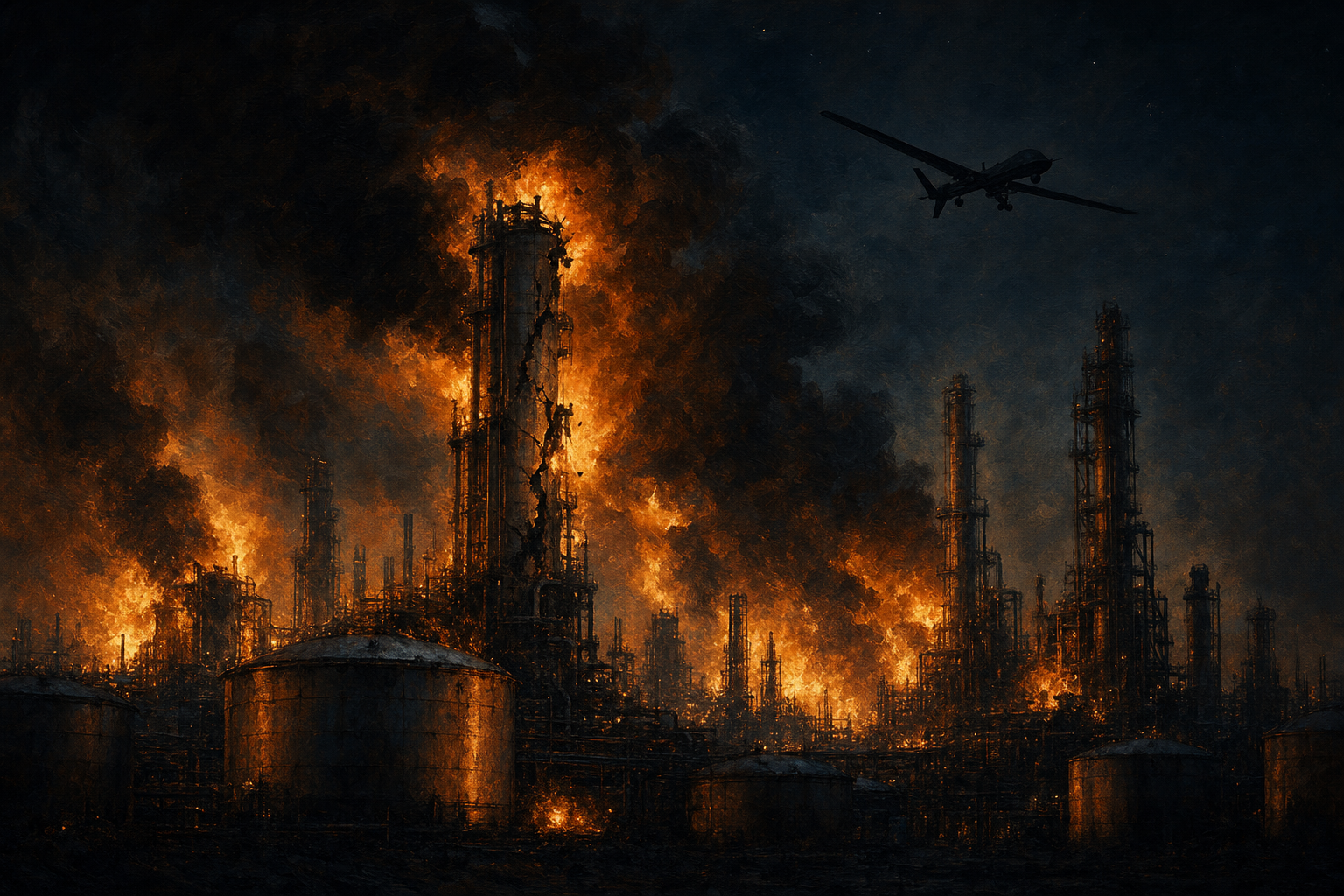
This week, in Russian-occupied Crimea, the petrol stations closed. Not because of sanctions, but because for the better part of a year Ukraine has been burning Russia's fuel from the sky. It is one of the oldest lessons in modern war, relearned: you do not always have to beat an army at the front, if you can starve it of fuel. In 1944, that lesson ended the Third Reich.
Germany's fatal weakness in the Second World War was oil. It had almost no crude of its own. It ran the entire war machine on two lifelines. One was the oilfields of Ploiesti in Romania. The other was synthetic fuel: petrol and diesel cooked out of coal in vast chemical plants, the largest run by IG Farben at Leuna. As long as those kept flowing, the panzers rolled and the Luftwaffe flew.
For years the Allies bombed everything else: factories, cities, submarine pens. Then, in the spring of 1944, they finally concentrated on the fuel. Wave after wave of heavy bombers went after the synthetic-fuel plants and the Romanian oilfields. And the effect was astonishing.
By the middle of 1944, German synthetic-fuel output had collapsed to less than a quarter of what it had been. The consequences cascaded. The Luftwaffe, the air force that had terrorised Europe, began grounding its aircraft for lack of petrol, and worse, it no longer had the fuel to train new pilots, so the Allies simply took command of the sky. On the ground, the panzer divisions that had blitzed across whole countries now sat hidden and immobile, their tanks dry. In the Ardennes that December, in Germany's last desperate offensive, tanks were abandoned at the roadside, out of fuel, and captured intact.
Albert Speer, Hitler's own armaments minister, wrote to him in 1944 that the war was effectively lost from the day the fuel plants were hit. He was right. Historians have called the oil campaign the death knell of the German war machine. The Reich still had soldiers, still had tanks, still had aircraft. It simply had nothing to put in them.
The principle, stated plainly, is this. A modern military is a machine that runs on fuel. Cut the fuel and the machine stops, however large the army standing around it.
Now look at Russia. For most of the war in Ukraine, the fighting has been a grinding contest of trench lines and missile barrages. But over the past year Ukraine has quietly opened a different front, deep in Russia's rear, sending long-range drones and missiles hundreds of kilometres to strike refineries, oil depots, and pipelines.
The results are mounting. By 2026, one industry estimate put roughly a third of Russia's oil-refining capacity knocked offline by Ukrainian strikes. Russia banned fuel exports. Petrol stations inside Russia itself began rationing. And this week, occupied Crimea suspended civilian gasoline sales altogether, holding drivers to twenty litres a week on prepaid coupons, the worst fuel crisis on the peninsula since Russia seized it in 2014. As one analysis put it, the long-range strikes are cutting how much fuel Russia can produce, while the shorter-range strikes are cutting its ability to move what it still makes. It is the 1944 strategy, exactly: do not only fight the army at the front, burn the fuel that powers it, and the export money that pays for it.
But here is the crucial difference, and it is the whole point. Germany was uniquely fragile. It was a fuel-poor country running on a small number of bombable synthetic plants, and once those were gone, there was nothing behind them. Russia is the opposite. It is one of the largest oil and gas producers on the planet, with enormous crude reserves and refining capacity scattered across eleven time zones. You cannot ground a petro-superpower the way the Allies grounded the Wehrmacht. Ukraine's strikes are causing genuine shortages, genuine economic bleeding, genuine pain. They are not going to leave Russian tanks dry by the roadside.
So the echo is real, but it is honest about its own limits. In 1944, cutting the fuel ended an empire in a matter of months, because the empire had no fuel to spare. In 2026, cutting the fuel is a slower, grinding thing: not a death blow, but a steady tax on the war, levied in petrol and paid from the sky.
The lesson Speer learned and the lesson Kyiv is applying are the same lesson. Armies do not run on courage. They run on diesel. The only thing that has changed is the size of the tank you are trying to drain.