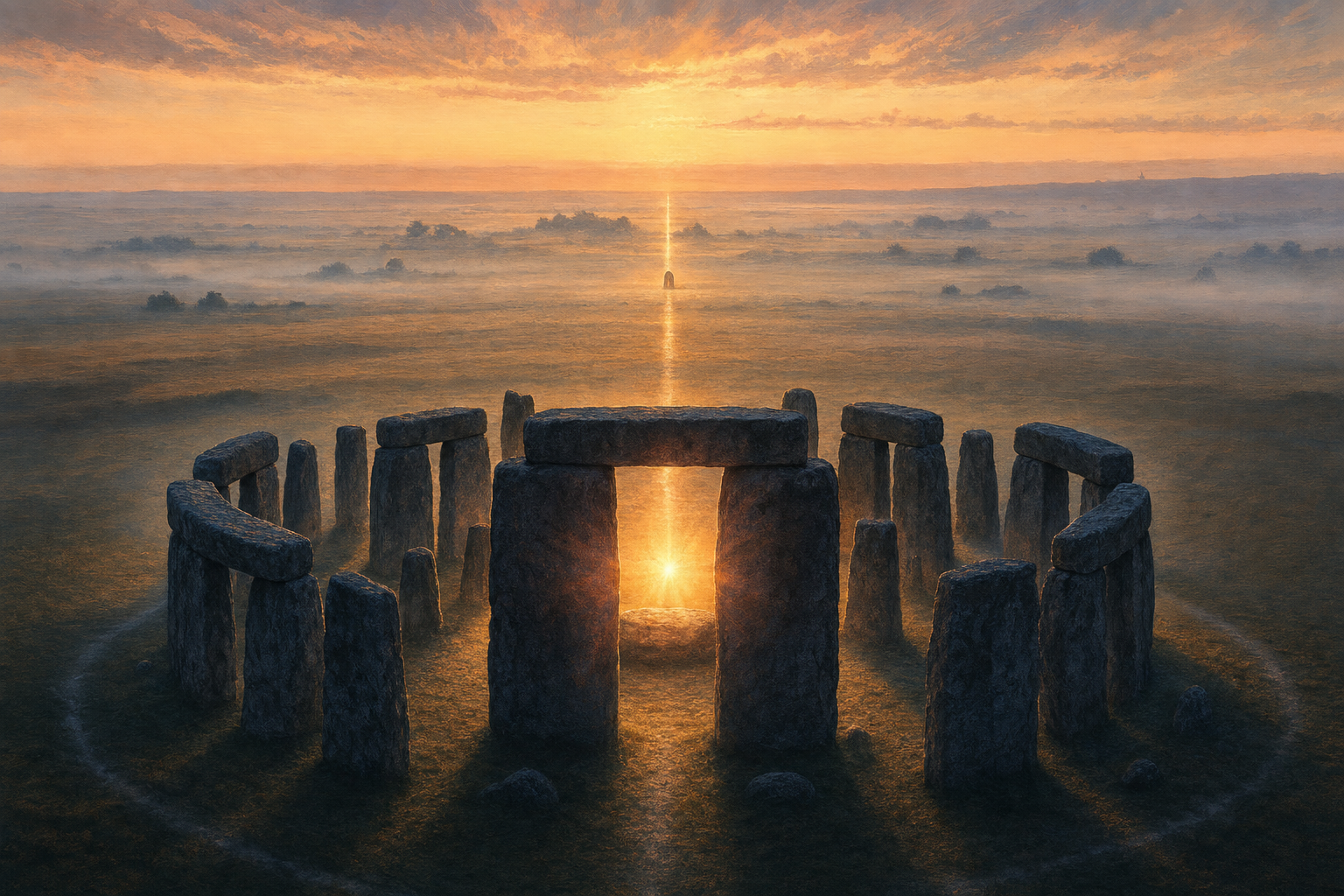
For a hundred years, the great mystery of Stonehenge was not why it was built, but how on earth the stones got there. And the answer kept getting stranger, until, just this year, we learned that the great stone at its very heart had been dragged the entire length of the island.
Stonehenge is built from two different kinds of rock. There are the giant uprights, the famous sarsens, the ones that form the great arches. And there is a set of smaller stones, known as the bluestones. For a long time nobody knew where any of them came from.
Then, in 1923, a geologist named Herbert Thomas did something remarkable. He matched the bluestones, by their mineral composition, to one specific range of hills: the Preseli Hills in west Wales, more than two hundred kilometres away. And he argued, against considerable scepticism, that Neolithic people had hauled these multi-tonne stones across the whole width of southern Britain, by hand, around four and a half thousand years ago. It sounded almost impossible. It turned out to be true. Much later, archaeologists even found the actual Welsh quarries the stones were cut from, and signs of a dismantled stone circle nearby, as though an early Stonehenge had first stood in Wales and then been taken down and carried east.
So for decades the picture settled into place. The big sarsens were reasonably local, pinned down in 2020 to West Woods, only about twenty-five kilometres away. The bluestones came from Wales. And the largest single stone of all, the so-called Altar Stone, the great slab lying flat at the very centre of the monument, was assumed to be Welsh as well, just one more long haul from the same direction.
Then, in 2024, a team led by the geologist Anthony Clarke decided to actually test that assumption. They fingerprinted the Altar Stone, not by how it looks, but by the tiny radioactive clocks locked inside its mineral grains, the precise ages of microscopic zircon and rutile crystals. The signature did not match Wales at all. It matched the Old Red Sandstone of the Orcadian Basin, in the far northeast of Scotland, more than seven hundred and fifty kilometres away. Follow-up work since has been narrowing down exactly where, ruling sites out, debating the route, but the headline holds: the heart-stone of Stonehenge is Scottish.
Sit with what that means. A slab of sandstone weighing perhaps six tonnes was moved, around 2600 BC, almost the entire length of Britain, and most likely for much of the way by sea, to be laid at the centre of Stonehenge. It is the longest journey of any stone in any Neolithic monument anywhere that we know of.
And it quietly rewrites who we think these people were. We tend to picture Neolithic Britons as scattered, isolated little farming communities, scratching at the soil and rarely seeing beyond the next valley. But to quarry a particular stone in northeast Scotland, move it the length of the island, and place it with intent in a monument on Salisbury Plain implies the exact opposite. It implies a Britain laced together by long-distance contact, by seafaring, by shared belief and shared purpose, and by an organisation sophisticated enough to coordinate a single project across the whole country, all without writing, without metal tools, without the wheel in any everyday use.
So why does a sourcing study about one rock matter beyond Stonehenge? Because it is a lesson about how badly we tend to underestimate the deep past. The very instinct that assumed the Altar Stone was local, that it must have come from the nearest plausible place, is the same instinct that has us imagining prehistoric people as simpler and smaller in their ambitions than they actually were. And it keeps being wrong. Almost every time we have the tools to truly test it, the answer comes back the same way: they went further, planned bigger, and connected wider than we dared to guess.
For a century, the question about Stonehenge was always, how far could Neolithic people possibly have carried a stone like this? We kept answering cautiously, reaching for the nearest source the story would allow. The stone itself has finally answered, and the answer is: as far as the island stretches.