In December 1970, a Frenchman stood at the Nobel podium in Stockholm to accept the prize in physics, and said something strange about his own life's work. The discovery he was being honoured for, he admitted, did not seem to be good for anything.
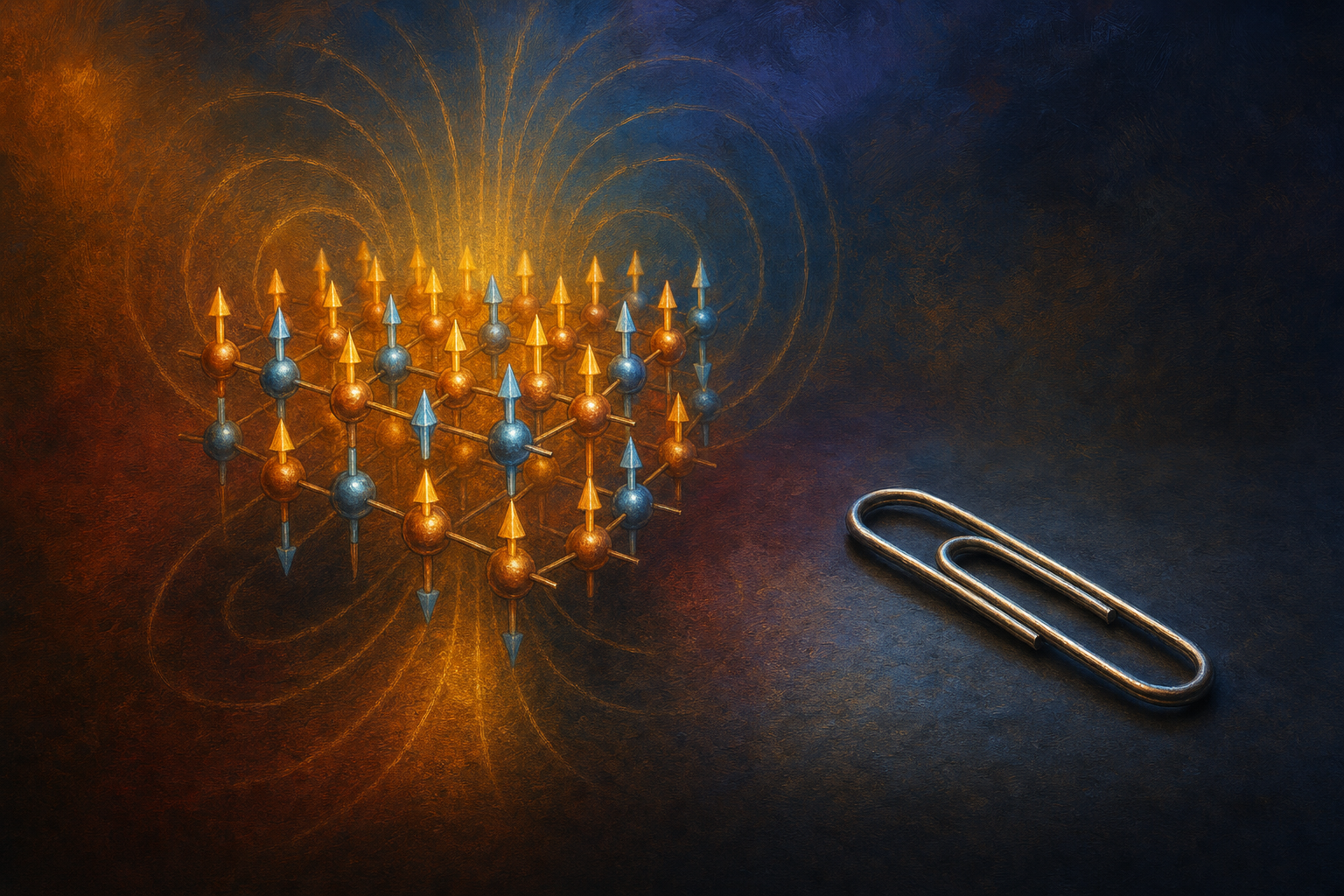
His name was Louis Néel, and the thing he had found was a hidden kind of magnetism. Back in 1932, he had worked out that in certain materials the tiny atomic magnets do not all line up the way they do in an ordinary fridge magnet. Instead they point in opposite directions, head to tail, head to tail, so that each one cancels its neighbour. The result is a material that is full of magnetism on the inside and shows almost none on the outside. A magnet that does not act like a magnet. He called it antiferromagnetism.
It was beautiful physics, and it seemed completely pointless. A magnet you cannot feel cannot pick anything up. In his Nobel lecture, Néel said it plainly: these materials are extremely interesting from the theoretical point of view, but do not seem to have any application. The man receiving the world's highest scientific honour for a discovery was, in the same breath, calling it useless.
He was wrong, and the way he was wrong is the whole story.
Decades later, engineers learned to read the faint magnetic patterns on a spinning disk with ever smaller, ever more sensitive heads. To make those heads work, they needed a perfectly stable magnetic anchor, a layer whose direction would never drift and could not be wiped by a stray field. The ideal anchor was exactly Néel's useless magnet. Because an antiferromagnet shows no field to the outside world, it is almost impossible to disturb, and that immovability, the very thing that made it seem good for nothing, made it perfect. Pinned to the read heads that followed the discovery of giant magnetoresistance in the late 1980s, antiferromagnets quietly became the anchor of the hard-disk era. The magnet you could not feel is part of why the world could suddenly store everything.
The lesson is one physics keeps teaching. The useless discovery is very often just the early one.
For nearly a century, there were only two kinds of magnetism worth the name: the ordinary sort in your fridge magnet, and Néel's hidden, cancelling sort. Then, in the last few years, physicists confirmed a third. They call it altermagnetism, and in 2024 it was hailed as the breakthrough of the year.
An altermagnet is a strange hybrid. From the outside it looks as quiet as one of Néel's antiferromagnets, with no obvious field, yet its internal structure twists in a way that gives it some of the useful muscle of an ordinary magnet. In theory, it could carry information faster and pack it denser than anything we use today, which is why the memory industry is suddenly very interested.
There is just one problem, and it is Néel's problem all over again. Because an altermagnet hides its nature so well, it is fiendishly hard to even tell whether you have one. So in April 2026, a team led by Jamir Marino at the University at Buffalo proposed an extraordinary detector: a single flaw in a diamond. A nitrogen-vacancy centre, where one carbon atom in the crystal is swapped for nitrogen and its neighbour left empty, behaves like a tiny, exquisitely sensitive compass. By watching how that one atomic flaw's spin settles in different directions, they showed, you could finally fingerprint an altermagnet hiding in plain sight.
So here we are again. A new kind of magnetism that looks like it does nothing. A way to read it out using a defect in a gemstone. And a memory industry betting that this quiet, useless-looking material is the next revolution, just as Néel's was.
Néel called his discovery interesting but pointless, and it ended up holding the memory of the world. The safest bet in science is that the thing we cannot yet use is simply the thing we are too early to understand.