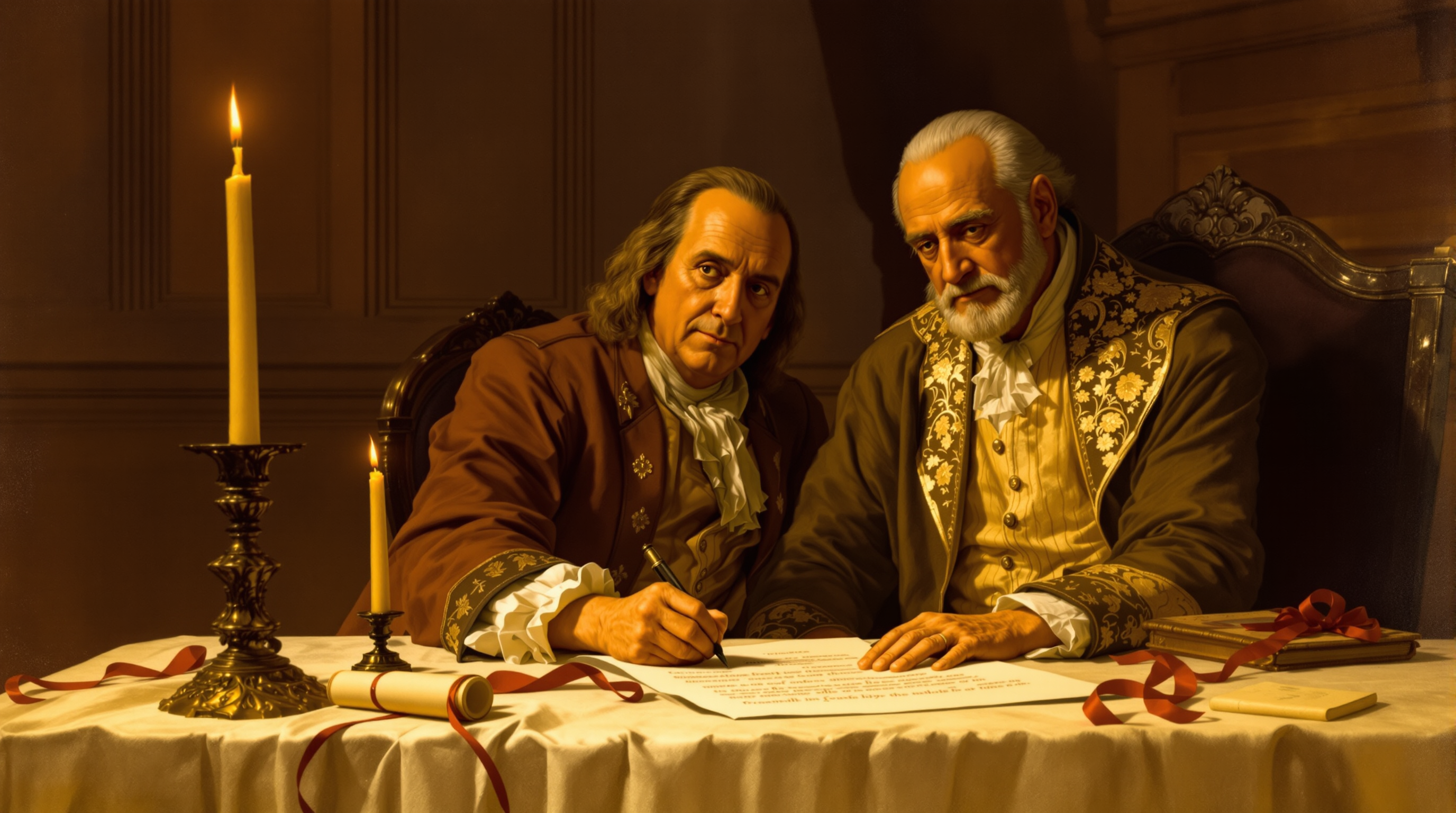
In December 1776, an old man in a fur cap stepped off a ship onto the French coast and became the most famous person in Paris. Benjamin Franklin, seventy years old, had crossed a winter Atlantic to ask a king for the one thing his new country could not win on a battlefield: to be believed in.
A rebel colony is not a country. It is a claim. In 1776 the United States existed on paper and in the field, but no power on earth had said out loud that it was real. Recognition was the prize, and only a great power could grant it.
France was the obvious door, and the most reluctant. King Louis the Sixteenth had no love for a republic of rebels lecturing the world about throwing off kings. But his foreign minister, Charles Gravier, the comte de Vergennes, was not thinking about liberty. He was thinking about Canada.
Thirteen years earlier, the Treaty of Paris of 1763 had ended the Seven Years War and stripped France of its empire in North America. Vergennes had spent the years since planning the rematch. An American republic was not a cause to him. It was a crowbar to pry Britain's empire apart.
So Vergennes waited, and he set a condition: prove you can win. In October 1777 the proof arrived. At Saratoga, an entire British army under General Burgoyne surrendered. When the news reached Paris that December, Vergennes moved, partly out of confidence, and partly out of fear that Franklin, who was quietly letting the rumour spread, might make a separate peace with London instead.
On the sixth of February 1778, France signed two treaties with the United States: one of amity and commerce, one of alliance. With a stroke of a pen, France became the first great power to recognise American independence. On the thirteenth of March, Versailles informed London. Four days later, Britain declared war on France.
That was the whole game. Recognition was not a compliment. It was an act of war by other means, handed to a struggling rebel not because its cause was just, but because its existence wounded a rival. The aid, the fleet, the money that followed, and the French ships that sealed the British surrender at Yorktown three years later, all of it flowed from one cold calculation in a minister's study.
Recognition has always been the weapon a great power keeps in its pocket, to be spent when an enemy's enemy becomes useful.
On the twenty-sixth of December 2025, Israel became the first country on earth to formally recognise Somaliland.
Somaliland had been waiting for that sentence for thirty-four years. It broke from collapsing Somalia in 1991, and then did the thing failed states never do: it worked. It printed its own currency, held real elections, kept the peace. And still no one would say it was real. To recognise it was to insult Somalia, and no one thought the insult worth it.
Then the calculation changed. Somaliland sits at the southern gate of the Bab el-Mandeb, the narrow strait that funnels the world's shipping toward the Suez Canal, the same waters where Houthi missiles have been hunting ships. Its port at Berbera had just been rebuilt. Israel wanted a foothold on the Red Sea, and Somaliland's recognition was the price of the door. Prime Minister Netanyahu called it the spirit of the Abraham Accords. Vergennes would have recognised the move on sight.
There is even an echo inside the echo. For five days in 1960, Somaliland was an independent country, recognised by some thirty-three governments before it dissolved itself into Somalia. One of those thirty-three was Israel. The recognition Israel granted in 2025 was one it had quietly extended once before, sixty-five years earlier, and then watched disappear.
Somalia called it an attack on its sovereignty. The African Union rejected it. Turkey, with troops in Mogadishu, denounced it.
They are arguing about justice. The powers doing the recognising are doing what they have always done: spending recognition where it costs an enemy the most.
A country becomes real when someone powerful needs it to be.