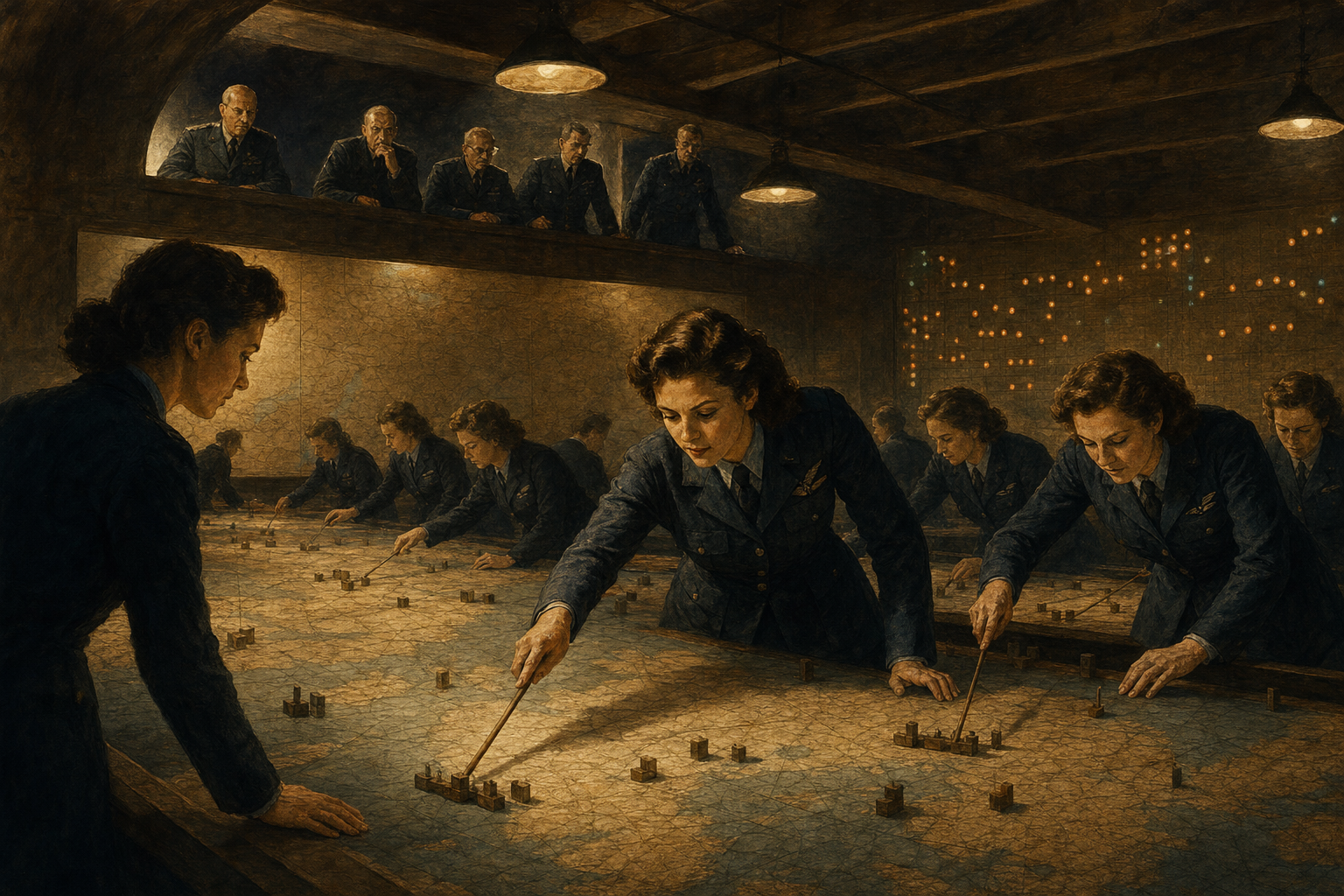
In the summer of 1940, in an underground room north of London, a young woman in air-force blue leaned over a vast map table and pushed a wooden marker a few inches across the English Channel. Above her, on a balcony, officers watched the whole battle laid out like a board game. She was not playing a game. She was helping win the most important air battle in history, and almost no one remembers her.
We remember the Spitfire. We remember the pilots, the few to whom so much was owed. But the thing that actually won the Battle of Britain was not a plane or a man. It was a system. An invisible machine made of radar, telephone wire, and people, and it was the first of its kind anywhere on earth.
The man who built it was Air Chief Marshal Hugh Dowding, the head of RAF Fighter Command. He was awkward, cold, and so unclubbable that his own men nicknamed him Stuffy. He was also right about almost everything, which made him no friends at all.
Dowding's problem was arithmetic. The German air force had more planes than he did. If he flew standing patrols, hunting for raids in an empty sky, he would burn out his pilots and his fighters for nothing and lose. He needed to put his scarce aircraft in exactly the right place at exactly the right time, and to do that, he needed to see the future.
So he wired the country together. Along the coast stood the masts of Chain Home, the world's first large-scale radar network, watching for aircraft massing over France. Once raiders crossed the coast and vanished from radar, the volunteers of the Observer Corps tracked them by eye and ear from thousands of little posts. Every sighting flowed down telephone lines into a filter room, where it was turned into those wooden markers on the map table. Controllers in sector stations then read the map and scrambled the right squadrons to the right altitude, over the right town, with minutes to spare.
For the first time, a commander could see a battle whole, as it happened, and move his pieces to meet it. The Germans, who had better pilots and more machines, never grasped what they were up against. They bombed the airfields but not the invisible web that made the airfields deadly. They even started to bomb the radar masts, then decided it was not worth it. It was the single greatest mistake of the battle.
Dowding husbanded his forces, refused to be panicked into throwing everything in at once, and won. His reward, a few weeks after saving the country, was to be quietly removed from his command. The system outlived the man, as systems do.
The lesson of 1940 is the one every air force has had to relearn since. It was never really about the plane. It was about the network that told the plane where to be.
In 2026, Ukraine has assembled what many now call the most combat-tested air-defence network in the world. Like Dowding, the Ukrainians began with a brutal arithmetic problem: Russia could fire more missiles and more drones than any stock of expensive interceptors could ever match.
Their answer was a system in layers. At the top sit a handful of precious Patriot missiles, each costing around four million dollars, saved for the fastest ballistic threats they alone can stop. Below them, medium-range launchers like the IRIS-T knock down cruise missiles, reportedly intercepting almost everything across hundreds of engagements. And at the bottom, swarms of tiny interceptor drones, some costing barely a thousand dollars each, ram the cheap Russian Shaheds out of the sky before they reach a city. Over Kyiv, those cheap drones now down the large majority of incoming attacks.
The point is the same as Dowding's: integrate the sensors and the command so that the scarce, expensive weapons are never wasted on a target a cheap one could kill. Ukraine even flipped the economics, killing a cheap drone with a cheap drone. And now, like Britain after 1940, it is selling the system itself, opening defence-export offices across Europe and offering its layered shield to Gulf states.
The weapon everyone photographs is the missile. The thing that actually wins is the web behind it.