Every day, we find the historical story hiding inside the headlines. Riveting narratives
that connect the past to the present, and make you wonder what happens next.
Choose your topics
You'll receive one email per topic, per day. Pick as many as you like.
Today's Echo · History & Current Events
1922 to 1928, the British Empire and the United States
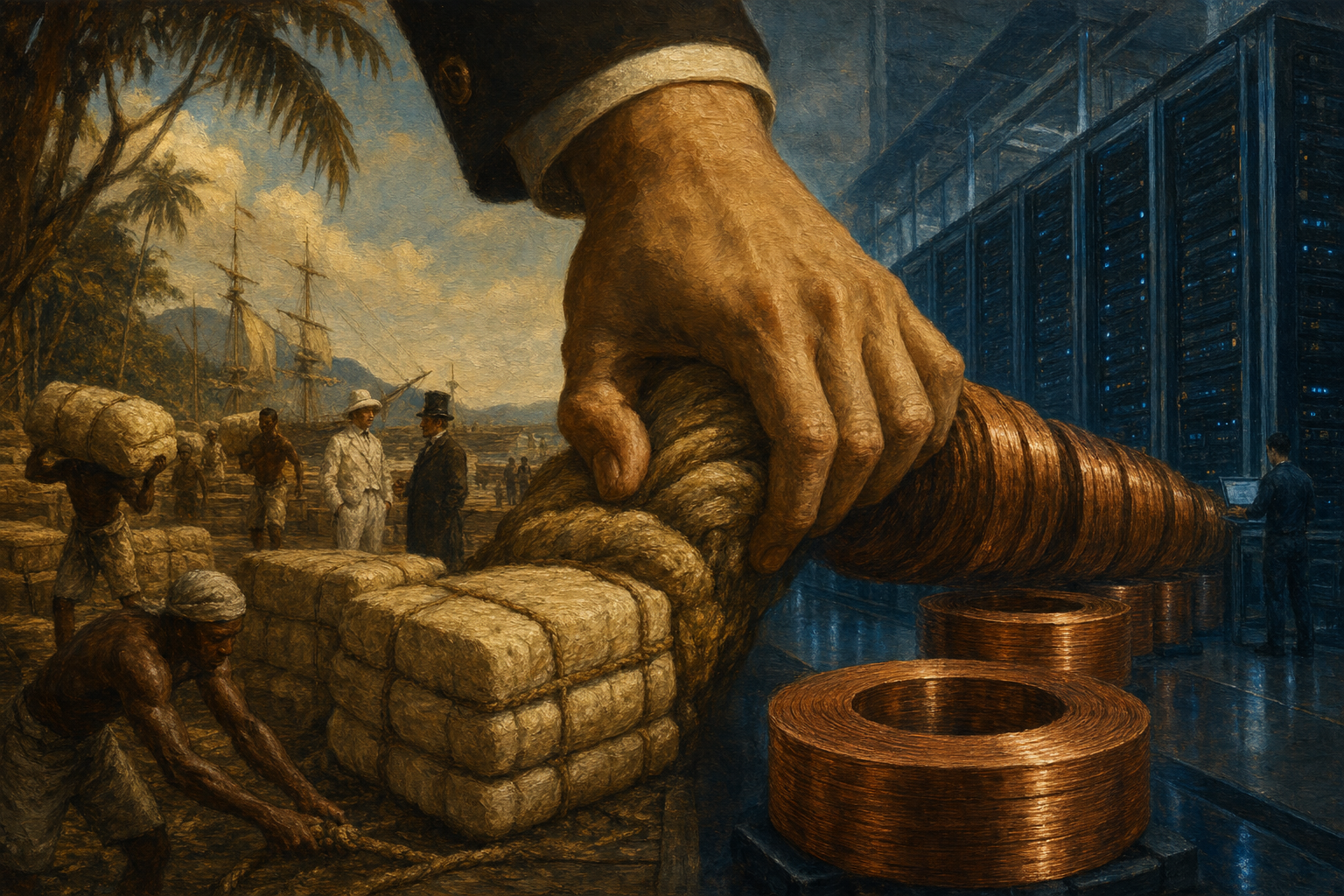
In 1925 the most valuable thing in America was a milky sap from trees on the far side of the world. Rubber ran every car, factory and phone line, Britain's colonies grew about three quarters of it, and Britain had just choked the supply: the Stevenson Plan restricted exports to drive the price from around thirteen cents a pound past a dollar. America, which bought most of the world's rubber, did not just pay. Commerce Secretary Herbert Hoover funded a global hunt for new supply, Harvey Firestone planted a million acres of Liberia, chemists chased synthetic rubber, and the cartel collapsed when the Dutch refused to join and flooded the market. Squeeze a customer hard enough and you do not make him pay; you teach him to never need you again. A century later it is copper for AI data centres and China's grip on rare earths, and the same scramble has begun.
•3 min readA century later the same dynamic has returned with metal instead of sap. The lifeblood of the AI age is copper (a single large AI-ready data centre can require up to about 50,000 tonnes) and rare earth elements used in magnets, motors and weapons. Analysts forecast a structural refined-copper deficit (J.P. Morgan projecting roughly 330,000 tonnes for 2026), with new mines averaging about 17.9 years from discovery to production. The choke point is as lopsided as rubber was in 1925: China processes around 90 percent of the world's rare earths and has used that control as leverage, prohibiting exports of gallium and germanium to the US from December 2024 and adding medium and heavy rare earths and magnets to its export-control list through 2025. Washington's response could have been written by Hoover: in February 2026 it launched a Strategic Critical Minerals Reserve (Project Vault), backed by a $10 billion EXIM loan, and pressed a global search for friendly supply, recycling and substitutes. The lesson of the rubber war is not that a choke point is permanent but the opposite: squeeze a customer hard enough and you teach him, and everyone watching, how to make sure he never needs you again.
Queen and worker bees hatch from identical eggs, yet one lives for years and lays a million eggs while the others live for weeks and never breed. For a century the textbook answer was a single food: royal jelly. In 2026 a team at UC Riverside showed the real answer is grander. Specialised worker bees build the queen a palace: a peanut-shaped 'royal crib' of custom wax with its own chemistry, and they cluster to keep it warm. Raise a would-be queen in ordinary wax instead and she develops poorly and often dies. The jelly feeds her; the crib crowns her. We love a story with one secret ingredient. Nature almost never works that way.
•3 min readIn 2026 a team at the University of California, Riverside (its Center for Integrative Bee Research) showed that royal jelly alone does not make a queen: the environment does much of the work. A specialised caste of young worker bees acts as royal builders, constructing the large peanut-shaped 'royal crib' from a custom wax that is softer, melts at a higher temperature, and carries a distinct chemical signature of fatty acids and signals, and they alter their own physiology to raise the temperature around the cell, like underfloor heating. Crucially, when would-be queens were raised in ordinary worker-cell wax instead of the royal crib, the larvae developed poorly and many died: they needed the 'smell and feel' of the royal wax to transform at all. So queen determination is a whole system, diet plus architecture, temperature and wax chemistry plus the labour of many bees, not a single ingredient. It is a recurring lesson in biology: we love single-cause stories (one gene, one molecule, one food), but nature's marvels are usually built from many small causes acting together. A queen is built, not dosed.
Seoul, 15 August 1974: a 22-year-old woman watched her mother die at the National Theatre. Two presidencies, an assassination, an impeachment and a prison sentence later, the same arc is being walked in Peru. Keiko Fujimori is in her fourth presidential runoff on 7 June.
•6 min readPeru's 7 June 2026 presidential runoff: Keiko Fujimori (Fuerza Popular, 17.19%) versus leftist Roberto Sánchez (Juntos por el Perú, 12.03%). It is Keiko's fourth consecutive runoff, eight months after the death of her father Alberto Fujimori.
1781 to 1822, Bath, Datchet, and Slough in late-Georgian England
Bath, 13 March 1781: a German-born church organist named William Herschel accidentally discovered Uranus through a home-made seven-foot telescope in his back garden. Four years later he and his sister Caroline read a paper to the Royal Society arguing that the Milky Way was a disc-shaped system of stars, the first attempt in human history to map cosmic structure. In May 2026 the James Webb Space Telescope just published the clearest map of the cosmic web ever made.
•5 min readOn 6 May 2026 the JWST COSMOS-Web collaboration published in The Astrophysical Journal the largest and highest-resolution map ever made of the cosmic web of dark-matter filaments, based on a quarter of a million galaxies in a 0.54-square-degree patch of sky reaching back to less than a billion years after the Big Bang; the same week, the European Southern Observatory's VLT released the first sharp direct image ever taken of a single cosmic filament (a 3-million-light-year strand of intergalactic gas connecting two quasars).
At dawn on 30 September 1980, four Iranian F-4 Phantoms refuelled in the air over the border, climbed deliberately high, then dropped to the deck and bombed Iraq's Osirak reactor. It was the first attack on a nuclear plant in human history. Forty-six years later something flew at the UAE's Barakah.
•6 min read17 May 2026 drone strike on the UAE's Barakah Nuclear Energy Plant: three drones, two intercepted, one hit a perimeter substation generator. No claim of responsibility. UAE adviser pointed at Iran's proxy network.
1815 to 1816, Sumbawa Island, Lake Geneva, and the northern hemisphere
In April 1815, the volcano of Tambora in Indonesia produced the largest eruption in recorded human history; the summer that followed killed harvests across two hemispheres and produced Frankenstein at Lake Geneva. In May 2026, atmospheric chemists at Copenhagen and the Acacia lab have shown that the 2022 Hunga Tonga eruption scrubbed 900 tonnes of methane a day from the upper atmosphere by a chemistry no model had predicted. The atmosphere is still surprising the chemists.
•6 min readA May 2026 Nature Communications paper by van Herpen, Johnson et al. (Acacia Impact Innovation Lab + University of Copenhagen) shows that the 2022 Hunga Tonga-Hunga Ha'apai underwater eruption injected seawater into the stratosphere that combined with volcanic ash and ultraviolet light to generate reactive chlorine, oxidising atmospheric methane at 900 ± 220 tonnes per day. The atmosphere did something none of the contemporary models had predicted: a complex-system surprise on the opposite side of the ledger from Tambora.
1890 to 1953, New York Hospital, Memorial Hospital, and the Cancer Research Institute
New York Hospital, 3 May 1891: a young bone surgeon called William Coley rubbed Streptococcus pyogenes into the tumour of an Italian immigrant called Zola. Zola got a fever; his cancer disappeared. A hundred and thirty-five years later, thirty-two British bowel cancer patients given a short course of pre-surgical immunotherapy have just hit thirty-three months without a single relapse.
•5 min readAt AACR 2026 in San Diego, the British NEOPRISM-CRC trial (led by Dr Kai-Keen Shiu of UCL) reports that all 32 patients given pre-surgical pembrolizumab for stage 2/3 dMMR/MSI-high bowel cancer remain alive and relapse-free at 33 months of follow-up. The principle that Coley reached for in 1891 (pre-surgical immune activation) is now standard immunotherapy.
Reykjavík, 12 October 1986: Reagan and Gorbachev nearly abolished all nuclear weapons and signed nothing. The press called it a disaster. Within five years the Cold War was over. In Beijing this month, Trump and Xi did the same.
•6 min readThe Trump-Xi Beijing state summit (13-15 May 2026): no treaty signed, a walk to the Temple of Heaven, and parallel actions including Yuan Hua Hu's Hormuz transit, the cancelled Polish deployment, the Havana visit, and Kinmen tourism resumption.
1868 to 1895, the Madras Presidency, London, and Uppsala
Guntur, 18 August 1868: during a total solar eclipse, Pierre Janssen saw a yellow line in the Sun's spectrum at 587.49 nanometres that matched no known element. It took twenty-seven years to find helium on Earth. This month, physicists in Erlangen and Ottawa used ordinary sunlight to make quantum-entangled photons without a laser.
•5 min readMax Planck Institute for the Science of Light and University of Ottawa physicists, led by Hanieh Fattahi and Robert W. Boyd, generate polarisation-entangled photon pairs directly from sunlight using spontaneous parametric down-conversion through a lithium niobate crystal, with Bell-state fidelity ~94% and Bell inequality S=2.54, while a separate Xiamen University group performs quantum ghost imaging with sunlight in Advanced Photonics.
Paris, 29 June 1853: Napoleon III handed a prefect a map and told him to air the city, unite it, beautify it. Three hundred and fifty thousand poor Parisians were pushed out of the centre. Lagos is doing the same thing this week.
•6 min readThe Lagos waterfront clearances in Makoko and other lagoon communities (Dec 2025-May 2026): 10,000+ displaced, 3,000+ homes destroyed, 12 dead from tear gas including two infants, for luxury 'Dubai of Africa' development.
Farnborough, June 1954. Arnold Hall's team pumped water in and out of a Comet fuselage for three thousand cycles until the metal split open at the corner of a square hatch. Seventy-two years later, Anthropic's Mythos is doing the same to the source code of the world's banks.
•6 min readAnthropic's new AI model Mythos has identified thousands of high-severity software vulnerabilities, including a 27-year-old flaw in OpenBSD, and is finding hundreds to thousands of chained weaknesses inside JPMorgan, Goldman Sachs, Bank of America, Citi, Morgan Stanley and Wells Fargo through the new Project Glasswing programme.
Rome, 67 BCE: the grain ships could not get past the pirates. The Senate handed one man the entire Mediterranean, and he cleared it in three months. The Republic never recovered. The Strait of Hormuz, May 2026: same chokepoint, same emergency, same temptation.
•6 min readThe Strait of Hormuz blockade, Project Freedom, and the unilateral executive authority exercised in the 2026 Iran war.