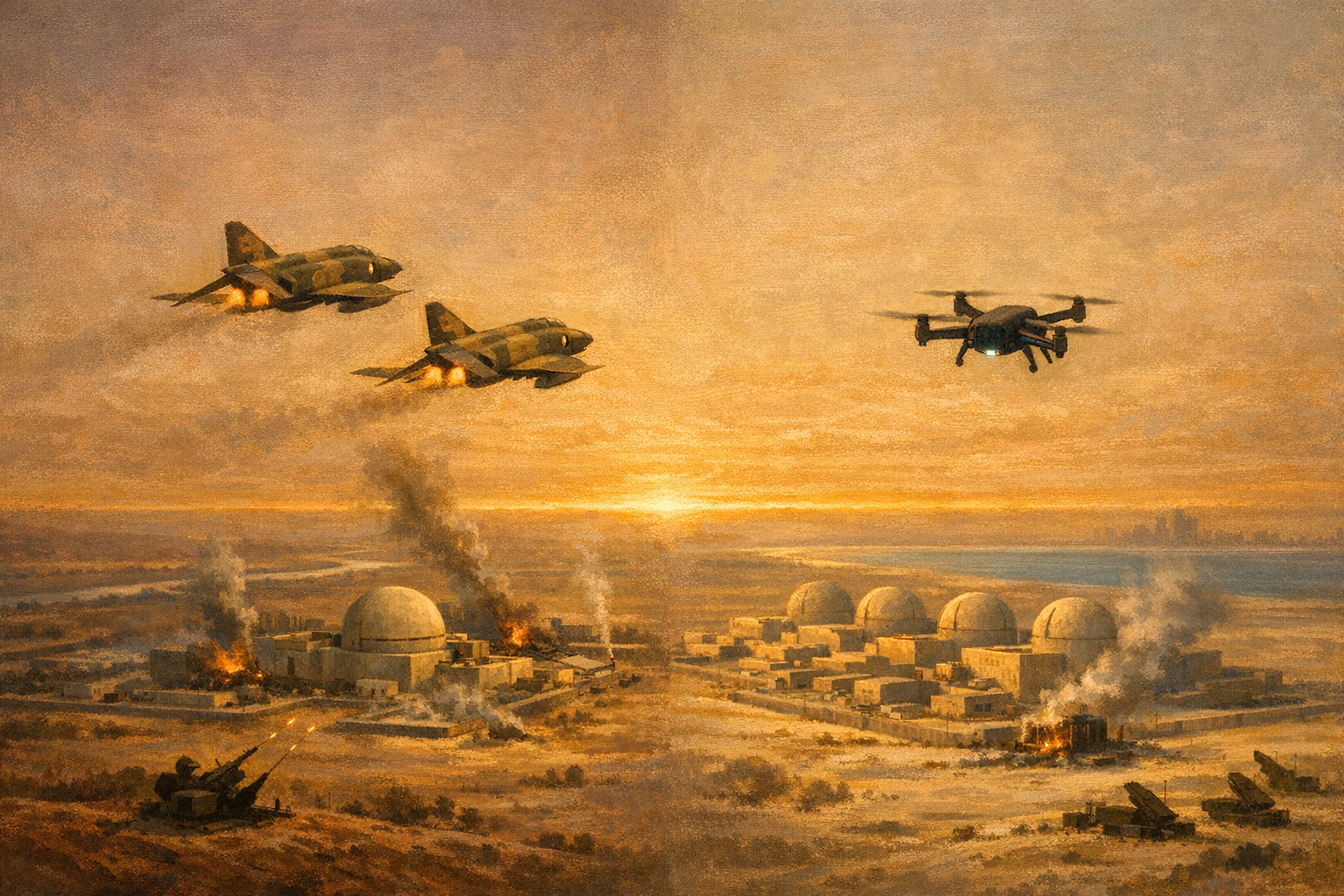
Eight days into a war that was about to last another seven years and nine months, four Iranian F-4 Phantom IIs took off from Hamadan air base in western Iran, refuelled in the air above the Zagros mountains, and crossed the Iraqi border at dawn on 30 September 1980. The lead pilot of each pair pushed his Phantom up to high altitude in a flagrant fan-shaped course that any Iraqi air-defence radar could not have missed. He wanted to be seen. He wanted to be seen on the wrong vector. The two wingmen then peeled off, dropped to the deck below the radar horizon, and turned south-east for a small village on the Tigris seventeen kilometres south-east of Baghdad called Tuwaitha.
What was at Tuwaitha was a complex of three reactors that the Iraqi government had bought from France during the prime ministership of Jacques Chirac in 1975. The largest of them, an Osiris-class research reactor with a forty-megawatt thermal capacity that French engineers had nicknamed Osirak, was within months of going critical with weapons-grade uranium. The Iranian high command, looking out from a Tehran that the Iraqi army was at that very moment shelling, had calculated that an Iraq with a nuclear weapon would be an Iraq with a weapon that could reach Tehran.
The two low-altitude Phantoms reached Tuwaitha unchallenged and dropped a stick of bombs across the reactor complex. They damaged the secondary cooling building, scorched the dome of the containment vessel, killed nobody, and turned for home. The Iraqi radar operators, still watching their high-altitude decoys, missed them on the way out. Five hours later the Iranian Air Force put a photo-reconnaissance F-4 over Tuwaitha to see what they had done. The damage was less than they had wanted. Saddam Hussein's nuclear programme was set back, on the engineers' own estimates, by three months.
It was the first attack on a nuclear reactor in human history.
The world barely noticed. The Iran-Iraq War had begun a week and a half earlier and Tehran was burning. The wire services ran the Tuwaitha strike on inside pages of the second day's papers and let it sink. The International Atomic Energy Agency, which had inspected Osirak in July and certified it for civilian use, issued no statement of grave concern. The United Nations Security Council was occupied with Iraq's invasion of Iran. The precedent had been set in silence. Iran, the country that would spend the following four decades being accused of seeking nuclear weapons, was the country that opened the door to the regional practice of bombing other people's nuclear facilities.
Nine months later, on 7 June 1981, eight Israeli Air Force F-16As escorted by six F-15s flew the same approximate route in from the opposite direction. The Israeli pilots had trained on a one-to-one scale plywood mock-up of the reactor dome in the Negev for half a year. They flew at low altitude across Saudi Arabian airspace without being engaged, popped up over Tuwaitha at three o'clock in the afternoon, and put their sixteen unguided Mark-84 two-thousand-pound bombs, all but two of them, through the dome of the containment vessel. Ten Iraqi soldiers and a French civilian engineer named Damien Chaussepied were killed. The reactor was destroyed beyond repair. Operation Opera was the second attack on a nuclear plant in history.
The world noticed this one. The United Nations Security Council passed Resolution 487 on 19 June unanimously, with American support, condemning Israel's action as a clear violation of the United Nations Charter. The IAEA Board of Governors voted to suspend technical assistance to Israel. The French government, which had lost an engineer and a multibillion-franc reactor sale, recalled its ambassador for consultations. The Reagan administration publicly condemned the strike and quietly slowed F-16 deliveries to Tel Aviv for two months. The Iraqi minister of foreign affairs, who had said nothing in public about the Iranian strike nine months earlier, demanded the United Nations expel Israel from the General Assembly.
What none of the condemners said in public, and what every chancellery in the world knew in private, was that Iran had done the same thing first and that the door now stood open.
Twenty-six years later, in the early hours of 6 September 2007, eight Israeli F-15Is and F-16Is flew low across the Syrian border, jammed Syrian radar with electronic countermeasures whose existence had not previously been declared, and destroyed a North Korean-designed gas-cooled graphite reactor near Deir ez-Zor that the Syrian government had been building covertly with North Korean help. Operation Outside the Box was the second Israeli aerial strike on a regional nuclear facility, the third such strike since 1980, and the first to be conducted in such silence that Damascus refused to acknowledge it had happened at all and that Israel itself would not publicly confirm responsibility for over a decade. The world noticed less than it had noticed Osirak. The taboo had eroded a degree.
Now look at last weekend.
Around midnight on Sunday 17 May 2026, three small armed drones approached the Barakah Nuclear Energy Plant in Al Dhafra, two hundred and twenty-five kilometres west of Abu Dhabi. The plant is the first nuclear power station on the Arabian Peninsula. It consists of four South Korean APR-1400 reactors, supplies roughly a quarter of the United Arab Emirates' electricity, and was certified by the IAEA in 2024 as one of the most strictly inspected and safeguarded civilian programmes in the world. The UAE's air-defences brought down two of the three drones. The third hit an electrical generator on the perimeter, outside the inner security cordon. It started a fire. Nobody was killed. No radiation was released. The reactor units continued to operate. Off-site grid power was restored within hours, the IAEA confirmed.
No state or group claimed responsibility. The UAE's defence ministry called it an "unprovoked terrorist attack." An adviser to the president of the UAE pointed publicly at Iran's proxy network of allied armed groups in the region without naming the state directly. The director general of the International Atomic Energy Agency, Rafael Mariano Grossi, expressed grave concern, and reiterated that military activity that threatens nuclear safety is unacceptable. The lines were the right lines. They were the lines the world has been writing, slightly louder each time, since Osirak.
The fourth attack on a nuclear facility in the Middle East was the first attack on a fully operational civilian nuclear power station in the region's history. The targets of the first three strikes had all been research reactors under construction. The Barakah target was the lights of Abu Dhabi.
Here is the shape of the thing. The rule that civilian nuclear infrastructure in the Middle East is a legitimate military target if your enemies own it was written, in Arabic, by Iran, in 1980. It was rewritten by Israel in 1981, with a heavier hand. It was rewritten by Israel again in 2007, with quieter ink. It has now (probably) been rewritten by Iran again in 2026, with a drone, against a peaceful neighbour that has never declared an enmity. The country that opened the door is the country standing now at a door of its own opening.
The Iranian pilots who took off from Hamadan at dawn on the third Saturday of the Iran-Iraq War understood themselves as defending Tehran from a future Iraqi bomb. They were, on the facts then known, almost certainly right. The Iraqi bomb did not come. But the rule they wrote that morning, that nuclear plants in the region were targets, has now been used against every variant of regional nuclear plant: the research reactor (Iraq, Syria), the civilian power station (the UAE), and against every kind of opponent: Sunni, Shia, Baathist, Alawite, Israeli-recognised, Israeli-non-recognised, IAEA-safeguarded, IAEA-uninspected.
There is no version of regional nuclear safety, civilian or military, that this rule does not now apply to. The rule was free to write. It is going to be expensive to take back.