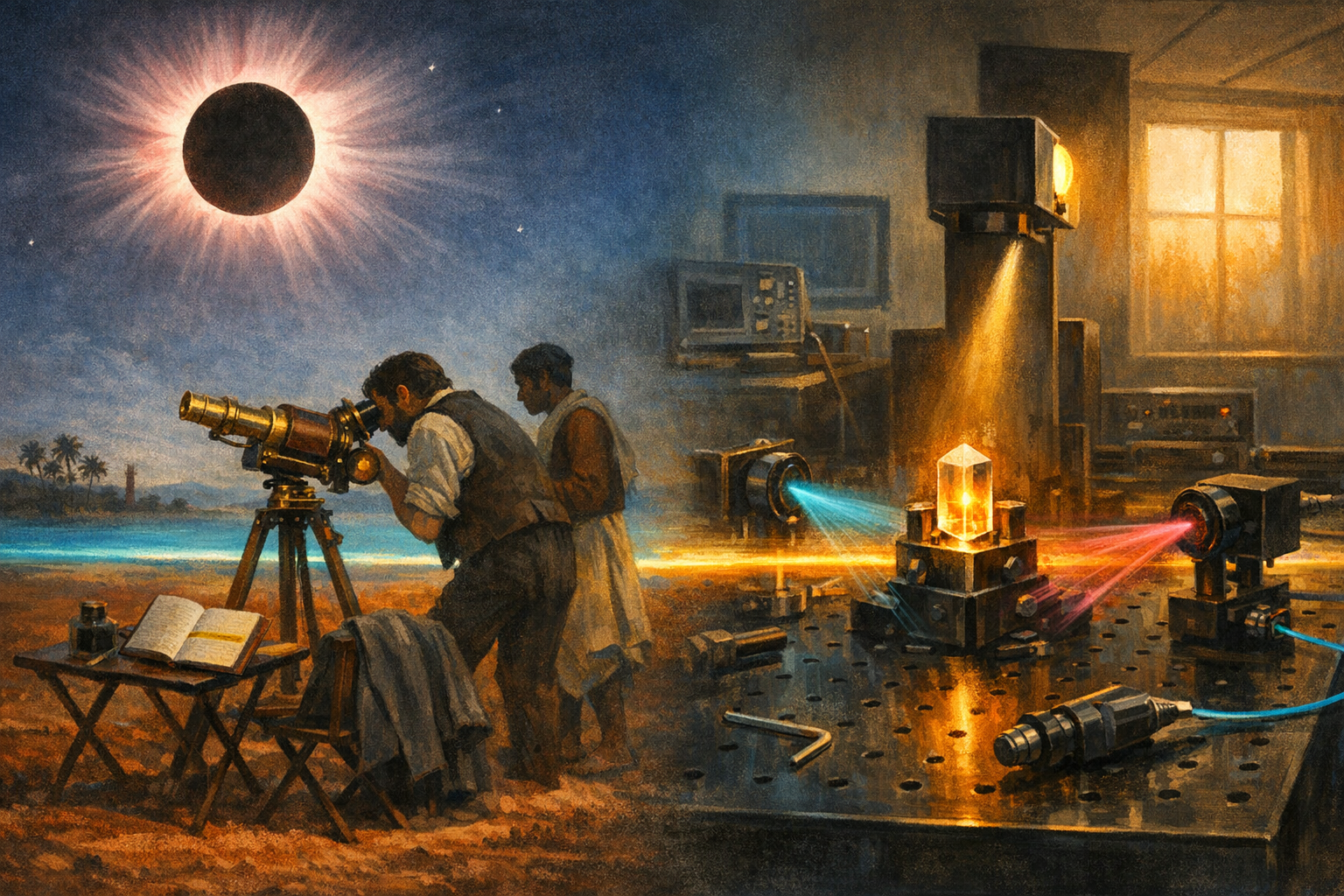
On the morning of 18 August 1868, a French astronomer named Pierre Jules César Janssen stood in a small clearing outside the town of Guntur, in what was then the Madras Presidency of British India, and waited for the Moon to swallow the Sun. He had carried his spectroscope across half the world to be there. When the eclipse came, the corona of the Sun blazed out in pink and white above the dark disc of the Moon, and through his instrument a single sharp yellow line appeared at a wavelength of 587.49 nanometres.
It belonged to nothing on Earth.
Sodium has two yellow lines, the familiar D1 and D2 of every spectroscope handbook. The line Janssen saw was just adjacent to them, in a position where no terrestrial element produced anything. He stayed at Guntur for weeks after the eclipse, refining his measurements on the chromosphere of the Sun by day and writing up his results by lamp at night. Two months later, working from a house off Finchley Road in west London, an English astronomer called Joseph Norman Lockyer observed the same yellow line through a spectroscope he had built himself. Lockyer, by his own account, called his wife in from the next room and asked her to look. The line was unmistakable.
Janssen's report and Lockyer's independent report reached the French Academy of Sciences in Paris in the same session in November. Neither man knew the other had been working on the problem. The French, recognising the symmetry of the moment, eventually struck a bronze medal with both portraits facing each other across it.
Lockyer named the new element. He called it helium, after the Greek word for the Sun, helios. He was so certain it was real that he made it the centrepiece of an entire new astronomical journal he founded the following year called Nature.
It is hard, now, to convey how strange that was. To name an element no chemist had ever weighed, no flask had ever held, no platinum dish had ever heated, was an act of considerable bravado. Other British chemists treated the claim with polite contempt. The line, they said, was probably just a sodium artefact, or a quirk of pressure in the chromosphere, or the well-known tendency of solar spectroscopes to invent things. For more than twenty-six years the only known sample of helium in the universe was the Sun.
The wait ended in the basement of University College London.
In February 1895 a Scottish chemist named William Ramsay received a tip from a mineralogy colleague, Henry Miers, that an American geologist named William Hillebrand had been heating a Norwegian uranium mineral called cleveite with sulfuric acid and noticed an unreactive gas bubbling out. Hillebrand had assumed the gas was nitrogen and moved on. Ramsay had not. He had spent the previous year isolating argon, the first noble gas, with Lord Rayleigh, and he was hungry for the next one. He bought a lump of cleveite from a London mineral dealer for a few shillings, dropped it into acid in his Gower Street laboratory, and collected the gas in a glass tube.
On 26 March 1895 he passed the gas through his spectroscope. The yellow line at 587.49 nanometres flashed out at him. Ramsay sent a sealed tube the next day to William Crookes, the most experienced solar spectroscopist in London. Crookes confirmed the identification the same afternoon. Helium had landed.
Within weeks a Swedish team in Uppsala, Per Teodor Cleve and Abraham Langlet, isolated enough of the gas from the same kind of cleveite to weigh it. The atomic weight came in just above four, the second-lightest element in the universe and the second most abundant in it. Within five years British meteorologists were filling weather balloons with helium. Within forty years the Americans were running an entire helium-extraction industry out of the Texas panhandle to keep their rigid airships afloat. Within seventy years they were using it to cool the magnets of magnetic-resonance scanners and the mirrors of orbital telescopes. The Sun had been hoarding the most useful gas in the periodic table the entire time.
The line is the lesson. Sunlight has always carried more information than we could read. Every photon that fell on a chemist's bench in 1840 was carrying the signature of helium. The chemists were not stupid; they simply did not yet have an instrument that could distinguish 587.49 nanometres from the 589 nanometre line just beside it. When the instrument arrived, the gas arrived with it.
This month, in May 2026, a team based at the Max Planck Institute for the Science of Light in Erlangen and the Department of Physics at the University of Ottawa, led by Hanieh Fattahi at Max Planck and Robert W. Boyd in Ottawa, reported in two preprints that they had used ordinary sunlight, focused through a non-linear lithium niobate crystal, to generate pairs of quantum-entangled photons. The technique is called spontaneous parametric down-conversion. It is normally driven by a tightly tuned laser. Coherent laser light is supposed to be essential. The dogma is that you cannot do it with the messy, broadband, every-direction light of the Sun. The dogma was wrong.
The Max Planck and Ottawa team detected polarisation-entangled photon pairs with a Bell-state fidelity of ninety-four per cent and a Bell-inequality violation of S equals 2.54, comfortably above the classical threshold of 2 that separates ordinary correlation from genuine quantum entanglement. A separate Chinese group at Xiamen University led by Lixiang Chen, publishing in Advanced Photonics the same month, used sunlight in the same way to perform quantum ghost imaging: forming an image of an object using the sister photons of light that never touched it. Both groups got results comparable to laser-pumped setups.
The Sun has been doing this for four and a half billion years. Every blade of grass on a sunny afternoon is being illuminated, in addition to all the other things sunlight does, by streams of entangled photon pairs that have been carrying quantum-correlated information out of the photosphere since before there was an Earth to receive them. The pairs have been arriving the whole time. We did not have an instrument that could read them.
It is the helium story again, and it suggests a third instalment is on its way. Whatever the Sun is doing in May 2026 that we cannot yet detect, our great-grandchildren will pull out of sunlight with an instrument none of us has imagined and call it the discovery of the century. Spectroscopes pulled an element out of the Sun in 1868 that took twenty-seven years to find on Earth. Down-conversion crystals are now pulling entangled photons out of the Sun that have been there since the Hadean. The light has been a library. We are still learning the alphabet.
There is one small consolation in the lineage. Lockyer named his journal Nature in 1869 because he believed that the natural world contained more than human chemistry had yet measured. He turned out to be right about helium. The Erlangen and Ottawa physicists this month have proved him right again, in a way he could not have imagined.
The yellow line was always there. So is whatever comes next.