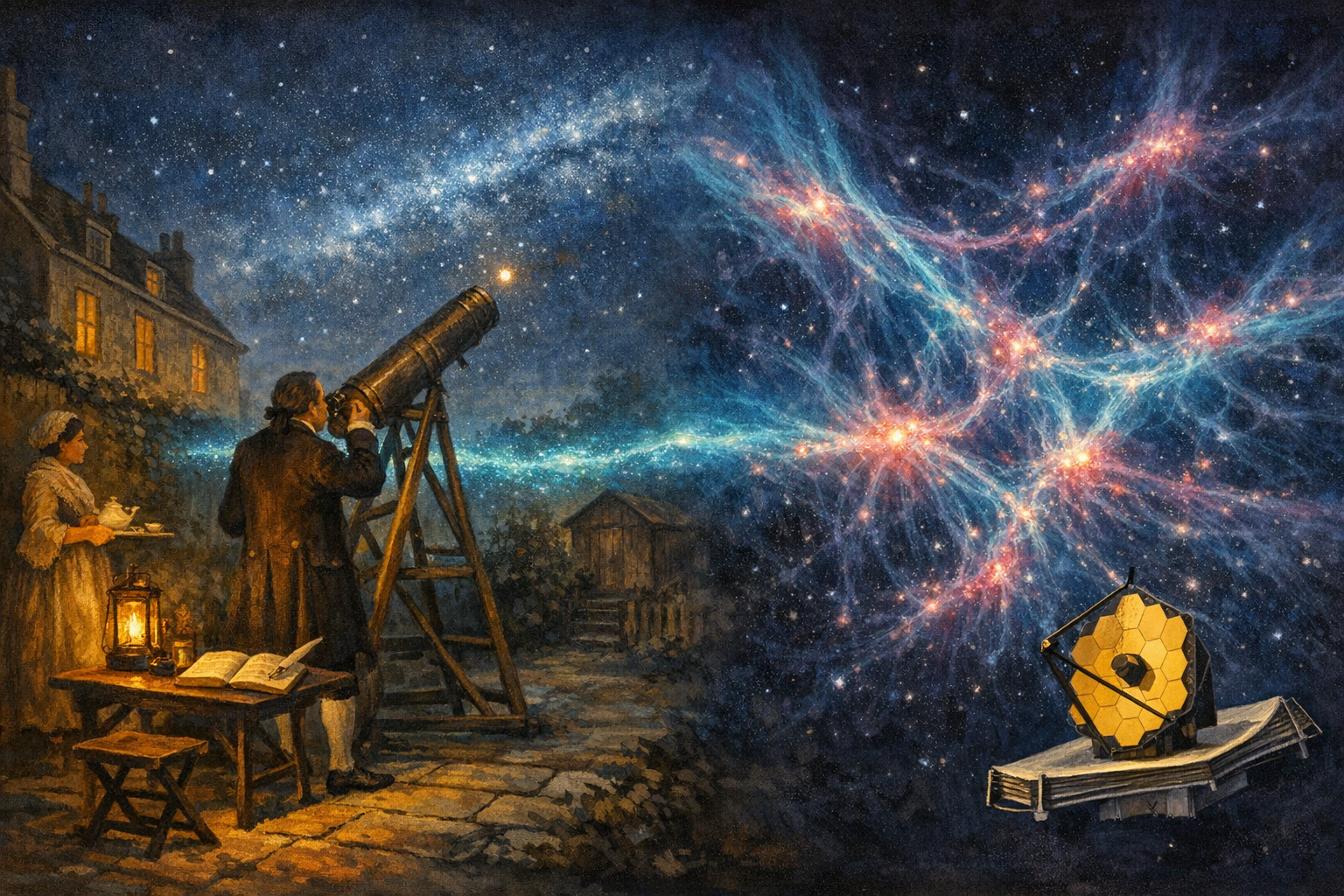
On the night of 13 March 1781, in the back garden of a terraced house at 19 New King Street in Bath, a forty-two-year-old church organist called William Herschel was systematically pointing his home-made seven-foot telescope at every star in the constellation of Taurus, in order of brightness, when he noticed that one of them was not a star.
It had a disc. Stars do not have discs.
Herschel had been born in Hanover in the German-speaking states of the Holy Roman Empire, had played oboe in the regimental band of the Hanoverian Foot Guards, had emigrated to England at nineteen with a small bag of music and very little English, and had supported himself as an organist and a composer in Yorkshire and then in Bath. Astronomy was his hobby. He ground his own mirrors in the cellar of the house at New King Street, sometimes for sixteen hours without stopping, and his sister Caroline, twelve years younger, who had also come from Hanover and lived with him as his housekeeper, fed him by hand at the eyepiece because he could not leave the polishing rig.
He wrote in his observing log that the new object was "either a Nebulous star or perhaps a comet." Four nights later, on 17 March, he looked again. It had moved. It had moved a tiny amount, slowly, against the fixed stars, like a planet, not a comet. He could not yet believe it himself. He told a friend at the Royal Society in London who told the Astronomer Royal, Nevil Maskelyne. By summer the calculation was complete. Herschel had found a new planet, the first new planet in recorded human history, twice as far from the Sun as Saturn, orbiting in eighty-four years. He proposed naming it Georgium Sidus, the Georgian Star, after King George III. The international community of astronomers preferred Uranus.
The King liked the Georgian Star idea well enough that he gave Herschel a royal pension of two hundred pounds a year, on the understanding that the family would move to Windsor and the King could come and look through the telescope when he wanted. Caroline came with her brother. In 1787 the King granted Caroline her own salary, fifty pounds a year, as William's assistant. She was the first British woman ever paid for science. She was four foot three because typhus as a child had stopped her growth, and she lived to ninety-seven, and over the next decade she would find eight comets, catalogue twenty-five hundred nebulae, and become in 1835 one of the first two women elected as honorary members of the Royal Astronomical Society. The other was Mary Somerville.
In February 1785, two years before Caroline got her salary, William read a paper to the Royal Society called "On the Construction of the Heavens." It is published in volume seventy-five of the Philosophical Transactions of the Royal Society of London. The paper is now considered the founding document of stellar cartography.
What Herschel did was a thing nobody had ever tried. He divided the night sky into six hundred and eighty-three small sample fields and, in each field, he counted the stars he could see in his telescope. The technique is known as star-gauging. It is the kind of brute-force statistical observation that requires a sister to fetch you bread and cheese for nine hours a night and to write down the numbers as you call them out. From the distribution of stars across the gauges, William reasoned, you could begin to infer the shape of the system they all belong to.
His answer was as bold as the methodology. The Milky Way, he proposed, was not a featureless cloud of points but a real physical structure: a thin disc of stars seen edge-on from somewhere near its middle. Beyond it, he suspected, lay other similar systems. He was not the first to guess that the Milky Way was a system; Thomas Wright had speculated as much in 1750. Herschel was the first to try to prove it by counting.
He was right. Approximately. He underestimated the size of the disc, and the position of the Sun within it, and the role of interstellar dust (which his star counts could not penetrate). But the basic claim, that the universe has architecture at scales larger than the individual star, is the one that built modern cosmology. Caroline lived long enough to see Lord Rosse's telescope at Birr in Ireland resolve some of William's nebulae into spirals. She did not live to see Edwin Hubble prove in 1924 that those spirals were other galaxies. She did not live to see the cosmic microwave background, or the first hints that the matter we can see is roughly one part in six of the matter that is actually out there.
She would have understood the result that the Hubble Space Telescope's successor reported this month.
On the sixth of May 2026, in The Astrophysical Journal, the COSMOS-Web team of about two hundred astronomers, using the James Webb Space Telescope, published the clearest map of the cosmic web ever made. The cosmic web is the architecture Herschel was guessing at. It is a real, measured, three-dimensional structure: a sponge-like network of dark-matter filaments tens of millions of light-years long, with galaxies strung along the strands like dewdrops on a spiderweb, and vast nearly-empty voids between them. COSMOS-Web catalogued roughly a quarter of a million galaxies inside a single patch of sky just over half a square degree across, and reached back through more than twelve billion years of light-travel time to an era when the universe was less than a billion years old. The same week, an international team using the Very Large Telescope in Chile released the first sharp image ever taken of a single named filament: a strand of intergalactic gas three million light-years long, connecting two distant quasars, fluorescing in the dark.
It is the same project as Herschel's. The instruments have improved by many orders of magnitude. The question has not changed. What is the construction of the heavens?
William Herschel could not have measured what JWST measured. The instrument did not yet exist; the wavelengths it works at had not yet been theorised. But the question, the question of whether the stars form a structure, the question of whether the structure has structures beyond it, the question of how far that nesting goes, is the question he raised in his sister's handwriting in 1785, in volume seventy-five of the Philosophical Transactions of the Royal Society of London, in the original. The questions in science last longer than the instruments. Caroline counted nebulae. We measure dark-matter filaments. We are still asking what they were asking, with better arithmetic.
The Herschels died believing the Milky Way was the universe. We now believe the universe contains roughly two trillion galaxies, organised into the filamentary web they suspected. The next astronomers will look at our cosmic-web map the way we look at Caroline's nebula catalogue. They will say it was an honest first attempt, that it was right in the things it could measure and wrong in the things it could not, and that the question stands.
The construction of the heavens is the work that does not end.