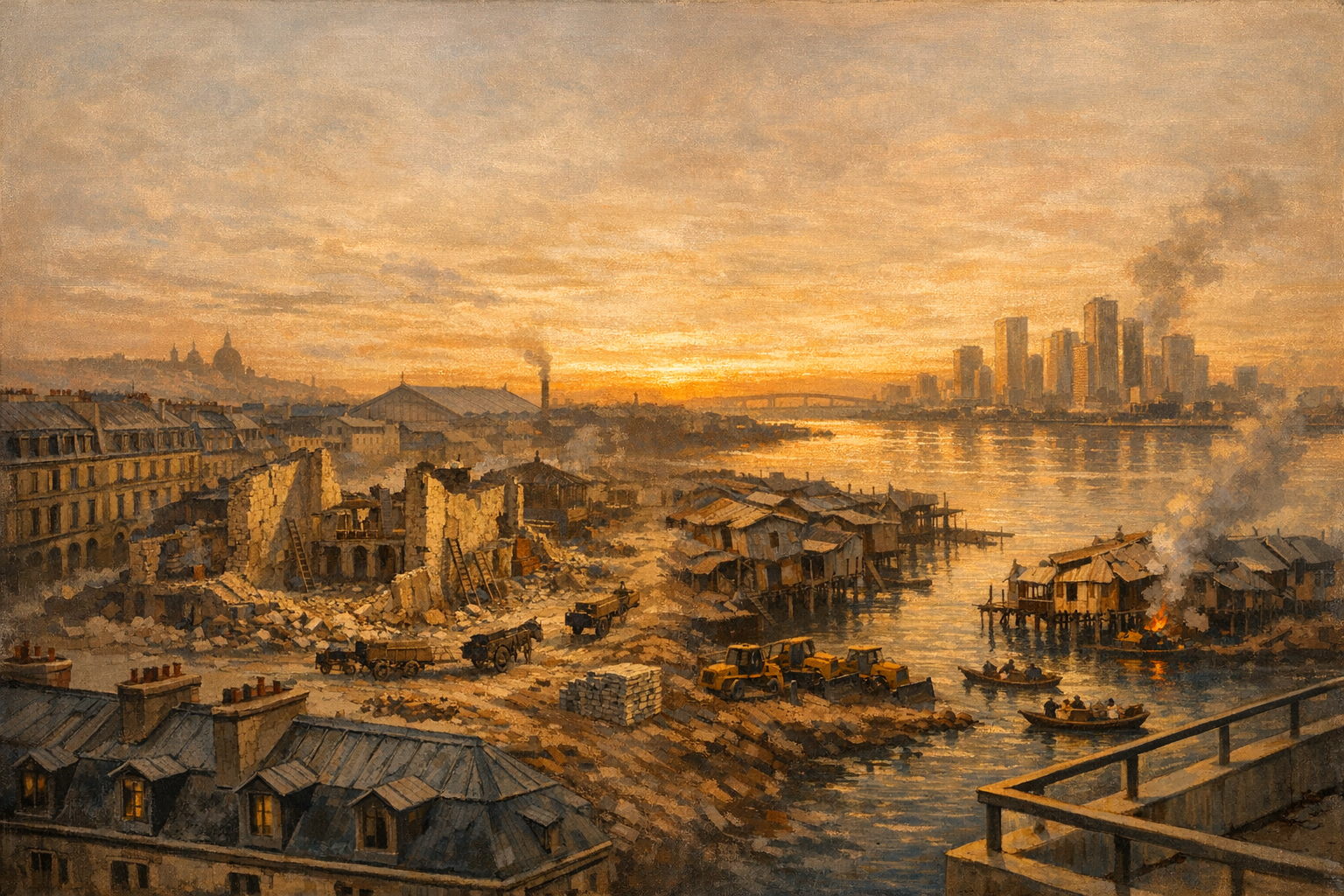
On the afternoon of 29 June 1853, in the painted gallery of the Tuileries Palace, the Emperor Napoleon III unrolled a map of Paris and handed it to a tall, abrasive prefect from Bordeaux named Georges-Eugène Haussmann. The Emperor had taken the throne by coup eighteen months earlier. He had ideas about cities. He spoke three verbs to his new prefect. Aérer, unifier, embellir. Air it. Unite it. Beautify it.
The map was annotated in the Emperor's own hand. Red ink for the boulevards he wanted opened. Blue ink for the parks. The map covered the part of medieval Paris in which more than four hundred thousand people lived in apartments that had been subdivided so many times that whole families slept in single rooms above tanneries, above slaughterhouses, above sewers that ran open down the middle of the street. Cholera had killed about twenty thousand of them in 1832 and about nineteen thousand more in 1849. The water came from the Seine. The Seine also took the waste.
It was a public-health emergency, and Haussmann's authorisation was a public-health authorisation. It was also something else.
Between 1853 and 1870, Haussmann demolished one hundred thousand apartments in twenty thousand buildings, including the house in which he had been born. He cut one hundred and forty kilometres of new boulevards through the medieval city. He built the modern Paris sewer, the modern Paris water supply, the two great urban parks, the dozen smaller ones. He pushed roughly three hundred and fifty thousand Parisians, almost all of them poor, out of the centre of the city to the eastern and northern outliers of the old city walls. The map of the modern Paris banlieue, where the wealth and the poverty of France still divide along a sharp line, is the map of where Haussmann's evictions landed.
Here is the part the tourist brochures leave out. The width of the boulevards was not chosen for the air.
Between 1830 and 1848 the people of central Paris had risen against the monarchy six times. Each rising began the same way. The men of a neighbourhood would take up the cobblestones, drag furniture from the apartments above, overturn carriages, and within a few hours throw up a chain of barricades across the narrow medieval streets. Once a barricade was up, cavalry could not charge through it. Artillery could not be wheeled into position. The army had to fight house to house, lose officers slowly, and watch the rest of the city take fire by example. The 1848 revolution overthrew Louis-Philippe. The 1851 coup that brought Napoleon III to power was a counter-stroke against the assemblies that revolution had elected. The Emperor wanted no third act.
The new boulevards ran wide enough to deny the barricade. They ran straight, with long sight-lines down which artillery could fire from one end to the other. They were paved with macadam, not cobblestones, because macadam cannot be pried up by hand. They cut through the working-class quartiers of Saint-Antoine, Belleville and the Marais like a surgeon's drainage incisions. In 1854, before the boulevard work began, the Emperor had a new barracks built on the Place du Château d'Eau (today's Place de la République), the Caserne du Prince Eugène, designed for three thousand two hundred troops, the largest single military building in the city. Three years later Haussmann opened the Boulevard du Prince Eugène (today's Boulevard Voltaire) straight out from the barracks gate into the heart of the insurrectionary east. The boulevard was declared of public utility in 1857. The Caserne was placed where it was, the architectural historian of the Liberation later wrote, to be able to encircle the faubourg Saint-Antoine in a single morning.
Haussmann, who was not given to euphemism, wrote about this himself afterwards. In his Mémoires, published in three volumes between 1890 and 1893, he describes the cutting of one of his eastern boulevards with the cheerful candour of a man who had won. It was, he said, "the gutting of old Paris, of the neighbourhood of riots, and of barricades, from one end to the other."
There were no more barricades. There was also no more old Paris.
The poor who had been pushed out did not stop existing. They moved to the rim of the old city walls, and when the walls were demolished in turn, to the banlieue beyond. The slum landlords who had owned the medieval tenements were paid compensation at compulsory rates, used the money to build six-storey speculative apartment buildings of regulated façade and bel étage and chambres de bonne under the mansard, sold the apartments to the bourgeoisie that the new boulevards drew in, and made fortunes. Paris was beautiful. Paris was hygienic. The poor lived elsewhere.
Now look at Lagos this week.
Since December 2025, the Lagos State Government has been bulldozing and burning the waterfront settlement of Makoko, the floating fishing community on the northern shore of the Lagos Lagoon that has been there for roughly a hundred and twenty years and that, before the demolitions, was home to about three hundred thousand people. Over three thousand homes have been destroyed. More than ten thousand people are displaced. By the twenty-third of January, twelve people, including two infants, had died from inhaling tear gas during the demolitions. Some families have not been able to find their children. The state's stated justification is to "improve residents' living conditions and minimise exposure to flooding and other hazards." The land, once cleared, is being released to private developers for luxury waterfront housing in what the government's own promotional material has called "the Dubai of Africa."
This morning, the seventeenth of May 2026, National Public Radio led its Sunday programme with a long report from Lagos by the correspondent Emmanuel Akinwotu, recorded at the burned sites of Makoko and Oworonshoki. The Lagos State House of Assembly had ordered a halt to the demolitions in February. The bulldozers kept coming. Court injunctions filed by the displaced families were ignored. The drive that began in Makoko has now extended to Aiyetoro, Ilaje-Otumara, Baba Ijora and Oworonshoki along the lagoon, all of them positioned on what the developers' brochures describe as prime waterfront.
The Emperor's three verbs would have served. Aérer. The settlements are damp and crowded, and the government talks about flood resilience and sewer modernisation. Unifier. The clearances connect the new Lekki-Epe expressway corridor to the older Victoria Island commercial district, the way Haussmann's Boulevard de Sébastopol connected the Right Bank to the Île de la Cité. Embellir. The renderings released by the State show what is planned to replace Makoko: glass towers, a yacht marina, a Dubai-style promenade.
The instruction is the same. The compensation is the same: rates set by the state, paid only to those who can prove freehold title, which the inhabitants of an informal settlement built over water on a tidal mudflat almost by definition do not have. The beneficiaries are the same: speculative developers and the wealthy migrants who will occupy the new towers. The displaced are the same: pushed to outer Lagos, into the satellite towns of the mainland, into the canoes of whatever lagoon remains. The justification is the same. The defence even rhymes. When Haussmann was finally fired in 1870 for his cost overruns, his replacement quietly continued the work. The Lagos legislature's halt was issued in February and ignored by April.
Paris is still defined by what Haussmann did. The maps the United Nations publishes of income, of police killings, of immigration, of the 2005 banlieue riots, of the gilet jaune movement of the 2010s, all of them are the negative photograph of the map Napoleon III handed Haussmann in the gallery of the Tuileries in June 1853. One hundred and seventy-three years later, the city's wealth still occupies Haussmann's bel étages and the city's grievance still lives in Haussmann's exile.
Lagos will be defined the same way, and for at least as long. Whatever rises on the lagoon after the bulldozers finish, the people who are now sleeping in canoes will be sleeping somewhere worse a generation from now, and so will their grandchildren. The Emperor was not wrong that medieval Paris needed sewers. The Lagos State Government is not wrong that Makoko floods. They are wrong about the second half of the sentence. It is possible to air a city without driving its poor into the sea.