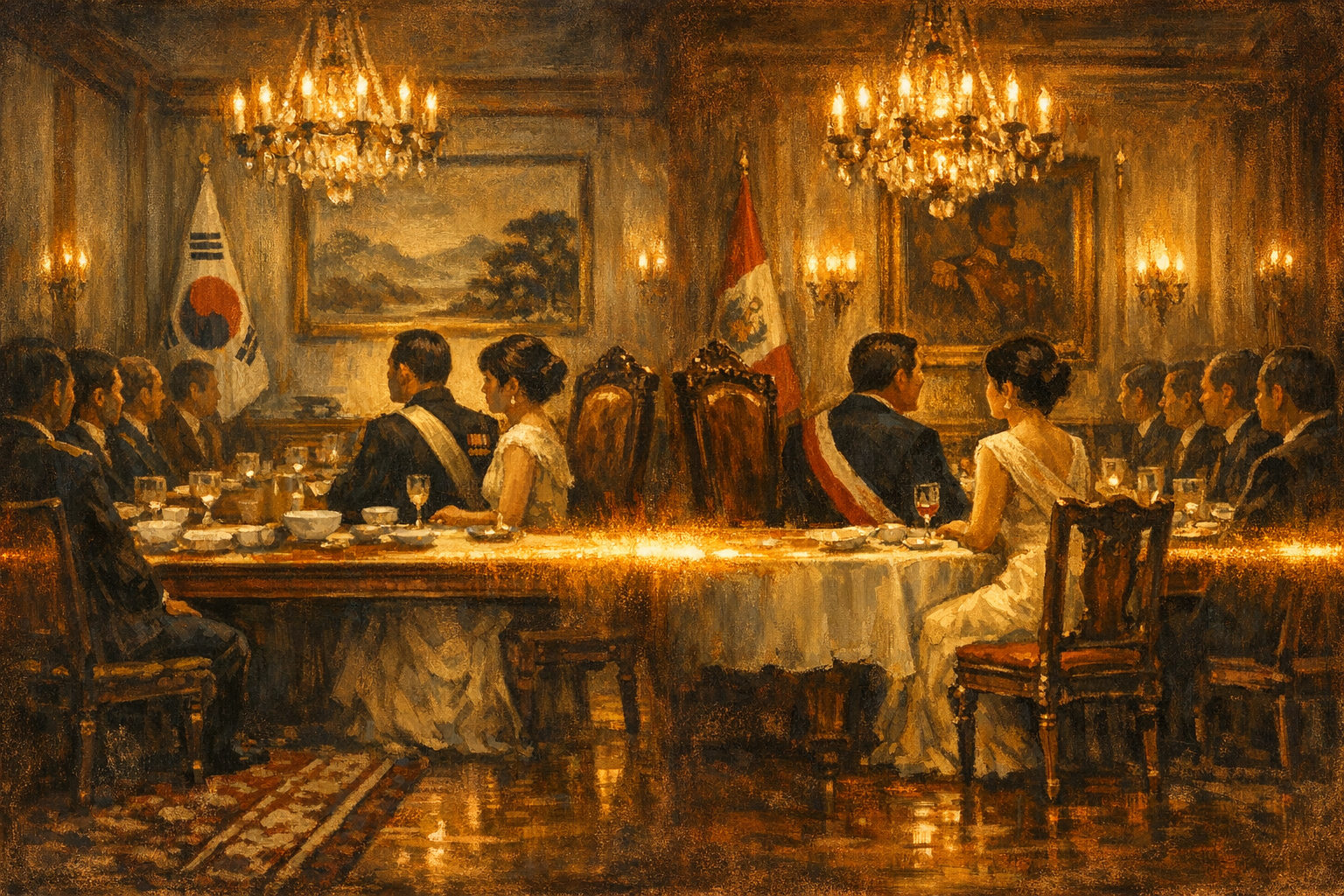
At the National Theatre in Seoul on the morning of 15 August 1974, the president of the Republic of Korea was about to deliver his annual Liberation Day address. His wife, Yuk Young-soo, sat in the front row. Their eldest daughter, Park Geun-hye, was twenty-two years old and had graduated three months earlier from Sogang University with a degree in electronic engineering. She was at her mother's side.
A man named Mun Se-gwang, a Japanese-born ethnic Korean sympathiser of North Korea, walked down the aisle and drew a Smith and Wesson revolver. He fired six rounds at the president on stage. One of them missed the president and struck Yuk Young-soo in the head.
The president's wife died that afternoon in hospital. The president himself returned to the lectern and finished his speech.
The daughter, who had buried her mother and was about to start a postgraduate fellowship in France, came home instead. From August 1974 until October 1979 she served as the de facto first lady of the Republic of Korea. She accompanied her father to state dinners, to factory openings, to summit meetings, to military parades. She was the public face of his domestic life. She was twenty-two years old.
Her father was Park Chung-hee, who had taken power in a military coup in May 1961, ruled for eighteen years, and built the South Korean economic miracle the world would later study. He had also imprisoned dissidents, banned the opposition press, abolished direct elections to the presidency under the 1972 Yushin Constitution, and authorised a torture-and-detention regime against political opponents. The trade-off between his developmental record and his authoritarian record was the central question of South Korean politics for the next forty years. It still is.
On the evening of 26 October 1979 the president dined at a private safe house in Gungjeong-dong with his chief of staff, his bodyguard chief and the director of the Korean Central Intelligence Agency, Kim Jae-gyu. During the meal Kim Jae-gyu pulled out a pistol and shot the bodyguard chief and the president. The president died on the way to the hospital. He was sixty-one. His eldest daughter, twenty-seven, became an orphan that night for the second time.
She withdrew from public life for the next eighteen years. She ran her father's foundation. She did not speak to the press. The South Korean opposition movement built a democracy around her in absentia, won direct elections in 1987, elected the dissident Kim Young-sam in 1992, and elected the dissident Kim Dae-jung in 1997. The country her father had ruled by martial law was being rewritten by the men he had jailed.
Then, in 1998, she walked back into politics. She joined the conservative Grand National Party. She ran for a National Assembly seat in her father's home province of Dalseong. She won. She kept winning. By 2004 she was leader of the party. By 2007 she was running for the presidential nomination. She lost the primary that year to Lee Myung-bak, but the contest had announced what she had decided to do with her father's name. Five years later, in the presidential election of December 2012, she defeated the centre-left candidate Moon Jae-in, a former human rights lawyer who had been imprisoned in the 1970s for protesting against her father's regime.
She was inaugurated as the eighteenth president of the Republic of Korea on 25 February 2013, thirty-three years and four months after her father's assassination.
Here is the part that broke. In October 2016 it emerged that a longtime friend of the president, a woman named Choi Soon-sil, the daughter of a shamanistic cult leader who had been her late mother's adviser in the early 1970s, had been editing the president's speeches, vetting cabinet appointments, and channelling donations from the chaebol (the Samsung, Hyundai, SK and Lotte conglomerates) into two foundations she personally controlled. Choi held no government position. The president denied the relationship was political, then admitted it was. On 9 December 2016, the National Assembly impeached the president by 234 votes of 300. On 10 March 2017, the Constitutional Court of Korea unanimously, eight to zero, upheld the impeachment. She was removed from office.
In April 2018 she was convicted of corruption and abuse of power and sentenced to twenty-four years. The sentence was eventually reduced to twenty on appeal. She served four and a half years in Seoul Detention Centre. On Christmas Eve 2021, President Moon Jae-in, the man she had defeated to win the presidency, pardoned her. She was released on 31 December 2021.
The full arc, end to end, took forty-seven years. Authoritarian father builds the country in his own image. He is assassinated. The country democratises around the daughter while she waits. The daughter returns on the family name, wins the presidency democratically, falls on her own scandal, is jailed, is pardoned by the man she beat, comes home. The country keeps the GDP, keeps the constitution, and keeps the question of what to do with the father's legacy unresolved.
Now look at Lima this week.
On Sunday 17 May 2026, the National Jury of Elections of Peru certified the final results of the first round of the country's presidential election. The Fuerza Popular candidate Keiko Fujimori, fifty years old, daughter of the late ex-president Alberto Fujimori, took 17.19 per cent and advanced to the runoff. The Juntos por el Perú candidate Roberto Sánchez, fifty-seven, a former trade minister in the leftist government of Pedro Castillo, took 12.03 per cent and joins her there. They will face each other on 7 June. Whoever wins becomes the ninth Peruvian head of state in under a decade.
Keiko Fujimori paused her university studies in 1994 at age nineteen, after her parents publicly separated, and served as her father's first lady from age nineteen until his fall in November 2000, when, while abroad for the APEC summit in Brunei, he travelled on to Japan and on the twentieth of November faxed his resignation to the Peruvian Congress (which refused to accept it and instead voted on 22 November to remove him on grounds of "permanent moral disability"). The pattern is exact. So is the rest of it. Her father was elected in 1990, dissolved Congress in an autocoup in April 1992, rewrote the constitution to permit his own re-election, and ran the country through the 1990s on a programme of brutal counter-insurgency against the Shining Path guerrilla and aggressive neoliberal economic restructuring. The Grupo Colina death squad, organised within his security services, killed civilians at La Cantuta in 1992 and at Barrios Altos in 1991. He was convicted in 2009 of those killings and sentenced to twenty-five years. He was pardoned by President Pedro Pablo Kuczynski on Christmas Eve 2017 (the "Christmas pardon"), released, returned to prison after the pardon was annulled, released again on a Constitutional Court order in December 2023, and died on 11 September 2024 of tongue cancer at the home of his daughter Keiko, age eighty-six.
Keiko herself has run for president four times. She lost the runoffs in 2011, 2016 and 2021, each by very narrow margins. Between 2018 and 2020 she served three stints in preventative prison on money-laundering charges connected to the regional Odebrecht corruption scandal. The Peruvian Constitutional Court dismissed the case in October 2025 for lack of legal grounds.
The structural parallels are not interpretive. They are factual. A daughter served as her authoritarian father's first lady from her early twenties. She inherited his political brand. She returned to politics decades later. She built a national party around herself. She kept running.
Park Geun-hye made it across the bridge. She had four and a half years in the Blue House before the scandal that took her down. Keiko Fujimori has lost three times in a row by margins of less than two percentage points each. She is older now than Park was at her inauguration. Her father is dead. The pardon question, the one Park resolved by accepting the prize from her old opponent, has already been settled for the Fujimori family: Peru has pardoned, jailed, pardoned, ordered released, and finally buried the patriarch in the space of seven years.
If Keiko wins on 7 June 2026, she will be the first woman elected president of Peru. The Korean precedent suggests that part may be the easier part.
The country that the father built does not vote against the daughter only because the father is gone. It often votes for her. What it votes against, eventually, is the daughter herself. That is the part that takes time.