1768 to 1864, Pavia and Paris
Spallanzani's Question
Pavia, October 1768. Wake Forest, April 2026. Two hundred and fifty-eight years between an Italian priest's question and the first molecular ingredient of an answer.
Every day, we find the historical story hiding inside the headlines. Riveting narratives that connect the past to the present, and make you wonder what happens next.
You'll receive one email per topic, per day. Pick as many as you like.
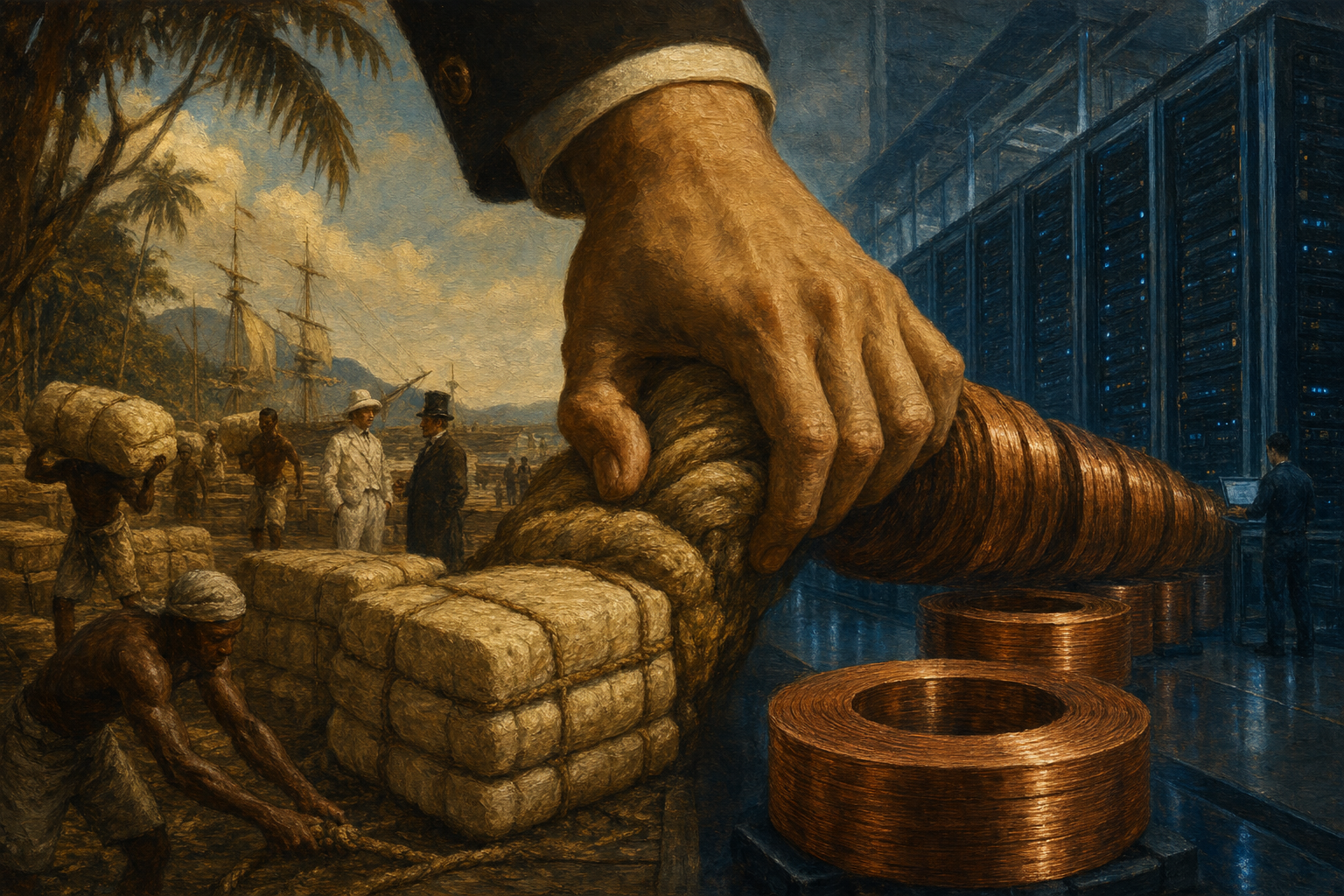
In 1925 the most valuable thing in America was a milky sap from trees on the far side of the world. Rubber ran every car, factory and phone line, Britain's colonies grew about three quarters of it, and Britain had just choked the supply: the Stevenson Plan restricted exports to drive the price from around thirteen cents a pound past a dollar. America, which bought most of the world's rubber, did not just pay. Commerce Secretary Herbert Hoover funded a global hunt for new supply, Harvey Firestone planted a million acres of Liberia, chemists chased synthetic rubber, and the cartel collapsed when the Dutch refused to join and flooded the market. Squeeze a customer hard enough and you do not make him pay; you teach him to never need you again. A century later it is copper for AI data centres and China's grip on rare earths, and the same scramble has begun.
Queen and worker bees hatch from identical eggs, yet one lives for years and lays a million eggs while the others live for weeks and never breed. For a century the textbook answer was a single food: royal jelly. In 2026 a team at UC Riverside showed the real answer is grander. Specialised worker bees build the queen a palace: a peanut-shaped 'royal crib' of custom wax with its own chemistry, and they cluster to keep it warm. Raise a would-be queen in ordinary wax instead and she develops poorly and often dies. The jelly feeds her; the crib crowns her. We love a story with one secret ingredient. Nature almost never works that way.
Pavia, October 1768. Wake Forest, April 2026. Two hundred and fifty-eight years between an Italian priest's question and the first molecular ingredient of an answer.
Hitler invoked an ancient Greek convention in 1936 so the world's leaders could comfortably attend his Olympics. Three years later he invaded Poland. Ninety years later, Putin needed a three-day ceasefire to hold his Victory Day parade.
A Japanese zipper company sued over a 10 percent global tariff in 1971. The warning the 1975 court left behind is what just struck down Donald Trump's tariffs, twice.
Yorktown Heights, 1980. Yorktown Heights, May 2026. The same lab, the same architecture, the same temperature, answering a different question forty-three years later.
Cold Spring Harbor, 1948. Heidelberg, May 2026. A maize geneticist who waited thirty years for vindication, and a consortium that just expanded the human proteome by ten per cent.
Berlin, May 1873. Beijing, May 2026. The same problem, on a much larger scale: what happens to a country that absorbs more money, faster, than it can possibly digest?
Berlin, March 1930. Bucharest, May 2026. The same vote, twice.
Stanford, May 1968. Utrecht, April 2026. Two retired worst cases, fifty-eight years apart. Both written off by a footnote, not a press conference.
Tirana, October 1971. Mbabane, May 2026. The smallest ally casts the longest shadow, until its patron decides otherwise.
Kiel, 1888. Penn State, 2026. Heinrich Quincke spent his career asking what made cerebrospinal fluid move. The answer was waiting in the same place his needle had pointed.