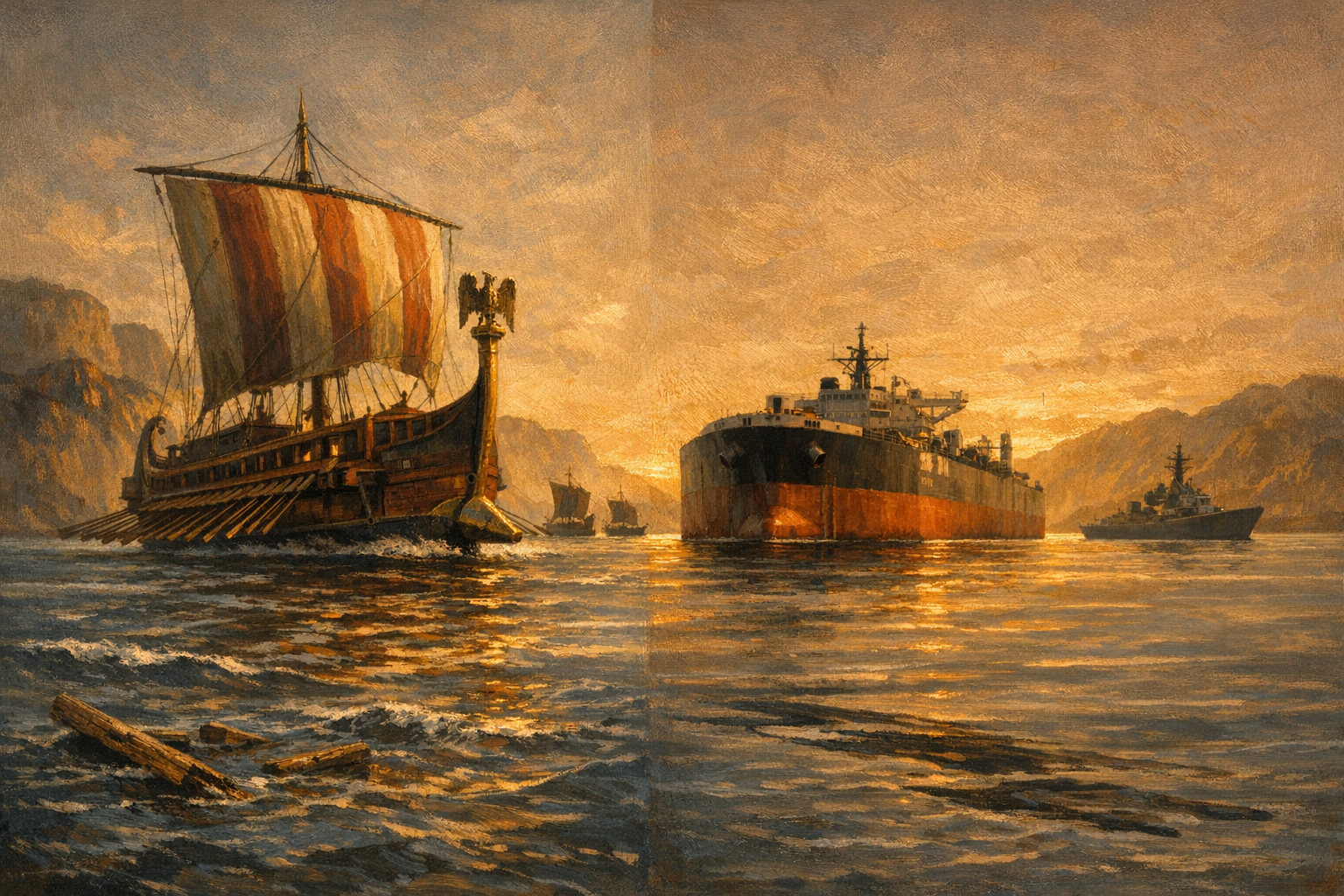
In the late winter of 67 BCE, a tribune named Aulus Gabinius stood up in the Forum and proposed something no Roman had ever been asked to vote on. He wanted the Republic to give one man absolute command of every Roman ship, every Roman soldier, every coast and harbour within fifty miles of the Mediterranean, for three years. The man in question was not named in the bill. Everyone in Rome knew who it was.
The crisis was the price of bread.
For decades the Romans had tolerated the pirates of Cilicia, in the rocky south coast of what is now southern Turkey, the way modern democracies tolerate offshore tax havens: an irritation, a moral embarrassment, somebody else's problem. The pirates ran a confederation of fast galleys out of cliff-protected harbours. They sold their plunder through the slave market on Delos. They were patronised quietly by Mediterranean kings who found them useful. They had never been quite Rome's problem, because Rome had a navy and the pirates, mostly, kept to merchant shipping.
What changed in the 70s BCE was scale. Plutarch, writing a century and a half later from sources now lost, put the pirates at over a thousand ships and four hundred captured coastal towns, including the temple of Artemis at Claros and the oracle at Didyma. They had attacked Roman seaside villas along the Italian coast. They had raided Ostia, the port of Rome itself, and burned a Roman fleet in its harbour. They had kidnapped two serving praetors with their lictors and insignia, and held them for ransom. They had captured, around 75 BCE, a twenty-five-year-old Roman noble on his way to Rhodes to study oratory under Apollonius Molon. The young man told his captors the ransom they had set, twenty talents, was an insult, and suggested they raise it to fifty. He read them his speeches. He threatened, repeatedly, to come back and crucify them. They laughed. His name was Gaius Julius Caesar. He did come back. He did crucify them.
But the pirates as a whole were now choking Rome's stomach. By the late 60s BCE, the grain ships that came from Sicily and North Africa and (above all) Egypt could no longer be guaranteed to arrive. The price of grain in the city rose. The grain dole, on which several hundred thousand of the urban poor depended for daily survival, began to wobble. Bread was political in Rome the way petrol is political in the modern West, only more so. It was the daily reminder that the Republic was supposed to deliver.
Gabinius's proposal was not popular with the Senate. It would put more authority in one Roman's hands than any single Roman had ever held. The optimates, the senatorial conservatives, recognised the danger immediately. Quintus Lutatius Catulus, the elder statesman of the faction, stood up in the Forum and asked the people what they would do if the man they were about to empower were killed in battle. Whom would they put in his place? The crowd shouted back, according to Plutarch: "You." Catulus understood the answer. The law passed.
Pompey was thirty-eight years old. He had already triumphed twice, once over Africa, once over Spain. He had cleared out the last Marian holdouts in Numidia. He had broken the long Spanish revolt of Sertorius. He had been on hand for the mopping up of Spartacus's slaves and had claimed more credit for it than Crassus thought was decent. He took the new command. He took the money, a thousand Attic talents. He took the staff, twenty-five legates. He took the right to draw on any Roman province, and the authority for five hundred ships. He divided the entire Mediterranean and Black Sea into thirteen zones, gave one to each of his senior legates, kept a flying squadron of sixty ships under his own flag, and worked the sea west to east like a man combing a beach.
The western half of the Mediterranean was cleared in forty days. He drove the pirates of Sicily into the arms of the legate off Sardinia, swept down to North Africa, came back up off Liguria, then sailed for Brundisium and the east. The eastern campaign, against the pirates' main strongholds along the Cilician coast, took another forty-nine days. By late summer he had fought a final battle off Coracesium and the war was over. Forty days for the West. Forty-nine days for the East. Roughly three months for the whole sea. The grain ships sailed. The historian Cassius Dio reports that on the news of Pompey's first victories the Roman markets reacted as the futures markets react now, instantly, on rumour. The price of bread in the city fell before he was back.
Here is the part that gets left out of the modern accounts. Pompey did not crucify the pirates. He resettled them. He took the survivors, the ones who had surrendered or been captured, and gave them land. He founded a colony at Soli on the Cilician coast and renamed it Pompeiopolis, "Pompey's town." He sent others inland to Mallus, Adana, Epiphaneia, and to towns in Greece. They became farmers. Their children became Roman citizens. Plutarch records his reasoning, delivered to his staff in private: men do not turn pirate by nature. They turn pirate when the land cannot hold them. Take away the reason and the symptom goes with it. The pirates of Cilicia did not come back.
Now look at this week.
The Strait of Hormuz has been closed since 28 February 2026, when the United States and Israel struck Iran from the air and assassinated the Supreme Leader Ali Khamenei. About a fifth of the world's seaborne oil normally moves through that strait. At peak it carries roughly three thousand vessels a month. In April 2026 the total was a hundred and ninety-one. Around two thousand tankers are stuck inside the Gulf, waiting to be allowed out. Crude has crept above a hundred dollars a barrel. The price of petrol in the United States is the daily reminder that the Republic is supposed to deliver.
The American answer is "Project Freedom," a Navy mission launched on 4 May to escort merchant tankers through the strait. The President paused it two days later, citing "great progress" toward an agreement. He has since rejected an Iranian counterproposal as "totally unacceptable" and declared the ceasefire "on life support." On 1 May, on what would have been the sixtieth-day deadline of the War Powers Resolution, he sent a letter to House Speaker Mike Johnson and to the Senate informing them that the resolution did not apply, because hostilities, in his reading, had been "terminated."
This is the part Catulus would have recognised. Pompey was given the sea by a vote of the Roman people, over the objections of the Senate, because the bread had stopped arriving and only one man had a reputation big enough to fix it. He fixed it. He fixed it fast, and he fixed it humanely, by addressing what made the pirates pirates. But the lex Gabinia was the door through which everything else then walked. The following year another tribune, Manilius, gave Pompey the entire war against Mithridates in the East. The year after that, Pompey came home the richest, most popular Roman alive, with armies loyal to him personally, settlements of former pirates loyal to him personally, and client kings in five eastern provinces loyal to him personally. Within twenty years he was at war with the Senate, and then at war with his old colleague Caesar, the boy whose ransom the pirates had once raised on demand. The Republic that had given Pompey the Mediterranean did not survive the precedent.
The pirates were a real problem. Bread mattered. The sea did need clearing. The Romans were not wrong to grant the power. They were wrong to assume they could take it back.