On a clear Sunday morning in January 1954, fishermen working the water off the island of Elba saw an aircraft come apart in the sky above them. Bodies and pieces of metal fell into the Mediterranean around their boats. They rowed toward what was left, recovered six of the dead before the day was out, and brought them to shore for autopsy.
They had just witnessed the death of the future.
BOAC Flight 781 had left Ciampino airport in Rome an hour earlier, bound for London. It was a de Havilland Comet, the first commercial jet airliner in the world: pressurised, aluminium-skinned, much faster than the propeller airliners it was replacing. Britain, beaten in shipping and beaten in cars, had won the race to the sky. The Comet carried royalty. It was, to use a phrase that did not yet need to be cliché, the future of travel.
At twenty-seven thousand feet over Elba, climbing in clear weather, Captain Alan Gibson stopped speaking to a friend on another aircraft mid-sentence. He was thirty-one years old, a wartime pilot with a Distinguished Flying Cross, one of the youngest captains BOAC had. His last words, on a routine exchange about the weather, were cut off in the middle of a syllable. The Comet tore itself apart in the air. All thirty-five people aboard died before they could understand what was happening.
The British grounded the fleet, looked for the cause, and could not find it. Wreckage rested on the seabed at depth. The Royal Navy spent weeks lifting pieces with grabs and divers. The Comets went back into service on a working theory that the Elba accident had been a freak: lightning, perhaps, or a turbine disintegration.
On the eighth of April, a Comet on a South African Airways charter, registration G-ALYY, left the same airport in Rome, bound for Cairo and then Johannesburg. As it climbed toward thirty-five thousand feet, it broke apart over the sea north of Stromboli, seventy miles south of Naples. Twenty-one people died. This time no one pretended.
The Air Ministry withdrew the Comet from service and handed the investigation to Arnold Hall, the director of the Royal Aircraft Establishment at Farnborough, and to a court of inquiry chaired by Lord Cohen. Hall was thirty-nine years old, a Cambridge-trained engineer who had been at the RAE since 1938 and had built gyroscopic gun-sights and the compressor for Frank Whittle's first jet during the war. He did something no aircraft investigator had ever done. He asked for an entire Comet.
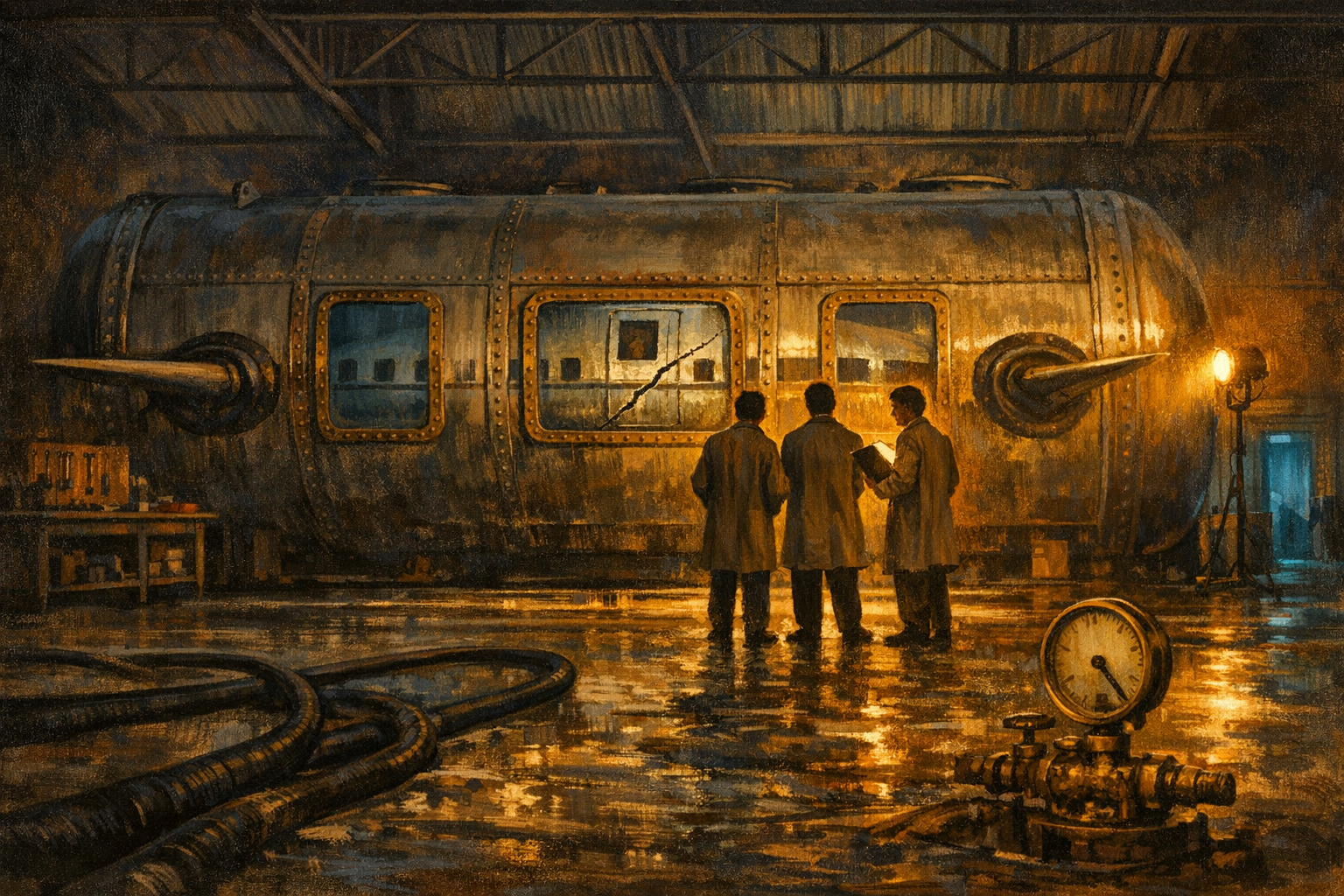
The aircraft, G-ALYU, was towed to Farnborough and slid inside a vast steel water tank specially built around its fuselage. The wings stuck out through rubber seals. Hall's team filled the tank, then pumped water in and out of the pressure cabin to simulate the pressurisation cycle of one flight. Then another. Then another. The tank ran day and night. Each cycle was a flight.
On the twenty-fourth of June 1954, after three thousand and fifty-seven simulated flights, the fuselage of G-ALYU split open. The crack ran from the corner of a square escape-hatch cutout in the forward fuselage. The team drained the tank, photographed the tear, and understood the whole story at once.
Every time the Comet had climbed and descended, the aluminium skin around every square window and every square hatch had stretched and shrunk by a fraction of a millimetre. The stress had concentrated at the corners of the cutouts. Microscopic cracks had grown a few thousandths of an inch with each flight. After roughly a thousand cycles on the average airframe, those cracks ran to ground and the fuselage came apart in the air. The punch-rivet construction used to fasten the skin had made the cracks easier to start.
The cracks had been there from the day the planes rolled out of the factory. No inspection in 1954 was looking for them. No engineering textbook required it. The Comet had been certified, flown by royalty, sold abroad, and held up at every air show as the proof of British genius. The defect had been propagating, silently, in plain sight, the entire time.
De Havilland refitted the surviving Comets with rounded windows and thicker skin. The civil aviation industry rewrote the rules. Every commercial jet you have ever flown on has oval windows because Arnold Hall put a Comet in a tank. The American manufacturers, watching from across the Atlantic, were spared the cost of their own water tank by the British paying it first.
Fifty-six people had to die before the bug was found.
Now, seventy-two years later, in May of 2026, Anthropic's new AI model, called Mythos, has been let loose on the source code of the major American banks. Anthropic announced the programme, Project Glasswing, on the seventh of April. The launch partners include Amazon, Apple, Cisco, Google, the Linux Foundation, Microsoft and NVIDIA, along with the cybersecurity firms CrowdStrike and Palo Alto Networks. The chief executives of Bank of America, Citi, Goldman Sachs, Morgan Stanley and Wells Fargo flew in for the meeting. JPMorgan signed up separately. Anthropic has put a hundred million dollars of model credits and four million in donations on the table.
In its preview runs, Mythos has identified thousands of high-severity vulnerabilities, including bugs in every major operating system and every major web browser. One of the flaws it surfaced, in the OpenBSD operating system that underpins a great deal of financial-services infrastructure, had been quietly sitting in the code for twenty-seven years. The model identifies hundreds to thousands of low and moderate vulnerabilities inside the banks themselves, and chains them together into combinations that would not have looked dangerous on their own.
The vulnerabilities are not new. They were there yesterday, and last year, and the year before. They were there during the 2008 financial crisis. They were there during the Y2K rollover. They were there when those banks were certifying their systems to regulators and selling their security architectures at conferences. What is new is the tank. Mythos can do, in an afternoon, what a thousand human auditors could not do in a decade: read every line of code with patient and unsleeping attention, follow every chain, notice the corner where the stress concentrates.
Anthropic's chief executive, Dario Amodei, has said publicly that the United States has a six- to twelve-month window to fix what Mythos is finding before equivalent Chinese models catch up and begin looking for the same flaws. Kemba Walden, who served as Acting National Cyber Director under President Biden in 2023 and now runs the Paladin Global Institute, has written that the country is not ready: that the sectors most exposed are not the big banks but water systems and power grids, often maintained by under-resourced state and local agencies.
The Comet inquiry's lesson is the one that matters. The failures that killed Flight 781 and Flight 201 were not introduced by sabotage. They were not the result of a moment of carelessness. They were the predictable consequence of a complex system being used in the way it was designed to be used, for long enough that the small unobserved stresses became cracks. The same is true of legacy banking code. No one set out to leave a back door open in 1999. Someone wrote a sensible-looking function, shipped it, moved on, and the function flew for twenty-seven years.
There is one consolation. The Comet engineers eventually built the tank themselves. They were the same profession that had built the aircraft. They understood what they were looking at when it broke. Mythos is a stranger to that code. The water keeps cycling.
Lord Cohen's final report was published on the first of February 1955. It did not blame the designers. It said only that the Comet had been built by people of high skill, who had, in good faith, relied on assumptions that turned out not to hold. The lesson, written in fifty-six lives, was that no complex system can be allowed to fly forever on the assumption that what we cannot see is not there.
The water keeps cycling. The corner is where the crack begins.