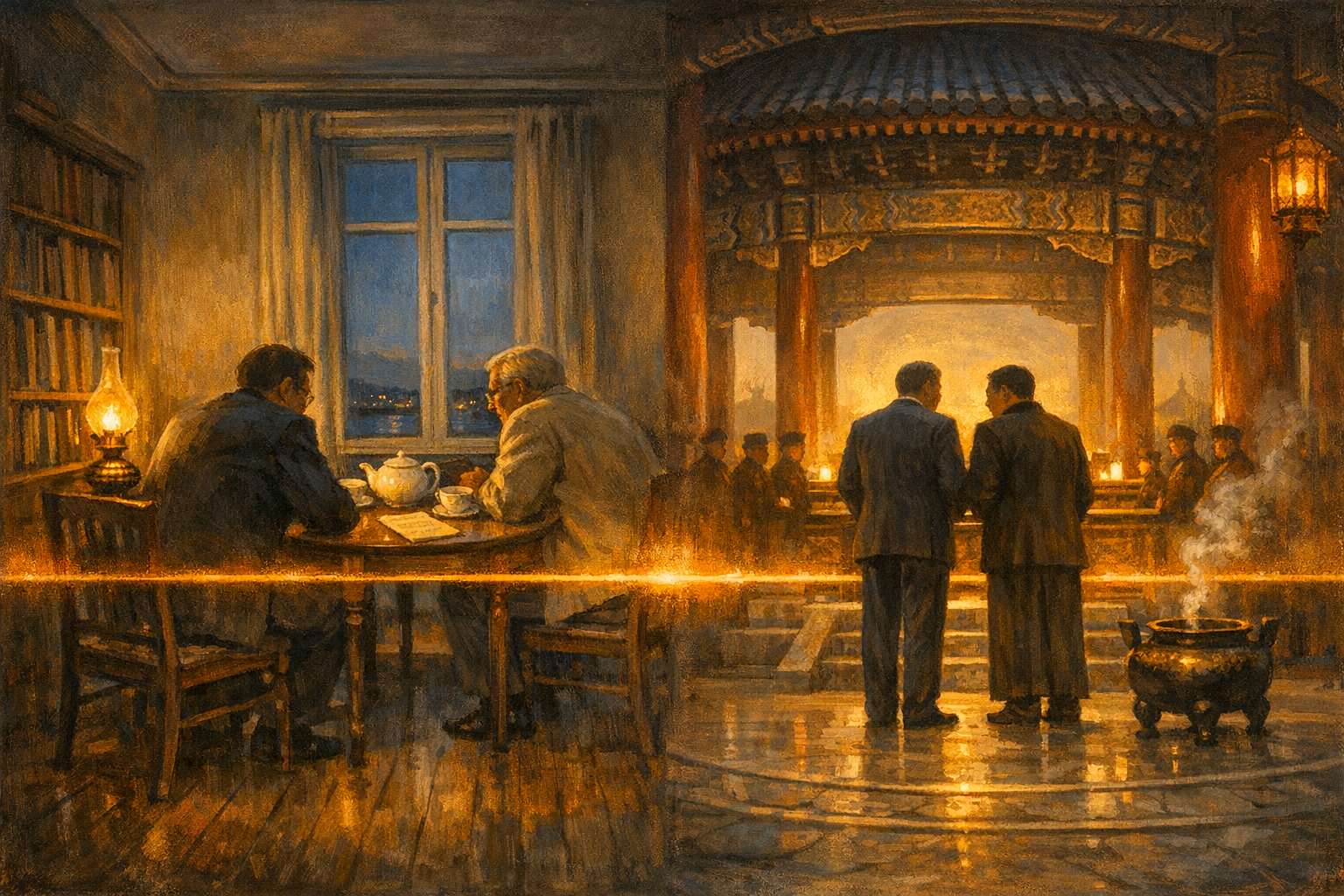
On the afternoon of Sunday 12 October 1986, in a small wooden seafront house called Höfði on the northern edge of Reykjavík, Ronald Reagan picked up his coat and walked out of a meeting with Mikhail Gorbachev. Both men looked, the photographers later said, as though they had been kicked. The summit had been arranged at three weeks' notice. There was no agenda. There was no advance preparation. The two leaders had sat at a small kitchen table on the upper floor of Höfði for two days with only their interpreters present. By Sunday morning Gorbachev had proposed eliminating every nuclear weapon on Earth by the year 2000. Reagan had agreed in principle. By Sunday afternoon the deal had collapsed over Reagan's refusal to confine research on his Strategic Defense Initiative, the "Star Wars" missile shield, to the laboratory. They signed nothing. They issued no joint statement. The press in both countries declared the Reykjavík Summit a humiliating failure.
A footnote that the British Foreign Office files will neither confirm nor deny. Höfði had been the British embassy in Iceland from 1938 to 1951. It was famously haunted. The resident ghost, called the White Lady, was held responsible for portraits falling off the walls and for thumps in the upstairs corridor. In the early 1950s the ambassador John Greenway formally wrote to the Foreign Office asking permission to sell the house because he could not live with her. He got the permission. The Reykjavík city authorities took it over. In October 1986 the Soviet and American delegations sat at the kitchen table on the upper floor and worked the night through.
Now consider what was actually happening at that table, beneath the ghosts.
For forty years the United States and the Soviet Union had governed each other with documents. The 1963 Limited Test Ban Treaty. The 1968 Non-Proliferation Treaty. SALT I in 1972. SALT II in 1979 (which the US Senate never ratified). The ABM Treaty. The Helsinki Accords. The documents had each been negotiated for years by specialists in Geneva and Vienna, marked up phrase by phrase, fought over in twelve-hour drafting sessions. They had stabilised the world by codifying a balance of terror. They had also frozen it. Each treaty foreclosed the next one, because the system the documents created made any change of direction look like betrayal.
At Höfði there were no documents. There was a man from Illinois and a man from Stavropol with two interpreters between them. There was an offer no arms-control specialist would have approved: that both sides eliminate all nuclear weapons within ten years. There was the ghost. There was Gorbachev's chief English interpreter Pavel Palazhchenko, who later wrote in his memoir that the peaceful end of the Cold War was made possible not by hidden negotiations but by the trust that gradually developed between the leaders. And there was, by Sunday afternoon, no deal.
The deal would not have held even if they had signed it. The Soviet Politburo would have refused to ratify the abolition of all nuclear weapons. The United States Senate would have refused. The British, the French, the Israelis, the South Africans and the Indians and Pakistanis would have refused on any of half a dozen grounds. The arms-control specialists who had spent their careers managing the balance of terror would have written devastating critiques in Foreign Affairs.
The deal did not have to hold. The relationship had to.
The Reykjavík summit "failed" on a Sunday in October 1986. In December 1987, fourteen months later, Reagan and Gorbachev signed the Intermediate-Range Nuclear Forces Treaty in the East Room of the White House, eliminating an entire class of weapon. In 1988 Gorbachev told the United Nations he would withdraw five hundred thousand Soviet troops from Eastern Europe. In November 1989 the Berlin Wall came down. In October 1990 Germany was reunified. In July 1991 the START treaty cut strategic nuclear weapons in half. In December 1991 the Soviet Union ceased to exist. None of those things were promised at Höfði. All of them happened because the two men at the kitchen table had decided, without writing anything down, that they trusted each other enough to do something difficult.
Now look at the third week of May 2026 in Beijing.
President Donald Trump arrived at Beijing Capital Airport on the evening of 13 May 2026 for the first state visit of an American president to the People's Republic of China in his second term, accompanied by an entourage of seventeen senior American chief executives including Elon Musk, Tim Cook, Jensen Huang and Larry Fink. On 14 May, in the Great Hall of the People, he and President Xi Jinping conducted formal bilateral meetings on trade, rare earths, semiconductors, agriculture, Taiwan and the Strait of Hormuz. On 15 May, in a gesture without precedent since President Gerald Ford in 1975, the two heads of state walked together to the Temple of Heaven in southern Beijing, the circular sanctuary built by the Ming Emperor Yongle in 1420, where for nearly five centuries the emperors of China prayed for feng tiao yu shun, favourable weather and timely rain.
They did not sign a treaty. Xi described the outcome as "a constructive China-United States relationship of strategic stability." Trump told the press that tariffs had not come up. The commitments on Chinese agricultural purchases were nebulous, the commitments on Iranian oil were tepid, the commitments on Taiwan were verbal, the commitments on the Strait of Hormuz were vague. CNN's analysis the following morning called the visit "more vibes than details."
The vibes turned out to do work.
On 13 May, while Trump was in the air, the Chinese supertanker Yuan Hua Hu, owned by Cosco, carrying about two million barrels of Iraqi crude and broadcasting on its AIS transponder the message CHINESE VESSEL AND CREW, exited the Strait of Hormuz, one of the first sustained transits by a Chinese Very Large Crude Carrier since the war began. The United States Navy did not interfere. On the same day, the Secretary of Defense Pete Hegseth cancelled the planned forward deployment of four thousand American troops to Poland. In late April mainland China had quietly extended approvals for Shanghai residents to apply for individual and group travel to Kinmen, the island sister of Taiwan that had been the flashpoint of the 1958 Taiwan Strait crisis, and the first such travellers were arriving as the summit met. On 14 May the CIA director John Ratcliffe landed in Havana, the first United States government flight to touch down anywhere in Cuba outside the Guantanamo naval base since 2016, and met with Raúl Castro's grandson Raúl Guillermo Rodríguez Castro, the Cuban interior minister and the head of Cuban intelligence. None of these things were in the joint statement. There was no joint statement.
In the British analyst Pippa Malmgren's reading of the week, the symbol of the summit was not a treaty but a circumpunct, the alchemical figure of a dot inside a circle, the unity of opposites at a single point. The Temple of Heaven is a circle drawn around a single altar stone. The Reykjavík kitchen table was a circle drawn around two men. Neither produced a document. Both produced a relationship that subsequent documents could be hung on.
There is a sobering coda. Reykjavík succeeded because one of the two systems was already terminally weak. The Soviet Union spent the next five years dissolving. The United States in 2026 is not weak in the way the Soviet Union of 1986 was, and neither is China. The kitchen-table outcome may run in either direction.
But Gorbachev himself, looking back, named Reykjavík a breakthrough rather than a failure. The document was beside the point. What had passed between the men in the room had been enough to begin.
The men in the room signed nothing in Beijing this month either. What they agreed on, we will learn.