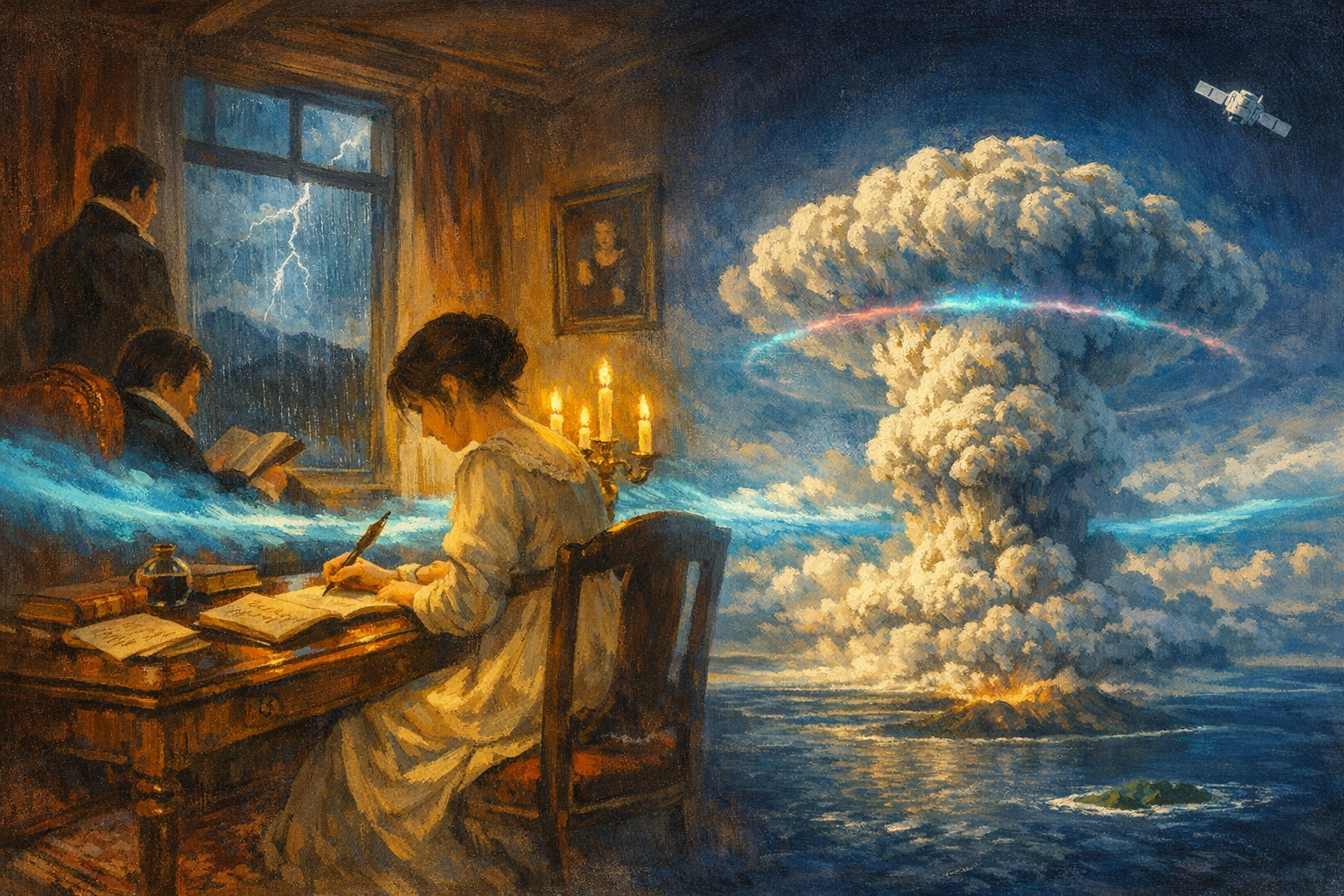
In the summer of 1816, the rain at Lake Geneva did not stop. Mary Godwin was eighteen years old and on holiday with her stepsister Claire and her future husband Percy Shelley at a small lakeside house called the Maison Chapuis, where the floor above was rented to a gentleman in his late twenties called George Gordon, Lord Byron, who had hired a larger house next door, the Villa Diodati, and was spending the wet weeks indoors with his physician John Polidori. The four of them spent most of June trapped inside by storms. They read aloud to each other from a translated German collection of horror stories called Fantasmagoriana. On the evening of 16 June, Byron proposed that each of them write a ghost story of their own. Mary's became Frankenstein. Polidori's became The Vampyre, the first vampire fiction in English.
It was raining because of a volcano on the other side of the world.
On the morning of 10 April 1815, on the small Indonesian island of Sumbawa, the volcano of Tambora produced what is still the largest eruption in human recorded history. The blast was heard sixteen hundred miles away in Sumatra. The eruption column climbed into the stratosphere to more than forty kilometres above the surface of the Earth. Around ten thousand people died on Sumbawa within hours, mostly from the pyroclastic flows that came down the slopes of the mountain at the speed of an express train. Sixty thousand more died across Indonesia in the following months, of starvation and disease, after the ash buried the rice harvest and poisoned the wells. The total toll is the kind of number historians still argue about. Seventy thousand is the lower bound.
What mattered for Mary Shelley was the part of the eruption no one on Sumbawa could see. Tambora threw roughly fifty-five million tonnes of sulphur dioxide gas above the height where weather happens, into the dry upper atmosphere, where the gas combined with water vapour to form a hundred million tonnes of fine droplets of sulphuric acid. The droplets were small enough to remain suspended for years. They were just bright enough, in the right spectrum, to reflect a small fraction of incoming sunlight back into space before it could warm the planet. Global temperatures fell by between four and seven tenths of a degree over the next two years. In the northern hemisphere the cooling was concentrated into one disastrous summer, the summer of 1816, which became known afterwards as the year without one.
Crops failed across New England. Farmers in Vermont and New Hampshire reported frost in every month of the summer. The price of wheat in London more than tripled. Typhus spread through southern Europe. Famine reached Switzerland. Shipping records from the North Atlantic that year describe pack ice at latitudes where summer ice had not been logged before. The rain at Lake Geneva was Tambora's rain. The skies above the Alps in the spring of 1816, painted by J. M. W. Turner across the next several years, glowed an unfamiliar orange-red at sunset, from the high sulphuric haze.
In the months after the eruption no one knew. The connection between Tambora and the cold summer would not be made until the 1920s, when an American climatologist named William Humphreys traced volcanic dust through the temperature record. Mary Shelley believed, in the summer she wrote Frankenstein, that she was simply having unusually bad weather.
The chemistry of the atmosphere has been a wild card ever since.
On 15 January 2022, the underwater volcano of Hunga Tonga–Hunga Ha'apai, north of Tongatapu in the South Pacific, erupted in the largest atmospheric explosion since Krakatoa in 1883. The plume rose past fifty kilometres into the upper atmosphere, the highest column ever measured. The unusual thing about Hunga Tonga was not the height. The unusual thing was that, because the volcano was underwater, the eruption injected an enormous quantity of seawater into the stratosphere along with the ash, and a much smaller quantity of sulphur dioxide than a comparable land eruption would have produced. The expected cooling effect was modest. The expected warming effect from the water vapour was small but real. The atmosphere, the models said, would essentially shrug.
It did something else.
In a paper published in Nature Communications in May 2026, a team led by Maarten van Herpen of the Acacia Impact Innovation lab in the Netherlands, with Professor Matthew Johnson of the Department of Chemistry at the University of Copenhagen, used satellite data to reconstruct what the plume actually did over the months after the eruption. The volcanic ash, mixed with the sudden injection of salty seawater and the ultraviolet light of the upper stratosphere, generated reactive chlorine. Reactive chlorine in the stratosphere is rare but powerful. It attacked methane. Methane, when attacked, breaks down through a chain of intermediate products, the second-to-last of which is formaldehyde, the substance that fixes embalmed tissue and irritates the eyes in the back of woodworking shops. The satellites picked up the formaldehyde signature at thirty kilometres up. It was the highest stratospheric formaldehyde concentration ever recorded, almost twelve parts per billion. From that signature van Herpen and Johnson were able to calculate the rate at which methane was being destroyed by the plume. The answer was about nine hundred tonnes a day.
Methane is the second-most important driver of human-caused warming after carbon dioxide, with a hundred-year warming effect roughly thirty times that of an equal mass of CO₂. The 2022 plume from Hunga Tonga, by inadvertent stratospheric chemistry, was scavenging an amount of methane equivalent to the daily emissions of about two million cows. The Copenhagen group is now working with the Acacia lab on whether the same chlorine chemistry can be reproduced deliberately at lower altitudes to draw methane out of the lower atmosphere, a technique that does not yet exist.
What both eruptions share, despite the opposite signs of their effect, is that the atmosphere did something none of the contemporary models had predicted. In 1816 it cooled the planet harder than the sulphate-aerosol theory of the day expected. In 2026 it has just removed methane through a chlorine chemistry no one had measured at altitude before. The atmosphere is the largest unintentional chemistry experiment on Earth, and it is still surprising the chemists who watch it.
That is the part that connects Mary Shelley to Maarten van Herpen across two hundred and ten years. Both halves of this story are about a planet whose response to an enormous chemical insult was both larger and more interesting than anyone had calculated in advance. Tambora's signal punched through the climate of the next two summers and produced the world's most famous monster novel by accident. Hunga Tonga's signal scrubbed nearly a tonne of greenhouse gas an hour out of the upper sky and may, if the chemistry can be domesticated, give us a tool we did not know how to build.
The lesson is not that we have the climate figured out. The lesson is that we do not.
The atmosphere is doing things up there. It is doing them with the chemicals it has and at temperatures and pressures that are not easily reproduced in a laboratory. It cools us when we do not expect it. It scrubs us when we do not expect it. It also warms us when we do not expect it. Mary Shelley wrote her novel in a summer that was supposed to be ordinary and turned out not to be. Van Herpen's paper was made possible by an eruption that was supposed to do nothing and turned out to do quite a lot.
The right reading of both stories is the same. We live inside a chemistry experiment we did not design. It is wise to be humble about the answers it is going to give us next.