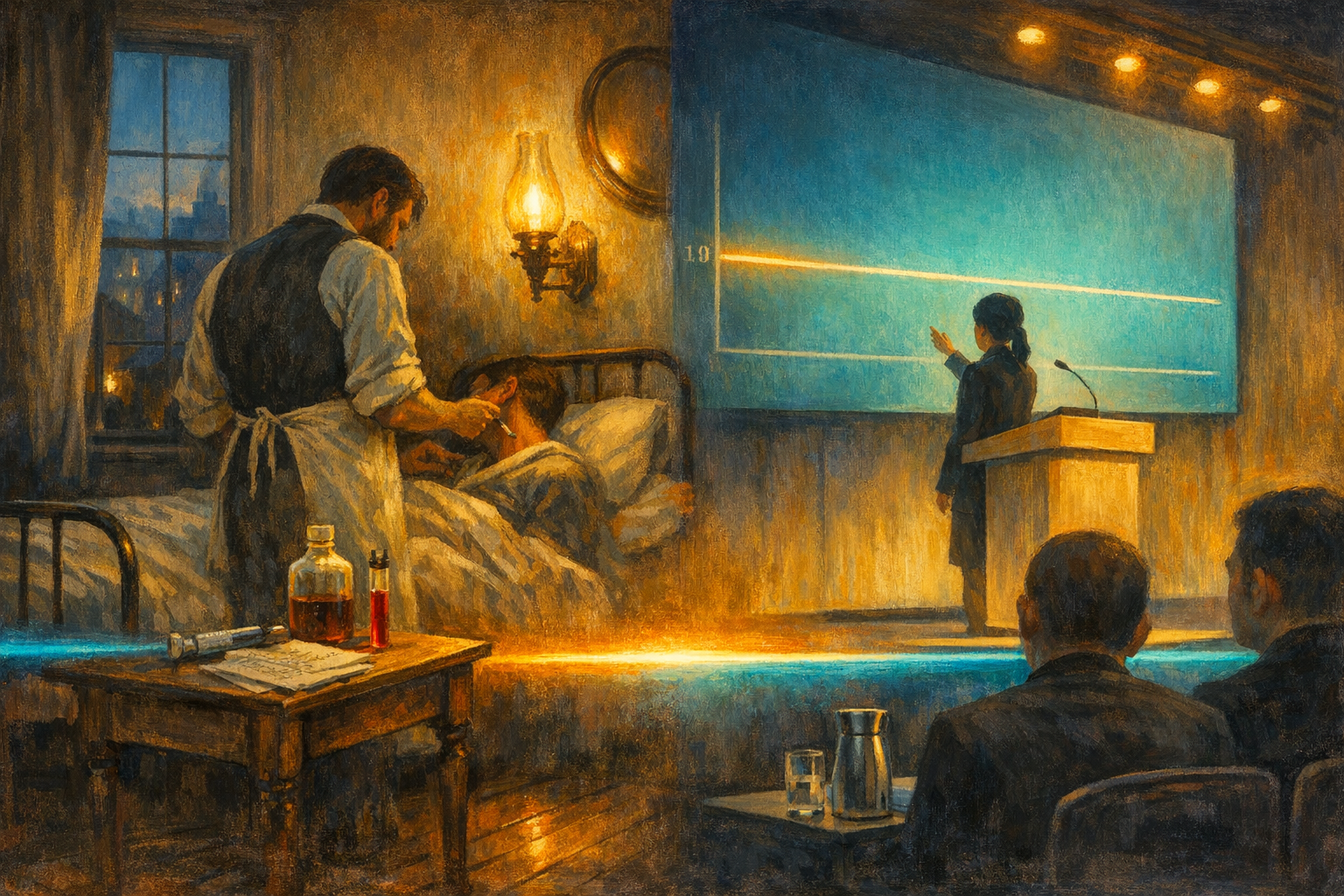
In the autumn of 1890, in his first year of private practice in New York, a twenty-eight-year-old bone surgeon named William Coley examined the right hand of a seventeen-year-old patient called Elizabeth Dashiell. She had crushed it on a train and the swelling had not gone down. Coley operated. He found an aggressive sarcoma. He amputated below the elbow. Ten weeks later Bessie Dashiell was dead.
Coley walked out of the hospital and across town to the records office at New York Hospital. He spent the next three months reading every sarcoma file the building held. He was looking for the patients who had survived.
He found one. A German immigrant named Fred Stein had been operated on for a sarcoma of the neck in 1880. The tumour kept coming back. Stein then caught a severe skin infection called erysipelas in the same wound. His face turned bright red, his temperature went up to forty degrees, and the staff at New York Hospital prepared to lose him. Instead, the tumour shrank away to nothing. Coley tracked the patient down still alive seven years later, the sarcoma never having returned.
This was not the only such case. Coley collected dozens of them from the medical literature of the previous century. In every one, the cancer had retreated only after the patient developed a serious bacterial infection with a high fever. The pattern was so consistent that Coley, who had no formal training in bacteriology, came to a one-sentence conclusion. The fever was the cure.
On the morning of 3 May 1891, in a ward at New York Hospital, Coley took a fresh culture of Streptococcus pyogenes and rubbed it into small cuts on the throat tumour of an Italian immigrant named Zola whom every other surgeon in the city had refused to operate on. He repeated the procedure across the next five months. Eventually Zola developed full erysipelas. His face turned bright red, his temperature went up to forty degrees, and the staff prepared to lose him. Instead, within two weeks of the full infection, the neck tumour was no longer palpable, and the tonsil tumour had stopped growing. Coley tracked Zola down four years later, in excellent health.
Coley moved to the new Memorial Hospital uptown in 1892. By 1893 he had refined his preparation to a mixed bacterial vaccine of heat-killed Streptococcus pyogenes and Serratia marcescens, more virulent than either organism alone. It became known as Coley's Toxins. Over the next forty years, as head of the Bone Tumour Service, he treated more than a thousand patients with it. Roughly half had remissions. Some of those remissions lasted decades.
The medical establishment hated it.
You could see why. The dose was hard to standardise; the side effects, by design, were violent; the underlying mechanism was unknown; and Coley himself was a surgeon with no laboratory and no theoretical paper to explain what he was doing. By the 1920s radiation therapy was the new prestige technology and the new big donors. Memorial Hospital's leadership leaned into it. By the 1930s chemotherapy was on the horizon. By the 1960s, four years after the American Cancer Society quietly put Coley's Toxins on its "unproven methods" list, the preparation was no longer manufactured in any country. Coley had died in 1936 still defending it.
The reason we know what he was doing is his daughter.
Helen Coley Nauts inherited fifteen thousand of her father's letters, the patient files from a thousand cases, and the lifelong conviction that the establishment had been wrong about him. She had no medical training. She taught herself enough biostatistics to grade her father's records herself, retaining only the ones with confirmed pathology, biopsy reports, and verifiable follow-up. In 1953, on a few thousand dollars borrowed from her cousins, she founded the Cancer Research Institute in New York and began publishing monograph after monograph cataloguing the surviving evidence. She kept doing it for half a century. She lived to ninety-three. Her papers now sit in the Manuscripts and Archives collection at Yale.
The institute she founded funded the next generation. By the 1970s, immunologists working with cleaner tools were finding that bacterial endotoxin, the active fraction of Coley's preparation, did indeed activate the part of the immune system that recognises and attacks tumour cells. By the 1990s, mouse studies were showing that fever-grade temperatures alone dramatically increased the trafficking of immune cells into tumours. By the 2000s, the first checkpoint-inhibitor drugs were entering trials. In 2018 the Nobel Committee gave the Prize in Physiology or Medicine to James Allison and Tasuku Honjo for showing that you could take the brakes off the body's own immune attack on cancer. Allison himself had received the William B. Coley Award for Distinguished Research in Basic and Tumour Immunology thirteen years earlier, in 2005.
This month, in early May 2026, at the American Association for Cancer Research annual meeting in San Diego, a UCL oncologist named Kai-Keen Shiu presented the long follow-up data from a British trial called NEOPRISM-CRC. Thirty-two patients with stage two or stage three bowel cancer of a particular genetic type, called mismatch-repair-deficient or MSI-high, had been given three cycles of the checkpoint-inhibitor drug pembrolizumab before their planned surgery. After a mean of thirty-three months of follow-up, none of the thirty-two had relapsed. None of them had died. Every one of them was alive.
This is not how outcomes for stage three bowel cancer normally read.
NEOPRISM-CRC is a small trial. The genetic subgroup it studies is roughly fifteen per cent of all colorectal cancer. The findings will need a larger phase-three trial to change standard practice, and the regulators will rightly be cautious. But the principle is no longer in doubt. A short course of immune activation before surgery, in the right patients, appears to be teaching the body to recognise its own cancer and to remember it well enough to attack any cells that surgery leaves behind. The trial is now being expanded to lung and to head-and-neck cancers in the same MSI-high genetic profile.
Coley would have recognised every part of it. The pre-surgical dose. The deliberately provoked immune response. The standing ovation at the surgical society meeting. The reluctance of the establishment to use the word cure. He would have wanted to ask only one question, and his daughter would have asked it for him: why did it take a hundred and thirty-five years?
The answer is partly that we did not have the right tools. Coley was working with whole bacterial cultures in the era before flow cytometry, before antibodies, before sequenced genomes. He could not have known why his toxins worked in some patients and failed in others, because the receptors involved had not yet been described. The MSI-high genetic profile that NEOPRISM-CRC selects for was not even nameable until the 1990s.
The other part of the answer is harder. Coley was a surgeon, not an Ehrlich-style chemist, and he was working in a profession that was institutionalising itself around two new prestige technologies and did not need a third. He was funny, well-dressed, well-connected, and wrong, in the specific sense that he could not produce a chemical formula. His daughter was right, in the specific sense that she could produce a citation list.
The fever was the cure all along. We are now allowed to say so.