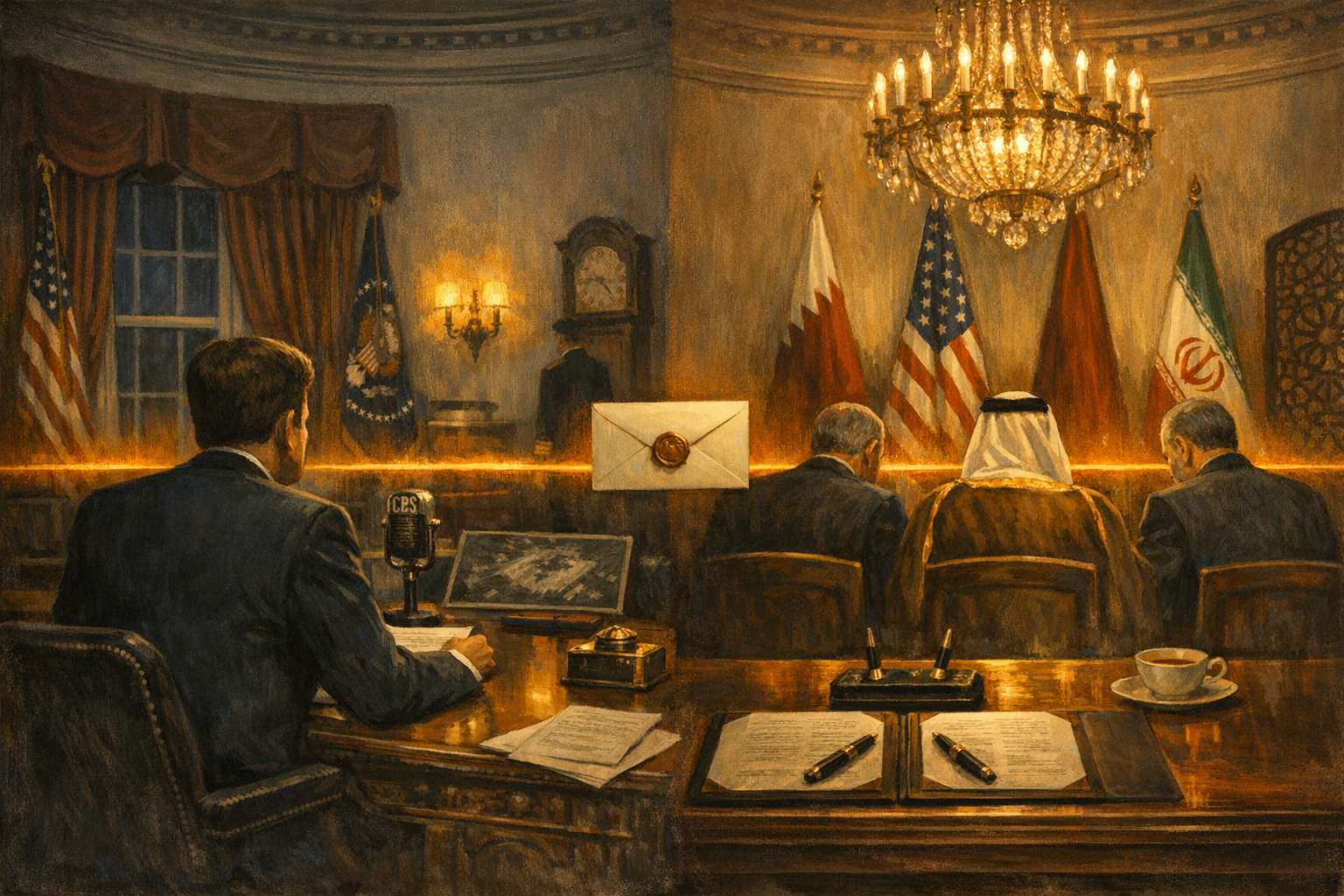
At nineteen hundred Greenwich Mean Time on Monday 22 October 1962, in a televised address from the Oval Office of the White House, President John Fitzgerald Kennedy informed the United States and the world that the United States Navy was, as of that moment, imposing what he called a "strict quarantine on all offensive military equipment under shipment to Cuba." He used the word quarantine deliberately. The legal word would have been blockade, and a blockade in international law is an act of war, an act for which the United States constitution required a congressional declaration. The president did not have one. He had thirteen days, a Central Intelligence Agency briefing pack from the morning of 16 October showing photographs of Soviet medium-range and intermediate-range ballistic missiles being assembled at sites in Pinar del Río province, the carrier task force of the United States Atlantic Fleet steaming for the Florida Straits, and a Soviet ambassador in Washington who had not yet been told what his own government had put on the island ninety miles south of Key West. The world spent the next six days roughly as close to a thermonuclear exchange as it has ever been.
It ended on Sunday 28 October 1962 with a public agreement and a secret agreement. The public agreement: the Soviet Union would dismantle and remove the missiles from Cuba; the United States would publicly pledge not to invade Cuba and would lift the quarantine. The secret agreement, conveyed through Attorney General Robert Kennedy to Soviet Ambassador Anatoly Dobrynin in two private meetings at the Justice Department on the evenings of 26 and 27 October, was that the United States would also quietly withdraw the fifteen Jupiter intermediate-range nuclear missiles it had stationed in Turkey under NATO command since 1961. The Jupiter withdrawal was not in the published agreement. The Kennedy administration insisted to the press, to the Congress, to NATO and to the American public that no such trade had been made. The actual withdrawal of the Jupiters from the Turkish bases at İncirlik happened slowly between April and July 1963 and was attributed publicly to their technological obsolescence. The secret connection between Cuba and Turkey, the actual structure of the deal that had ended the world's closest approach to nuclear war, did not become a public fact until 1989, when surviving members of Kennedy's Executive Committee disclosed it during a Moscow conference marking the twenty-fifth anniversary of the crisis.
The Cuban Missile Crisis is the founding case study in modern crisis diplomacy. It is taught in every international-relations programme on earth. The procedural template (a naval interdiction explicitly avoiding the term blockade; a thirteen-day window; a public deal that satisfies both sides' domestic narratives; a secret side agreement that resolves the actual technical impasse; a thirty-year refusal to acknowledge that the side agreement existed) is the structure that diplomats have spent the last sixty-four years reading and re-reading. The structure has reappeared this weekend.
On the late afternoon of Friday 23 May 2026, the President of the United States told reporters in the Oval Office that an agreement to end the United States Navy's fifty-day blockade of the Strait of Hormuz was "largely negotiated" and would be announced within the next forty-eight hours. By the morning of Saturday 24 May 2026 the relevant terms had leaked to Axios and to the Irish Times. The agreement is structured as a sixty-day memorandum of understanding rather than a treaty or an executive agreement, because a memorandum of understanding does not require Senate ratification. The terms: the United States lifts its naval blockade of the Strait of Hormuz, the Persian Gulf, and the Gulf of Oman. The Islamic Republic of Iran clears the influence mines it laid in the Strait during the fighting in March and April. Commercial shipping resumes with no tolls in either direction. Approximately twelve billion United States dollars in Iranian sovereign assets frozen in correspondent banks since 2026 are released into accounts in Doha and Muscat from which they can be used for civilian fuel-and-food imports. The United States issues a temporary sanctions waiver permitting Iranian crude exports of up to one million barrels per day for the sixty-day period. The Islamic Republic commits to negotiate, over the same sixty days, the suspension of its uranium-enrichment programme and the removal of its existing stockpile of twenty- and sixty-percent enriched uranium. The mediation has been led by Pakistan, with Qatar joining in the final week and additional pressure from Saudi Arabia, Egypt and Turkey. Oman conducted the early shuttle. Pakistan's chief of army staff General Asim Munir flew to Tehran in person on the evening of Wednesday 21 May 2026.
The Cuban-1962 precedent is not a casual reference. It is the actual structural template that the Iran agreement appears to be following.
Consider the legal-word substitution. Kennedy used "quarantine" rather than "blockade" to avoid the act-of-war trigger. The Trump administration's May 2026 deal calls itself a "memorandum of understanding" rather than an "agreement" or a "treaty" to avoid the Senate-ratification trigger and the JCPOA-style political opposition that any treaty with Iran would attract. In both cases the word chosen is technically distinguishable from the obvious word, and that technical distinction does most of the political work.
Consider the public-and-secret structure. Kennedy publicly traded a no-invade pledge for missile withdrawal; he secretly traded the Jupiters. The Iran 2026 deal publicly trades the lifted blockade and the released funds for the cleared mines and the nuclear-restraint commitments. The reported secret-or-quiet components, per the Axios reporting of the draft text, include United States Navy withdrawal from the Persian Gulf and the Gulf of Oman (presented publicly as a redeployment), an arrangement for Pakistan to take physical custody of any uranium-stockpile material that Iran agrees to remove (Pakistan being the only nuclear-armed Muslim state and therefore acceptable to both sides), and a quiet decision by the United States to stop opposing the upcoming election of the Iranian-aligned candidate for the next president of Lebanon. None of those three elements is in the published draft. All three are reported by people who claim to have seen it.
Consider the duration window. Cuba lasted thirteen days because both sides understood that another seventy-two hours would have produced an irrecoverable miscalculation; the agreement was the way of stopping the clock. The Iran sixty-day MOU is the same kind of clock-stopping device, designed not to settle the underlying question (whether Iran is permitted enrichment, whether the Islamic Republic's regional posture is acceptable, whether the United States is the guarantor of Gulf shipping) but to produce a period of time during which the underlying question can be re-litigated without active hostilities. Cuba's clock-stopping deal produced thirty years of cold, structured hostility before the Soviet Union dissolved and Cuba became, in American foreign-policy terms, a small problem. The Iran MOU's clock will tell us only what the next clock has to handle.
Consider the absent victor. Khrushchev in 1962 was very obviously the loser of the public agreement (he had bowed to American pressure, removed Soviet missiles from a Soviet ally's territory in exchange for an American promise nobody could enforce) and was removed from power by his own Politburo two years later. Kennedy was assassinated thirteen months later. The Jupiter trade became public twenty-five years after both men were dead. The pattern is that crisis agreements of this type are paid for, politically, by the leaders who negotiate them, and the strategic benefit accrues to the institutions and the publics they served. Trump's domestic political costs of the Iran agreement (the Republican hawkish opposition, the Israeli government's position, the Cuban-American framing) will be substantial. Iran's Supreme Leader Khamenei, who is 87 and ill, will pay similar costs to whichever faction in Tehran would prefer continued blockade and elevated oil prices to a settlement on these terms.
The Cuban crisis ended with both governments insisting that the agreement was a victory for their side. Within a year both governments had installed direct teleprinter communications (the "hotline") to ensure that no future crisis could escalate so far so fast. Within seven years both signed the Nuclear Non-Proliferation Treaty.
The agreement that ends a blockade is rarely the agreement that ends the war. It is the agreement that ends the worst version of the war. The version that was on the table in October 1962 was the end of human civilisation. The version on the table in the spring of 2026 is much smaller. The structural precedent is the same.