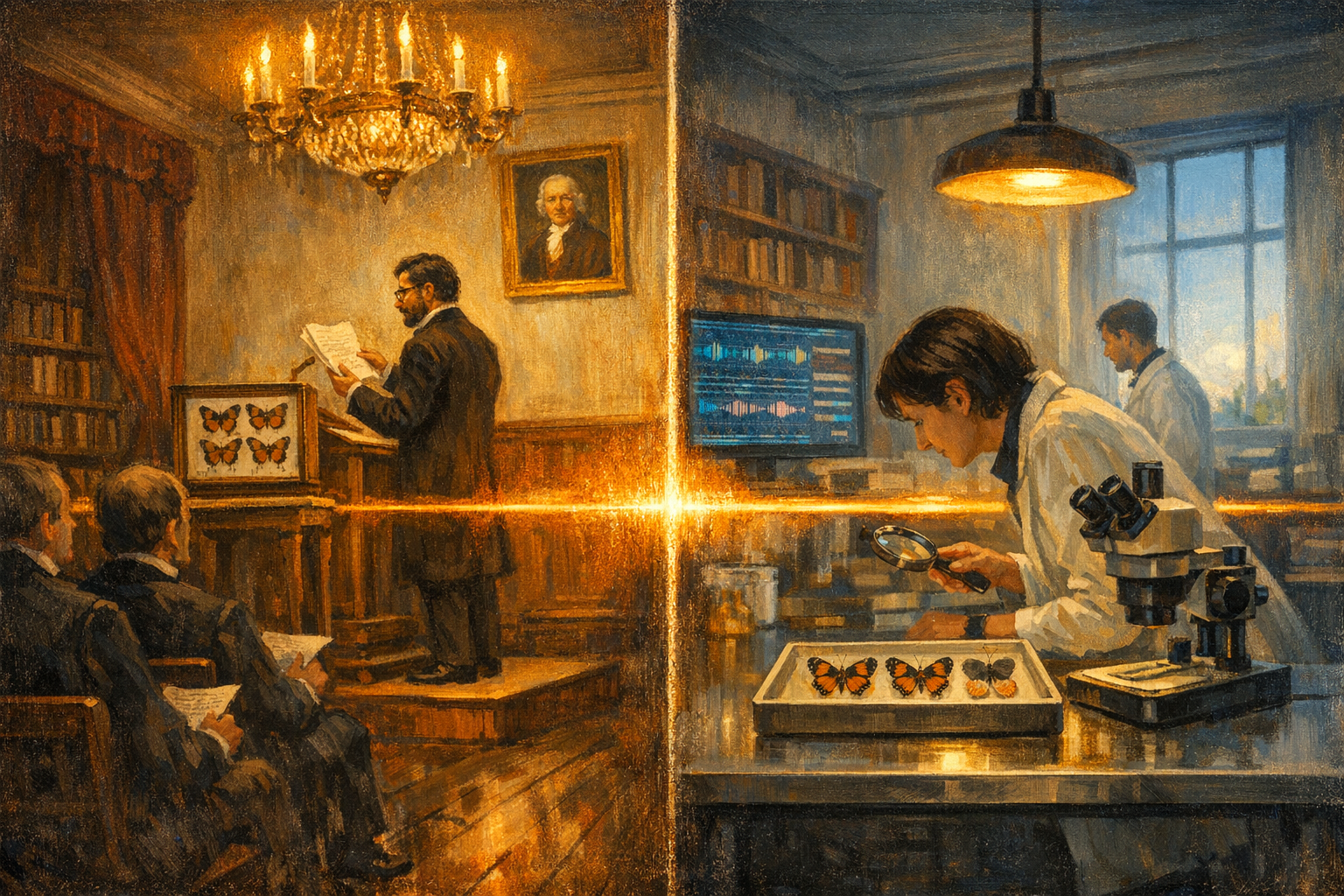
The April morning Henry Walter Bates sailed out of Liverpool for the Amazon in 1848, he was twenty-three years old and had spent most of his life on the floor of a hosiery warehouse in Leicester. He was the second son of a literate, ambitious middle-class family with no money for university, and he had taught himself entomology by collecting beetles in the Charnwood Forest on his days off. He had met Alfred Russel Wallace, a year older, in 1844 when Wallace took a teaching post at the Leicester Collegiate School. The two read Charles Darwin's Journal of Researches together and decided that the natural place for two self-taught Victorian naturalists with no academic credentials was the rainforest. They would pay their way home by selling specimens to the British Museum, to private collectors, and through their London agent Samuel Stevens.
Wallace lasted four years in South America. On the return voyage of 1852 his ship caught fire in the middle of the Atlantic and the entire collection, the journals, the dried bird skins, the boxes of pinned insects, went down with the Helen. He went back to the field three years later, this time to the Malay Archipelago.
Bates stayed. He stayed eleven years. He shipped his specimens home in three separate consignments on three separate ships specifically because he had seen what had happened to Wallace. Every box arrived. By the time he came home in 1859, exhausted and malarial and unable for a long time to face being in a room with other people, he had sent fourteen thousand seven hundred and twelve species of insect, bird, fish, reptile, plant, and mammal back to England. Eight thousand of them were new to science.
The one he could not stop thinking about was a butterfly.
In the várzea flood-forest of the upper Solimões he had repeatedly netted, over hundreds of identifications, two butterflies that looked nearly identical: the same dramatic black-and-orange wing pattern, the same lazy flight, the same flat resting posture. When he laid them out on his collecting board and looked at the wing venation and the abdomen, however, they turned out to belong to completely unrelated families. One was a Heliconius. The other was an unrelated Dismorphia or Mechanitis. He found the same pattern of unrelated lookalikes repeated across dozens of species pairs across the Amazon basin. He noticed that one of each pair was always the chemically defended one, the one a hungry bird would learn from one taste never to touch again. The other was an imposter.
On 21 November 1861, having spent two years writing it up at his desk in Leicester, Bates read a paper before the Linnean Society of London titled "Contributions to an Insect Fauna of the Amazon Valley: Lepidoptera, Heliconidae." The paper appeared in the Transactions the following year. It argued that the unrelated species had converged on the same wing pattern because birds had selected for the convergence: any individual whose wing pattern happened to resemble the unpalatable model lived longer, reproduced more, and passed the resemblance on. It was Darwin's natural selection in action, and the first independent demonstration of it published by anyone other than Darwin or Wallace themselves. Darwin wrote to Bates that the paper was "one of the most remarkable and admirable papers I have ever read in my life." It is now the foundation of the field that bears Bates's name. Batesian mimicry.
What he could not explain, in 1861, was how. There was no Mendel yet. Gregor Mendel was, that month, growing pea plants at the abbey at Brünn but would not publish for another four years, and the paper would sit unread for thirty-five. There was no DNA, no gene, no notion that two completely unrelated lineages might share a deep machinery. Bates wrote that the mimic must have evolved the pattern by gradual modification of its own ancestral form under selection. He could not say more.
On 2 May 2026, in PLOS Biology, an international team led by the Wellcome Sanger Institute and the University of York published "Genetic parallelism underpins convergent mimicry coloration in Lepidoptera across 120 million years of evolution." Working from whole-genome sequencing of seven species of Heliconius and Ithomiini butterflies and a day-flying Chetone moth, populations Bates himself collected in the same Amazon basin in the 1850s, they showed that all of them, across 120 million years of independent evolution, produce their nearly-identical mimetic wing patterns by re-using exactly the same two genes. The genes are called ivory and optix. They are conserved across the entire lepidopteran order. The species themselves diverged before the dinosaurs were extinct, well before the Amazon existed, and yet every one of them, every time the wing pattern was needed, reached into the same two-gene box.
What had evolved, repeatedly and independently, were the regulatory switches that turn the two genes on at the right places in the wing during development. In one of the moth species the switch turned out to be an inversion: a chunk of the chromosome physically flipped backwards in the genome, the same large-scale rearrangement an independently evolving butterfly lineage had hit upon some millions of years earlier. Convergent evolution at the level of the regulatory toolkit. The mechanism the moth used to find the switch turned out to be the mechanism a butterfly had also used. The genome, in other words, has a small repertoire of tricks for solving the predator-recognition problem, and lineages separated by a hundred and twenty million years keep reaching for the same ones.
There is a temptation to call this "evolution isn't random," and the paper's press release leans into the phrasing. The more careful claim is the one Bates would have recognised. The space of solutions to the warning-colouration problem turns out to be very small. Once a lineage discovers that flipping optix on in the right wing region produces a black-and-orange chevron, every subsequent lineage that needs the same chevron is statistically far more likely to discover the same switch than to reinvent a new colour pathway from scratch. Selection finds the toolbox. The toolbox is finite.
A self-taught hosier's son spent eleven years in a flood-forest watching the same wing patterns appear on the wings of unrelated butterflies, and called the phenomenon mimicry. A 2026 genomics consortium, working from his specimens and from descendants of his specimens still flying along the Solimões, found the two genes that have been doing the work for a hundred and twenty million years.
A bird on a branch, faced with a black-and-orange wing in 2026, sees what a bird on the same branch saw when T. rex was a young species: do not eat that one.
Bates would have approved.