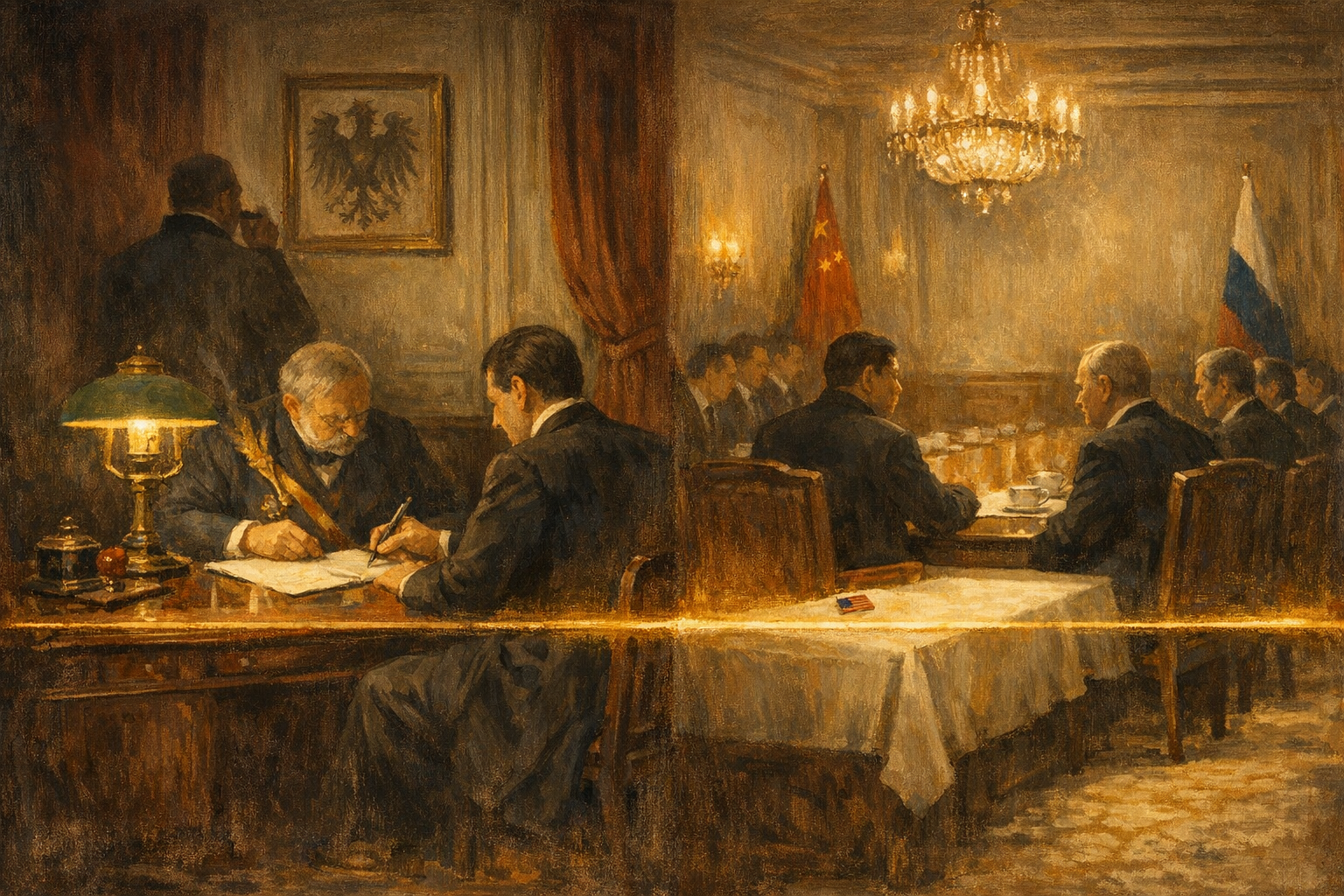
In an office of the German Foreign Ministry on the Wilhelmstrasse in Berlin on the afternoon of 18 June 1887, the State Secretary of the German Foreign Office, Herbert von Bismarck (the son of the German Chancellor Otto von Bismarck, and the man his father had personally placed at the head of the ministry the year before), sat down with the Russian ambassador Pavel Shuvalov and signed a secret document on behalf of his father's government. Two clean copies. Three years' duration. A strictly secret additional protocol that did not enter the German press archives at all. The general public did not learn of the treaty's existence until 1896, several years after it had lapsed, when the disgraced and bitter Bismarck himself authorised the disclosure in the press.
The treaty was the third leg of a stool Bismarck had been balancing since 1873.
The first leg was the public Dual Alliance with Austria-Hungary, signed in October 1879. It bound Germany to come to Vienna's aid if Russia attacked her. It was the cornerstone of the German position. Every chancellery in Europe knew about it.
The second leg was the Dreikaiserbund, the Three Emperors' League. The first version (1873) committed Germany, Austria-Hungary and Russia to consultation on matters of mutual interest. It collapsed in 1878 over the Balkans, where Russia's victory against the Ottomans had alarmed Vienna. Bismarck spent three years restitching it and signed a second, secret version in 1881. By 1887 that one had also fallen apart, again over the Balkans, this time over Bulgaria.
The third leg was the document Bismarck signed on 18 June 1887. The Russo-German Reinsurance Treaty, three years' duration, two articles in the body and a strictly secret protocol. The body promised that if either Germany or Russia became involved in a war with a third great power, the other would remain benevolently neutral, with one carve-out per side. The carve-out for Germany: this provision did not apply if Germany attacked France first. The carve-out for Russia: it did not apply if Russia attacked Austria-Hungary first. The secret protocol went further. Germany pledged to recognise Russia's special interest in Bulgaria and to maintain "benevolent neutrality" if Russia took action to defend the entrance to the Black Sea (the Bosphorus and the Dardanelles) against any "intruder."
It was, in plain language, a separate German deal with the very power against which Germany was publicly bound to defend Austria-Hungary. Russia and Austria-Hungary had fought a war scare in 1885 over Bulgaria. They would fight a real war over Bosnia in 1914. In 1887 Bismarck was on paper Vienna's military guarantor and was secretly Saint Petersburg's mutual-neutrality partner. Both governments knew the public part. Neither knew about the other's secret part. Bismarck knew both.
Here is the part that bears on this week. Bismarck did not want to choose.
He believed two things about Germany's position that no one in either Berlin or Vienna fully shared with him. He believed that Germany's geographic position in the middle of Europe made any war on its eastern frontier potentially a war on two fronts. He believed that a Russia driven into the arms of France was the strategic nightmare that everything else had to be subordinated to preventing. He said so explicitly. He told the Reichstag in 1888 that the Balkans were "not worth the healthy bones of a single Pomeranian grenadier." He told everyone who would listen that the German alliance with Austria-Hungary was a defensive guarantee, not a permission slip for Vienna to provoke Russia in the Slav lands. He kept the Reinsurance Treaty secret partly so that he could continue to tell Vienna whatever Vienna needed to hear.
The arrangement worked. Russia did not run to Paris. France remained diplomatically isolated for the second decade in a row. The peace of central Europe held.
Eight months after Bismarck signed the Reinsurance Treaty, on 9 March 1888, the German emperor Wilhelm I died at the age of ninety. He had been the chancellor's friend, sometimes his only friend, for thirty years. His son Friedrich III succeeded him that same day. Friedrich died ninety-nine days later, of throat cancer. His son Wilhelm II became emperor on 15 June 1888. He was twenty-nine years old.
In March 1890 the new emperor dismissed Bismarck and replaced him with the soldier-bureaucrat Leo von Caprivi. The Russians, who had wanted the Reinsurance Treaty renewed for another three years, made their formal proposal to Berlin in May 1890. Caprivi consulted his foreign ministry. The foreign ministry advised him that the treaty was inconsistent with the public Dual Alliance, that it complicated Germany's diplomatic position, and that maintaining it would require the kind of subtlety only Bismarck had. Caprivi agreed. He refused the Russian renewal. The Reinsurance Treaty lapsed on 18 June 1890.
Within four years, on 4 January 1894, France and Russia signed the Franco-Russian Alliance. Within twenty years there was an Entente Cordiale (1904) and an Anglo-Russian Convention (1907) tying the three to one another. Within twenty-four years there was a war that killed nineteen million people. The historians' debate about whether World War One would have come anyway, or whether Bismarck's bookkeeping could have held the peace for another decade, is now a hundred and ten years old and still active. The terms of the debate were set the morning Caprivi told Petersburg no.
Now look at this week in Beijing.
On the evening of 13 May 2026, Air Force One landed at Beijing Capital International Airport for the first state visit of an American president to the People's Republic of China since 2017. President Trump arrived with seventeen American chief executives. On 14 May, in the Great Hall of the People, he met with President Xi Jinping for several hours on trade, rare earths, semiconductors, agriculture, Taiwan and the Strait of Hormuz. On 15 May the two presidents walked to the Temple of Heaven. No treaty was signed. Xi described the outcome as "a constructive China-United States relationship of strategic stability." The Chinese state press reported a successful summit. The American press reported "more vibes than details."
Forty-eight hours after Trump's departure, on the morning of 19 May 2026, President Vladimir Putin landed at Beijing Capital International Airport for his own two-day state visit. He was received by Xi Jinping in the same Great Hall of the People where Trump had sat the previous week. The Russian and Chinese foreign ministries had been pre-negotiating the visit for six weeks. The energy package they signed on the afternoon of 20 May commits Russia to additional crude and natural-gas deliveries to China over the next ten years, on terms the Chinese side has called "very satisfactory." A separate security joint statement reaffirmed what Putin and Xi had called, in their February 2022 declaration days before Russia invaded Ukraine, a "no-limits" strategic partnership. Putin told the assembled reporters that Russia-China ties were at "an unprecedented historic high." A Chinese foreign ministry spokesperson, asked about the contrast with the previous week, told the press that "China's relations with one major power are not directed against any other."
Al Jazeera's correspondent in Beijing this week wrote that "China holds the cards." A foreign-policy editor at NPR called Xi's posture, in the language Indian non-alignment claimed for itself in the 1950s, "the new neutral superpower."
The phrase that nobody used was the one Bismarck would have recognised. Reinsurance.
China today is the formal partner of Russia and the simultaneous host to American business. Russia today is what Russia was to Bismarck: the unstable but indispensable counter-weight on the eastern flank. The United States today is what Britain was to Bismarck, or what France would have been if she had not been the loser of 1871: the rising rival whose isolation must be maintained, the alliance with whom must be permitted to lapse only on terms favourable to the balancer. The Sino-Russian "no-limits" partnership of February 2022 is China's Dual Alliance. The Trump-Xi summit of May 2026 is China's Reinsurance Treaty. Both are simultaneously in force. Both serve different audiences. Neither cancels the other. Xi, like Bismarck, does not want to choose.
The Bismarckian system worked while Bismarck ran it. It collapsed under a successor who decided that the simpler arrangement, the public treaty with the public ally, was more honest and required less bookkeeping. Wilhelm II thought he was tidying up. He was, in fact, removing the load-bearing wall.
The open question is who plays Wilhelm II in the modern story, and when. It might be a future Chinese leader who decides that the Russian partnership is enough and the American accommodation is not worth the diplomatic subtlety. It might be a future American president who decides that the China-Russia partnership has gone past the point where the United States can permit a parallel relationship with Beijing. It might be a future Russian leader who decides that China is treating Russia as the junior partner and forces a confrontation.
The Reinsurance Treaty lapsed three years after it was signed, the moment its author was removed. The "no-limits" partnership is now four years and three months old. The Trump-Xi summit is one week old.
The thing about a balance held by one man is that it is held by one man.