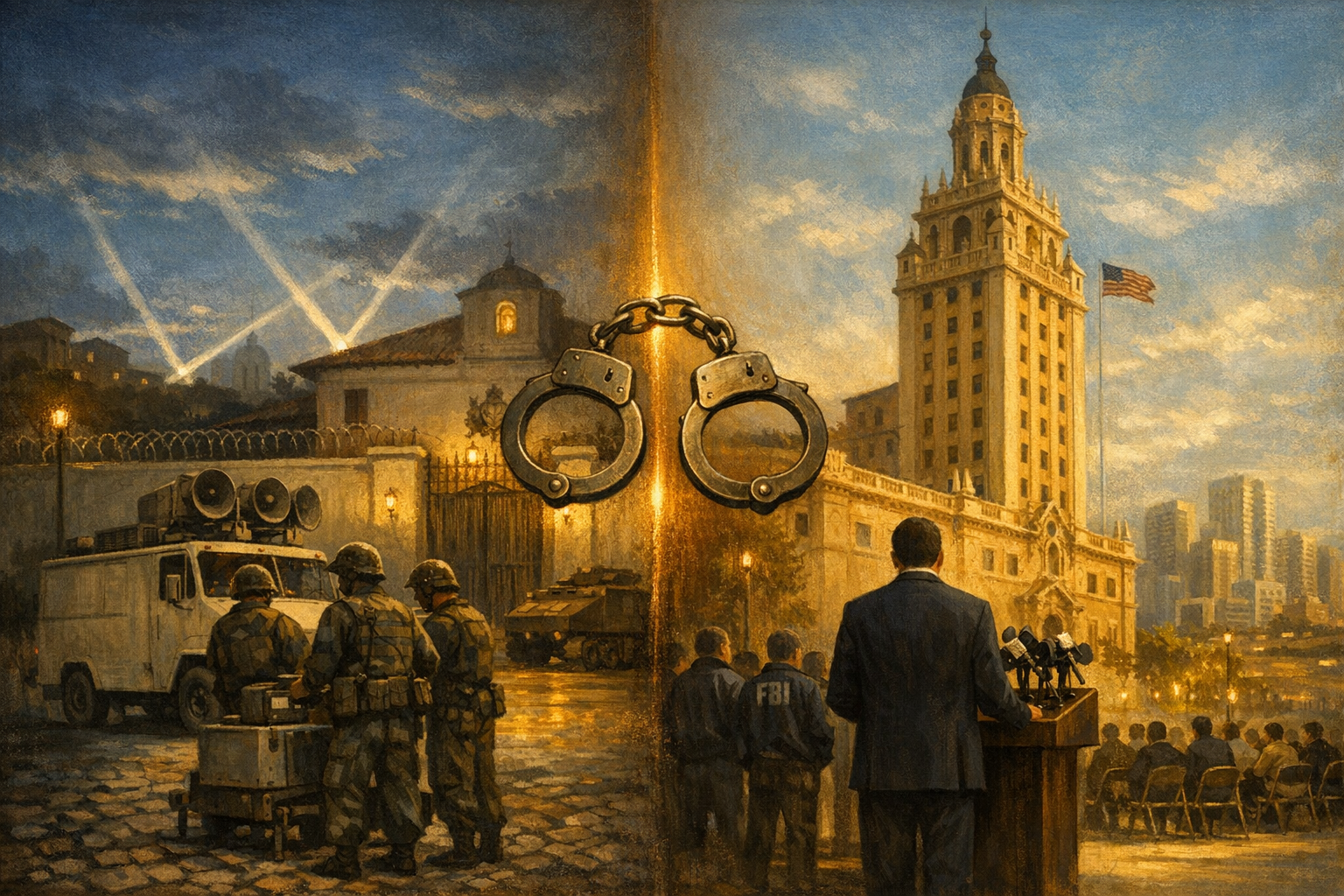
At 9.11 on the morning of Friday 22 May 2026, the United States Attorney for the Southern District of Florida unsealed a federal indictment at Miami's Freedom Tower, the cream-coloured colonial-revival building on Biscayne Boulevard that had served from 1962 to 1974 as the central processing centre for Cuban refugees fleeing the Castro government. The defendant named in the indictment was a 95-year-old man living in Havana. The charges were conspiracy to murder United States nationals, destruction of an aircraft in flight, and murder. The defendant's name was Raúl Modesto Castro Ruz. He had been First Secretary of the Cuban Communist Party until 2021, President of Cuba until 2018, head of Cuba's armed forces for almost half a century, and the younger brother of Fidel Castro. He had not left Cuba since 1959. The chance that the indictment would ever produce a trial in Miami depended on a sequence of events that has happened before, in the same federal courthouse, against the de facto ruler of another Caribbean basin country, thirty-eight years ago.
The conduct alleged in the indictment was the 24 February 1996 shootdown of two Cessna 337 Skymasters belonging to a Cuban-American exile group called Brothers to the Rescue, whose volunteer pilots flew the Florida Straits looking for rafters fleeing Cuba. Two Cuban Air Force MiG-29s engaged the unarmed civilian aircraft over international waters, nine and ten nautical miles outside Cuban airspace by the later International Civil Aviation Organisation finding. Four men died: Carlos Costa, Mario de la Peña, Pablo Morales, and Armando Alejandre Jr., all United States citizens. The Helms-Burton Act, which codifies the United States economic embargo on Cuba into binding law that no future president can lift without congressional approval, became law sixteen days later. The 1996 shootdown is one of the constitutive injuries in the modern Cuban-American political consciousness. It is also the case the United States Department of Justice has been quietly building against Raúl Castro for thirty years.
Here is what has happened before. On 4 February 1988, a federal grand jury in the Southern District of Florida indicted General Manuel Antonio Noriega, the de facto military ruler of Panama, on twelve counts of racketeering and drug trafficking. A second grand jury in Tampa indicted him on related charges the next day. The indictments were the first time a sitting head of state of a foreign sovereign country had been criminally charged in a United States federal court for conduct undertaken while in office. They produced, in 1988 and 1989, a series of diplomatic moves that the Reagan and Bush administrations described as escalating pressure for Noriega to step down. Sanctions. The withdrawal of Panama Canal Treaty privileges. The cancellation of military aid. The freezing of Panamanian assets in United States banks. None of it worked. On the night of 15 December 1989 Panama's National Assembly declared a state of war with the United States, and on the morning of 16 December a United States Marine officer was shot dead by Panamanian Defence Forces at a Panama City checkpoint. President George H. W. Bush ordered Operation Just Cause for the early hours of 20 December.
Twenty-seven thousand United States troops landed in Panama. The fighting lasted five days. Noriega took refuge in the Vatican Embassy in Panama City on Christmas Eve, while United States Army psychological-operations units played heavy-metal rock at maximum volume on speakers outside the embassy gates for ten days. The papal nuncio, Monsignor José Sebastián Laboa, finally persuaded Noriega to surrender on 3 January 1990. He was handcuffed, marched onto a United States C-130 transport aircraft on the tarmac at Howard Air Force Base, and flown directly to Homestead Air Force Base in southern Florida, twenty-five miles from the same federal courthouse where the grand jury had indicted him twenty-three months earlier. He was tried there, in front of Judge William Hoeveler, in a trial that ran from September 1991 to April 1992. On 9 April 1992 he was convicted on eight of the ten counts and sentenced to forty years in federal prison. The conviction was the first time in the history of the United States that a foreign head of state had been convicted by an American jury. He served seventeen years, was extradited to France in 2010 on a money-laundering conviction there, was extradited again to Panama in 2011 on an old murder conviction in absentia, and died in a Panama City hospital on 29 May 2017 at the age of 83.
The Noriega arc is the operational template, and the Trump administration is reportedly studying it. Maduro was the first reuse. On 26 March 2020 a federal grand jury in the Southern District of New York indicted the President of Venezuela on charges of narco-terrorism, conspiracy to import cocaine, and corruption, and the State Department offered a fifteen-million-dollar reward for information leading to his arrest. For five years nothing happened operationally. Then, in the first week of January 2026, a United States special operations forces detachment landed in the grounds of the Miraflores Palace in Caracas during what Venezuelan and Cuban media described as a Russian-mediated political negotiation, seized Maduro, and exfiltrated him through Curaçao. He is being held at the Federal Detention Center in Miami, fourteen blocks from the Freedom Tower, awaiting trial. The Trump administration's announcement at the Freedom Tower on 22 May 2026 sits inside that template. Indictment, escalation, military action, capture, Miami courtroom.
Cuba is not Panama and Cuba is not Venezuela. Eleven and a half million people live on the island, more than four times Panama's 1989 population. The Fuerzas Armadas Revolucionarias have approximately fifty thousand active personnel and a doctrine of territorial defence in depth that has been the central preoccupation of Cuban military planning since 1961. The geography is different: an island, not a Central American isthmus with a permanent United States military presence and a 1903 Canal Treaty granting jurisdictional rights. The legal predicate is different: a 1996 conspiracy-to-murder charge against a 95-year-old man does not produce the same urgency-of-removal narrative that a sitting Latin American head of state allegedly running cocaine into the United States in real time produces. The political target is different: Raúl Castro has not held formal office since 2021 and not run the government's day-to-day affairs since well before that. The actual President of Cuba is Miguel Mario Díaz-Canel Bermúdez, a 65-year-old engineer who has never been indicted in a United States court for anything, who on the afternoon of 22 May 2026 told a Havana audience that Cuba "has the absolute and legitimate right to defend itself against a military assault" and that such an assault would "cause a bloodbath with incalculable consequences."
The Maduro operation succeeded because the political-decapitation theory of regime change matched the constitutional reality of the Bolivarian state: remove Maduro, the chavista coalition fractures, the opposition takes over. The political-decapitation theory does not match Cuba in the same way. Raúl Castro is not the regime in any operational sense, and his removal would not produce a constitutional vacancy or transfer of power. A military operation to seize Castro, if it happened, would be the first United States amphibious assault in the Caribbean basin since the Bay of Pigs in 1961, with all of the strategic, diplomatic, and historical weight that comparison brings. The administration's officials have so far declined to say whether such an operation is being contemplated. They have also declined to say it is not.
An indictment is a piece of paper. An indictment of a head of state is a question. The answer arrived in Panama twenty-two months later. The answer is being administered in Caracas now. The answer is being typed in Havana this week.