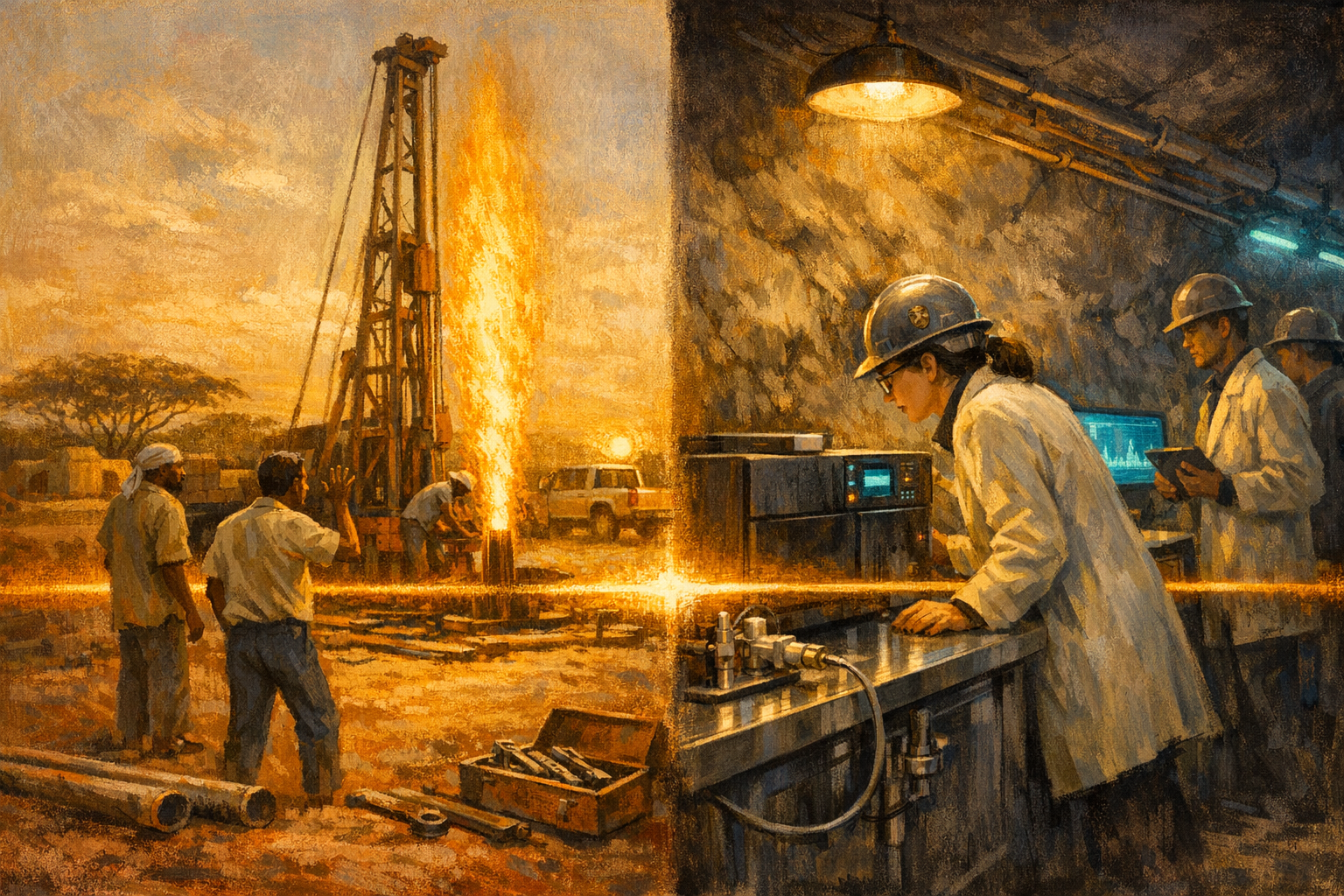
In 1987 in the village of Bourakébougou, fifty kilometres north of Bamako in the savannah country of southwestern Mali, a small drilling crew sank a water well. The work was routine. Bourakébougou had a few thousand inhabitants, no piped water, and a long dry season. The crew got down to around a hundred and eight metres before they hit something unexpected. They were drilling in shales and basalts laid down in the Pre-Cambrian, over a billion years before any village had needed a well, and the drill bit released a gas the team could not identify. One of them leaned over the wellhead to light a cigarette. The well caught fire. Witnesses described a column of flame the colour of pale heat rising several metres above the casing. Nobody was hurt. The well was capped. The crew moved on.
The village forgot about it for the next twenty years.
In 2007, a Malian businessman named Aliou Diallo, who had grown up in West Africa and who ran a small petroleum-services company called Petroma, acquired the prospecting rights to a large area of country around the village, including the old water well that was still in the ground. In 2012 he hired Chapman Petroleum, a Canadian engineering firm, to drill into the original borehole and analyse what came up. The answer, when it arrived, was that the gas was 98 percent pure hydrogen, accumulating continuously, and apparently being generated underground by some natural geological process. There were no fossil hydrocarbons in the well. There was no industrial source nearby. There was, however, an enormous volume of iron-rich Pre-Cambrian rock under the village, and groundwater moving slowly through it. A reaction called serpentinisation, well known to laboratory chemists since the nineteenth century, was producing the hydrogen at a steady rate.
Petroma plumbed a small thirty-kilowatt generator to the wellhead. By the end of 2012, Bourakébougou had its first reliable electricity. The freezers in the marketplace ran on it. The mosque's lighting ran on it. The village chief got a flat-screen television. The site was, and as of this year remains, the first and only commercial hydrogen-from-the-ground operation in the world. Petroma rebranded itself as Hydroma. Block 25, the licensed concession that surrounds the village, eventually grew to 1,264 square kilometres of prospecting rights. Estimated recoverable hydrogen reserves under just that one block now stand at sixty billion cubic metres, equivalent in energy terms to a small national gas field. None of the global energy press paid serious attention until about 2018.
For most of the period during which Bourakébougou was quietly running on hydrogen, the academic geochemistry community was unsure how to take the result. Natural hydrogen had been reported in scattered locations for decades. There were small leaks along mid-ocean ridges, fumaroles in serpentine massifs, anomalous readings in old Russian field surveys. But the orthodox view, set out in standard textbooks, was that any hydrogen produced inside the crust would react away with iron and oxygen long before it could accumulate in commercial volumes. A Malian water well that had been pumping pure hydrogen for over a decade was a problem for the textbook.
The problem has now grown.
On 19 May 2026 a team led by Barbara Sherwood Lollar of the University of Toronto, with collaborators at the University of Ottawa and at the Kidd Creek copper-zinc mine in northern Ontario, published in the Proceedings of the National Academy of Sciences the first sustained, long-duration direct measurement of natural hydrogen discharging from billion-year-old Canadian Shield rocks. The instrument was parked 2.4 kilometres underground in a sealed exploratory borehole. The hydrogen was not a leak. It was being continuously generated at depth, captured in fracture water under pressure, and then released at a stable rate over months of monitoring. The geochemistry mirrored Bourakébougou's: water reacting with deep, iron-rich, ancient crust.
Sherwood Lollar has been arguing for thirty years that something like this should be possible, and that it should be widespread. Her laboratory at Toronto has mapped hydrogen-rich fracture waters in Canadian Shield, in the South African Bushveld, and in the Fennoscandian Shield of northern Europe. The new paper changes the conversation because it moves natural hydrogen from "intermittent leak in odd places" to "continuous planetary process that almost certainly operates everywhere the geology is right." The geology that is right turns out to be roughly fifteen percent of the Earth's continental crust.
The economic implication is what the gold-rush press is currently spinning out of control. Exploration leases for "white" or "gold" hydrogen are now pegged across Australia, France, Spain, Albania, the United States Mid-Continent rift, the Canadian Shield, and large sections of the Sahel. The United States Geological Survey published a January 2025 white paper suggesting that subsurface hydrogen reserves could be sufficient to satisfy global hydrogen demand for two centuries. Several venture-funded start-ups, of varying credibility, are drilling speculative wells in Kansas, Nebraska, Lorraine and Western Australia. Almost none of them have produced a Bourakébougou-scale flow rate. Some of them never will. White hydrogen will follow the shape of every other extractive boom: a fraction of the wells will pay off, most will not, and somewhere a small number of patient operators will spend a decade quietly proving the resource is real.
What is harder to dispute is that the planet has been making clean fuel under our feet for a billion years and we did not know to look. The proof has been running a freezer in a Malian village since 2012. We had to publish thirty years of laboratory chemistry, run a borehole 2.4 kilometres into a Canadian mine, and put a continuous monitor on it before the rest of the world noticed.
A bored worker leaned over a water well one day in 1987 to light a cigarette. The flame is still going.