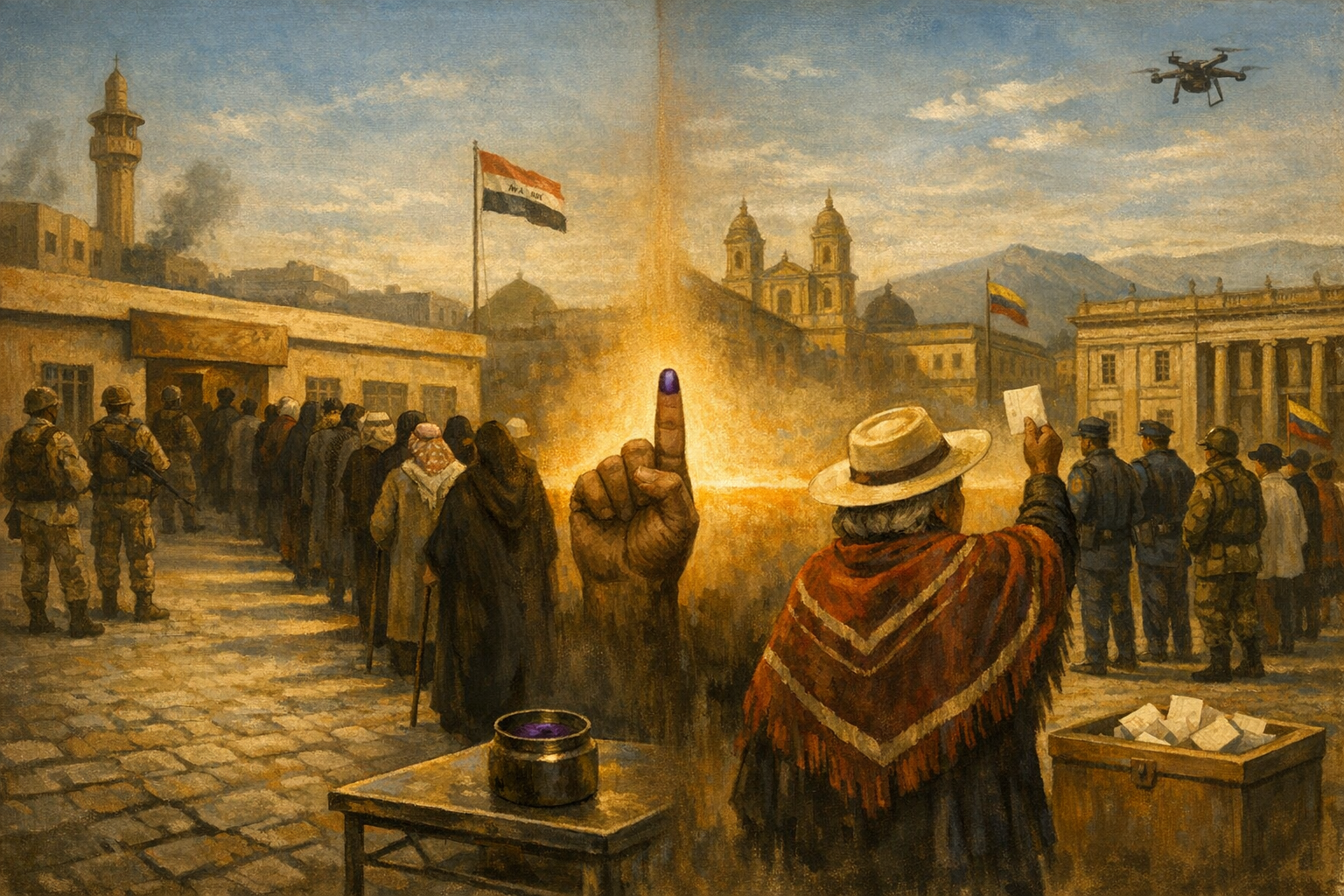
At seven in the morning on Sunday 30 January 2005, the polling station at the Karrada district school in central Baghdad opened with a queue already two hundred metres long. The voters in the queue had walked through the dark to get there because there had been no vehicle traffic permitted in Baghdad since midnight: the Iraqi Interim Government had declared a forty-eight-hour driving curfew and a ten o'clock-to-five-o'clock curfew on movement of any kind. The international border had been closed at midnight on Friday. Every airport in the country had been closed. Three Iraqi Army battalions and one US Marines battalion held the perimeter of the Karrada school. Above the queue, three minarets of the surrounding mosques had loudspeakers playing the recorded fatwa of Grand Ayatollah Ali al-Sistani that ordered Shia Iraqis to vote. Above the loudspeakers, two US Army helicopters orbited at perhaps three hundred metres. The voters entered the school one at a time, marked an X on a ballot of one hundred and ten candidate lists, fed it into a clear plastic ballot box, and put the right index finger of their right hand into a small painted-bronze pot of indelible violet ink. The ink dried into a stain that lasted the next seven days. Within hours the photograph of an old Iraqi woman holding her purple finger above her head outside that school was on the front page of every major newspaper in the world. It became the image of the day. It is what people now remember of the 30 January 2005 Iraqi parliamentary election. Voter turnout that day was 58 percent. Forty-four Iraqi civilians were killed by nine suicide bombings and one hundred and one armed attacks on polling stations across the country. The election had happened.
Abu Musab al-Zarqawi, the Jordanian Salafist who led al-Qaeda in Iraq, had issued his fatwa six days earlier. "We have declared a fierce war on this evil principle of democracy," he had said, "and on those who follow this wrong ideology." He had specifically promised that any Iraqi who voted would be killed. AQI had filmed and distributed the September 2004 beheading of British engineer Kenneth Bigley; it had attacked the Madrid commuter train system in March 2004; it had, by the end of 2004, become the most operationally feared Sunni jihadist organisation in the world. Its central operational target between October 2004 and January 2005 was the prevention of the election. It launched approximately 260 attacks on Iraqi electoral infrastructure in the four weeks before voting day. It assassinated nine candidates. It bombed sixty-three polling-station compounds. It distributed leaflets in Sunni neighbourhoods warning that the names and addresses of voters were being collected for execution.
The Iraqi Independent Electoral Commission, formed three months earlier under Coalition Provisional Authority order, had estimated in early January 2005 that voter turnout might be below 20 percent given the security situation. United States military intelligence estimates were similar. The British Foreign and Commonwealth Office's secret January 2005 assessment to the Cabinet was that turnout might fall below 15 percent and that the election might therefore not produce a legitimate government. The Sunni political establishment had called for a boycott. Sunni clerics had issued counter-fatwas saying that voting was haram. The pre-election polls in late January 2005 showed that Iraqi voters were terrified, and that they understood AQI's threat to be credible, and that they intended to vote anyway.
What happened that morning was that they voted anyway.
The Karrada queue at seven o'clock was the first wave. By midday it had become a national pattern. In Najaf and Karbala the queues stretched around the holy precincts and turnout reached 75 percent. In the Kurdish governorates of Dohuk and Erbil it reached 89 percent. In central Baghdad, where the suicide bombings were happening in real time, it was 56 percent. In Sunni Anbar province, where the boycott was strongest and where AQI's freedom of movement was greatest, it was 2 percent. The nationwide turnout, 58 percent, was higher than the United Kingdom's general election in 2001 (59 percent) and below the United States presidential election of 2004 (60 percent). The image of the purple finger went around the world by lunchtime. It was on the front page of the Washington Post, the Times of London, Le Monde, Bild, Asahi Shimbun and La Repubblica. It was the central exhibit of the case that Iraqi democracy was working.
The actual results of the election did not vindicate that case. The United Iraqi Alliance, a Shia electoral coalition tacitly endorsed by Sistani, won 48 percent of the vote and 140 of 275 seats. The Sunni boycott meant the Transitional National Assembly that drafted the 2005 Iraqi Constitution had no significant Sunni representation; the Sunnis later boycotted the constitutional referendum as well. The exclusion of the Sunni political class from the constitutional moment became the unhealed wound that produced the Sunni insurgency of 2005-08, the Sahwa councils of 2007-09, the Maliki government's anti-Sunni purges of 2010-13, and, eventually, the Islamic State's capture of Mosul in June 2014. The 30 January 2005 election worked as an election. It did not work as a settlement. The purple finger photograph aged less well than the voters who provided it.
This is the historical material that bears on this Sunday in Colombia.
Colombian voters go to the polls on Sunday 31 May 2026 to elect their next president from a field of fourteen candidates. The front-runner, polling at about 44 percent in the most recent Invamer survey, is Senator Iván Cepeda Castro, the candidate of the Pacto Histórico (Petro's left-wing coalition). His closest rivals are the lawyer and television commentator Abelardo de la Espriella at about 22 percent and the Centro Democrático senator Paloma Valencia at about 20 percent. Cepeda is 63. He was born into a Colombian Communist Party household. His father, Senator Manuel Cepeda Vargas, was the last sitting member of Congress from the Unión Patriótica when he was murdered in 1994 by paramilitaries acting in concert with elements of Colombian military intelligence; the Inter-American Court of Human Rights ruled in 2010 that the Colombian state was directly responsible. Iván Cepeda has spent the thirty-two years since his father's murder building the legal and historical-memory infrastructure of the UP political-genocide case (the murders of approximately three thousand UP members and elected officials between 1984 and 2002, ruled in 2023 to constitute a crime against humanity by the Inter-American Court).
He is running for president against an armed-group landscape that is unlike anything Colombia has faced since 1990. The Indepaz human-rights monitor has documented forty-eight massacres in the first four months of 2026, two hundred and forty-nine deaths: the highest pre-electoral toll in a decade. The Electoral Observation Mission has identified three hundred and eighty-six Colombian municipalities (approximately one-third of the country) as being at high or very high risk of armed-group interference with the vote. The technologically novel element is the drone. Colombian Defence Ministry figures show drone attacks struck three hundred and thirty-three targets in Colombia in 2025, up from sixty-one in 2024. The pattern is now "swarm" tactics: multiple cheap quadcopter drones carrying improvised grenades, launched simultaneously, against police stations, electoral-commission offices, and (since March 2026) at least four campaign events. The armed groups involved are the ELN, the Estado Mayor Central and Segunda Marquetalia FARC dissident factions, and the Gulf Clan paramilitary structure. The pattern in the Iraqi case was bomb-belt suicide and vehicle-borne improvised explosive devices. The pattern in the Colombian case is the autonomous swarm. The political logic is the same: prevent the vote, suppress turnout, delegitimise the result.
The decision the Iraqi voters made on 30 January 2005 was that the political project of voting was worth the personal risk of being killed for voting. Fifty-eight percent of them concluded that it was. The Colombian voters of this Sunday face a smaller version of the same decision. The technology is new. The political question is the same.
A purple finger is a piece of evidence. Of what, the next twenty years answer.