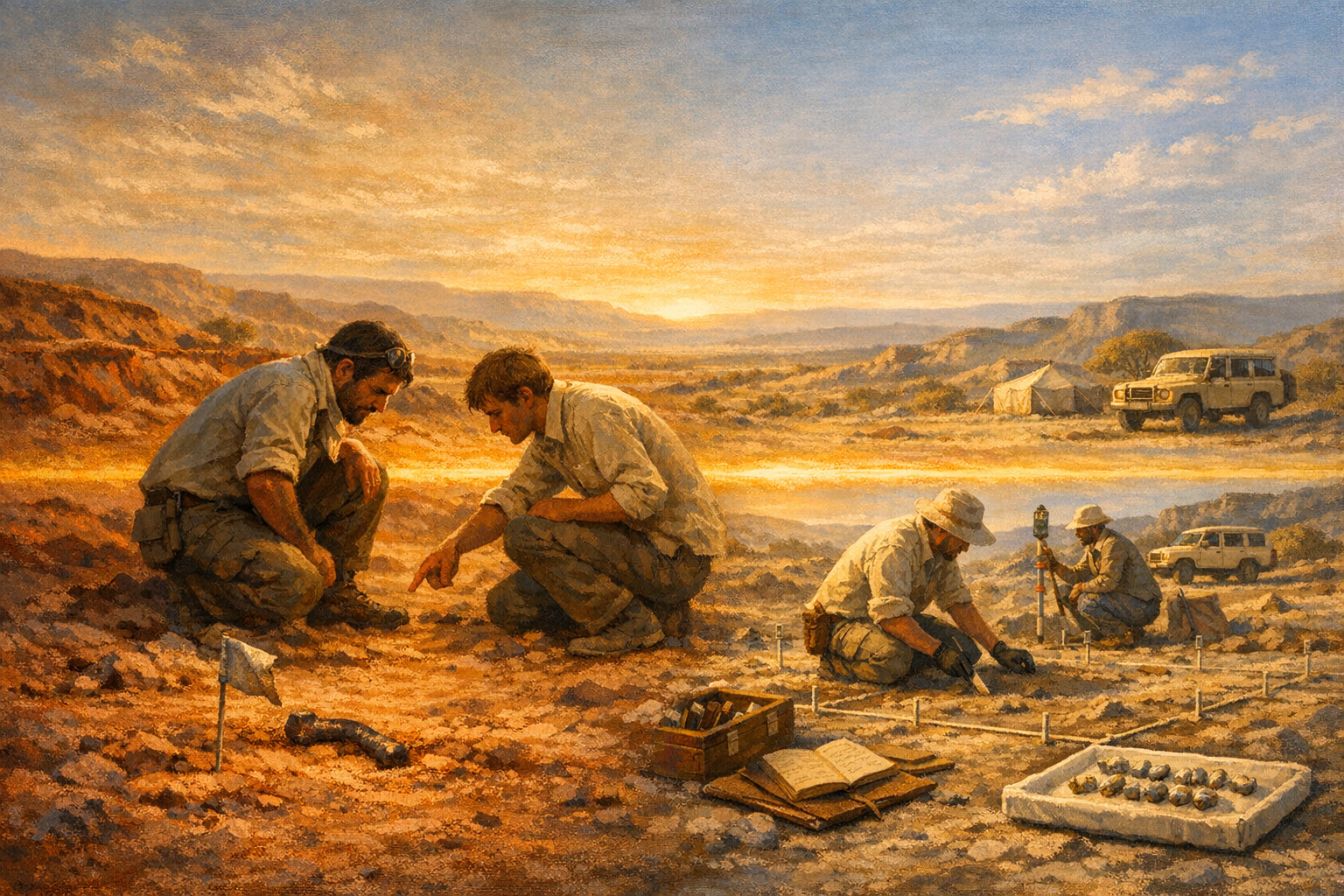
On the late afternoon of 24 November 1974, on a small dry watercourse in the Hadar badlands of the Afar Triangle in north-eastern Ethiopia, a thirty-one-year-old American paleoanthropologist named Donald Johanson and his graduate student Tom Gray were walking back to their jeep after a long unsuccessful day of fossil-hunting. Johanson, on a hunch, suggested they take a different route. Twenty metres from the jeep, he spotted a small dark curved fragment of bone lying in the powdery red-ochre dust at the bottom of a small gully.
It was a hominin arm bone.
Over the next two weeks the Hadar expedition recovered roughly forty per cent of a single skeleton from the same gully: cranial fragments, mandible, ribs, vertebrae, pelvis, both femurs, a tibia, and a complete left ulna. The skeleton was small, about a metre tall, female, between twenty and thirty years old at death. It was bipedal. It belonged to a species nobody had yet named. It was dated to about 3.2 million years old, half a million years older than any other complete hominin skeleton then known.
That evening at the camp, the expedition celebrated. Someone played a Beatles cassette. The song was Lucy in the Sky with Diamonds. Pamela Alderman, one of the expedition members, suggested the name. By the morning the new skeleton was Lucy. She was eventually catalogued as AL 288-1 and assigned to a new species, Australopithecus afarensis. She has spent the past fifty years sitting in a glass case at the National Museum of Ethiopia in Addis Ababa.
For most of those fifty years, the textbook picture of human ancestry was something like this. Lucy and her afarensis relatives lived around three million years ago in eastern Africa. They gave rise to the genus Homo somewhere around 2.5 million years ago. Homo then proceeded through Homo habilis, Homo erectus, archaic Homo sapiens, and us. The picture was a line. Lucy was on the line.
The picture is now a tree.
In August 2025, in Nature, a team led by Brian Villmoare at the University of Nevada at Las Vegas reported their analysis of thirteen teeth recovered from a research site called Ledi-Geraru, in the same Afar region a few hours' drive from Hadar. Some of the teeth belonged to the earliest known specimens of Homo, at 2.78 and 2.59 million years old. The rest of the teeth, dated to 2.63 million years, belonged to neither Homo nor any previously known Australopithecus. They were small, distinctive in their cusp pattern, and from a species the field has not yet given a Latin name to. It is the first new Australopithecine in twenty years.
Five months later, in January 2026, a separate team led by Professor Zeresenay Alemseged at the University of Chicago reported in Nature the discovery of a 2.6-million-year-old partial lower jaw from a place called Mille-Logya, also in the Afar region. The jaw, catalogued MLP-3000, belongs to Paranthropus: a robust, big-jawed cousin of our own genus that had previously been known only from sites about a thousand kilometres further south, in Kenya and Tanzania and South Africa. Alemseged's team showed that Paranthropus had been living in the Afar all along; the previous absence was an artefact of which rocks had been combed for fossils.
Taken together, the new fossils mean that the Afar between roughly 3.0 and 2.5 million years ago was home to at least four distinct hominin lineages walking the same landscape: late Australopithecus afarensis (Lucy's species, still around), the previously known Australopithecus garhi, the new Ledi-Geraru Australopithecus, the earliest Homo, and Paranthropus. They were probably eating different things, and certainly making different tools, or no tools, and competing for at least some of the same water sources. They did not share the landscape as a textbook line of ancestors and descendants. They shared it as cousins.
This is a different shape of story from the one Lucy was placed in.
The change is not a single discovery. It is the cumulative weight of forty years of new finds: the Black Skull, Kenyanthropus platyops, Homo naledi in South Africa, the Denisovans in Siberia, the Red Deer Cave people in China, Homo luzonensis in the Philippines, and now the unnamed Ledi-Geraru Australopithecus and the long-misplaced Afar Paranthropus. Every couple of years a new branch is added, and the line straightens slightly less. By the simplest count, the genus Homo has had something like ten species; the genus Australopithecus, at least five; the genus Paranthropus, three. They overlapped in time and in place. Some of them interbred. Most of them, eventually, died out.
Lucy did not get smaller because of the new fossils. She remains the most-studied early hominin skeleton in the world. Her pelvis is still the textbook proof that bipedal walking is older than the human brain. Her face is still the one in the museum case in Addis Ababa. What changed is that she is no longer on a line. She is on a tree. The line was an artefact of how few fossils we had.
The change is also a reminder of a quieter fact. The story we tell about ourselves at any given moment is constrained by the rocks we happen to have looked under. The Ledi-Geraru badlands sat there in the Afar for two and a half million years before anyone could spot a tooth in them. The Mille-Logya site sat there for the same period before anyone bothered to look at the right outcrop. The new fossils were always there. The picture they belong to is not new; the picture we had was incomplete.
Donald Johanson, eighty-two now, still gives lectures. In a recent interview he was asked whether the new Ledi-Geraru find changes how he thinks about Lucy. He said it makes her bigger, not smaller. The point of Lucy, he said, was never that she was alone on the road to Homo. The point was that she was the proof that there was anybody on the road at three million years ago, walking upright, in Africa, at all. Once you have her you can start looking for who else was walking beside her. He has spent the last fifty years saying this. The fossils are now agreeing.
The picture, as it stands in May 2026, is this. The hominin family of three million years ago was not a single line on its way to Homo. It was a small grove of upright apes, sharing water and stone tools and territory and, sometimes, genes. Most of the grove died out without descendants. One twig of it is us. The next twenty years of fieldwork will probably add more branches, and the grove will get denser, and the boundaries between the branches will get blurrier, until the question of who exactly we descended from looks less like a genealogy and more like the question of which particular oak in a forest of oaks happens to drop a particular acorn.
Lucy is fifty years and six months old this month. She is still on display in Addis Ababa. The grove around her is taller than we knew.