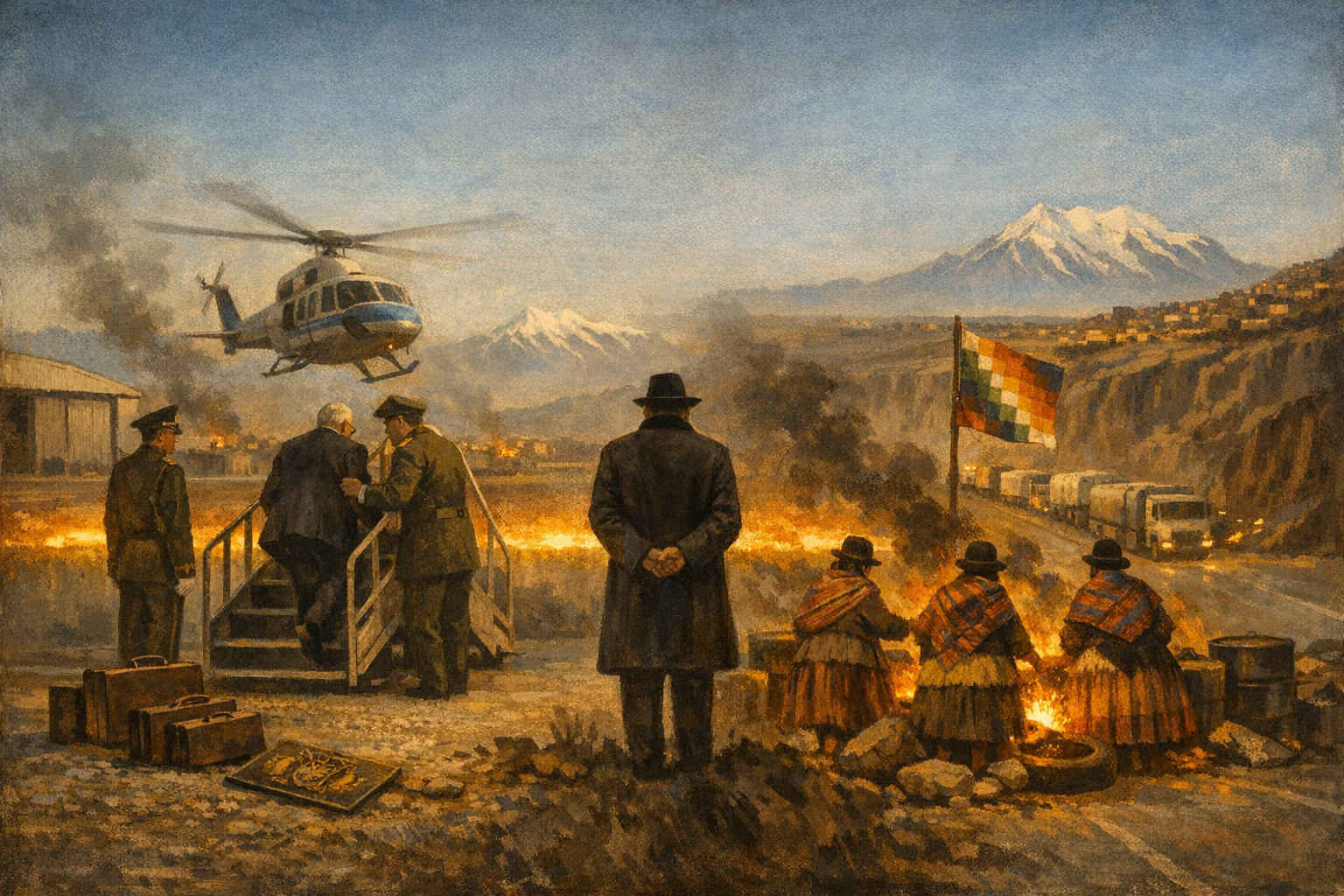
At 11.47 on the morning of Friday 17 October 2003, a small white helicopter lifted off the gravel airstrip of El Alto, the indigenous city on the rim of the canyon above La Paz, and turned south toward Santa Cruz. Inside it was the president of Bolivia, Gonzalo Sánchez de Lozada, his cabinet, and a typed letter of resignation that the Congress in La Paz was already preparing to accept. On the streets of El Alto behind him, sixty-seven people lay dead. Most of them had been shot the week before, by Bolivian Army soldiers, while trying to keep the road closed against the fuel convoys that the government had sent up from the lowlands to break the blockade. By the time the helicopter cleared the Cordillera Real, Sánchez de Lozada had been Bolivian president for thirteen months. He would not see the country again.
Gonzalo Sánchez de Lozada Sánchez Bustamante, known to almost everyone as Goni, had not always been Bolivian. He was the son of an exiled Bolivian diplomat, was born in Cochabamba but raised in Iowa City, took his degree from the University of Chicago, returned to Bolivia in his thirties and made his fortune in tin mining. He spoke Spanish with a Midwestern American accent. He was the most cosmopolitan and the most foreign-feeling man in Bolivian politics, and in 1985 he had become the architect, as Planning Minister, of the most aggressive shock-therapy programme attempted in Latin America. Inflation in Bolivia hit roughly twenty-four thousand percent in early 1985, the highest in the world that year. Goni's New Economic Policy, promulgated by Decree 21060 on 29 August 1985 under President Víctor Paz Estenssoro, stabilised the currency within days. It also closed the state tin mines, threw thousands of miners out of work, and produced a generation of organised indigenous and labour opposition that would haunt Bolivian politics for the next thirty years.
He served his first presidential term from 1993 to 1997. In June 2002 he won a second term with 22.46 percent of the vote, the slimmest plurality in Bolivian history. The man who came second, with 20.94 percent, was a forty-two-year-old coca grower from the Chapare region of Cochabamba named Evo Morales. Morales had been in Congress since 1997, expelled in early 2002 for inciting anti-government protests, and re-elected to the lower house under his own party banner (the Movimiento al Socialismo, MAS) in the same June 2002 vote that returned Goni. He took his seat in August 2002, in the same building Goni occupied.
The crisis began in February 2003. An IMF-recommended tax on monthly wages above 880 bolivianos triggered a police mutiny in La Paz and street protests that left more than thirty people dead in two days. Goni withdrew the tax and survived. By the summer he was attempting something more ambitious: a $1.3 billion deal to export liquefied natural gas from Bolivian wells to North American markets via a pipeline to a port in northern Chile. The plan ran into two problems. The first was Chile: Bolivia had lost its Pacific coast to Chile in the War of the Pacific in 1879, the loss was the great national wound, and routing the gas through a Chilean port was politically intolerable. The second was Morales. From his seat in Congress, from the coca-growers' federation in Chapare and from the COB (the Central Obrera Boliviana, the national workers' federation founded in 1952), Morales pulled together a coalition of indigenous communities, miners, peasants and urban poor to block every road into La Paz and to demand the project's cancellation and the president's resignation.
The first roadblocks went up in early September 2003 in the highland town of Warisata. On 20 September Army troops trying to evacuate stranded foreign tourists broke a blockade there and killed several Aymara villagers, including a child. The killings turned the protest into a national insurrection. By mid-October El Alto, the indigenous city of 800,000 people that sits above La Paz at thirteen thousand feet, was on full general strike. Petrol stations in La Paz ran dry. Goni ordered the Army to escort fuel tankers up the canyon road from the refinery to the capital. The soldiers fired on the El Alto crowds blocking the road. The official death toll for the October week alone was fifty-eight; by 17 October the total since September stood at around sixty-seven. Carlos Mesa, the vice president, denounced the killings and withdrew his political support from his own president on 13 October. A coalition party followed on 17 October. That morning Goni signed the resignation letter, drove in convoy up the canyon to El Alto airport (the only place from which a helicopter could safely lift), and was gone by lunchtime.
Carlos Mesa governed for nineteen months before the same coalition of blockaders forced him out as well. A caretaker, the Supreme Court president Eduardo Rodríguez Veltzé, organised early elections for December 2005. Evo Morales, the man whose movement had brought down two presidents, won 53.7 percent of the vote and became the first indigenous president in the history of South America. He served three terms. In October 2019 he claimed a fourth, in an election the Organisation of American States declared marred by serious irregularities, faced four weeks of street protests in turn, and on 10 November 2019 was advised by the head of the Armed Forces to resign. He fled to Mexico, then Argentina. He returned to Bolivia in November 2020 after his protégé Luis Arce won the next election. Within three years he had split bitterly with Arce. Bolivia's Constitutional Court ruled in December 2023, and again definitively in May 2025, that Morales could not run for a fourth term: indefinite re-election, the court said, was not a human right. He campaigned against the disqualification anyway. He was not on the ballot when Rodrigo Paz Pereira, a centrist Christian Democrat senator from Tarija, won the runoff against the former president Jorge Quiroga on 19 October 2025 with 55 percent of the vote.
Paz was inaugurated on 8 November 2025. He is the first non-MAS president of Bolivia since 2006. He inherited an economy collapsing under fuel shortages, a depleted central-bank reserve and 14 percent inflation, the worst Bolivian inflation in roughly four decades. His Christian Democratic Party holds a slim plurality in Congress. In April his government announced that the gasoline stockpiled in the state oil company's storage tanks under his predecessor was contaminated with gum and manganese, that it was damaging vehicles across the country, and that the state company would have to import emergency stocks on the international spot market. The president of YPFB and the Hydrocarbons Minister both resigned within thirty days of each other. Transport workers struck. Then on 2 May the COB declared an indefinite general strike. Then the Túpac Katari peasant federation blocked every road in the twenty provinces of La Paz department. Then the miners. By 19 May more than sixty road blockades were active across eight of Bolivia's nine departments, including the canyon road from the Altiplano into La Paz, the same road on which the soldiers had fired in October 2003. Markets in La Paz have run out of food. Hospital oxygen reserves are depleted. Three civilians have died because emergency vehicles cannot reach hospitals.
Morales is sixty-six. He is barred from running for office. He has no formal role in the COB, the cocaleros, or the peasant federation. He does not need one. The instrument he assembled in 2003 (the simultaneous blockade of the road from El Alto, the general strike of the COB, the cocalero mobilisation in Chapare, the peasant unions in the Altiplano, the urban poor in the indigenous markets of La Paz) is the instrument now being used against Rodrigo Paz. The trigger then was a pipeline to Chile. The trigger now is the contaminated petrol in the tanks. The unsigned author of the architecture is the same.
Bolivia is the only country in modern Latin America that has perfected the use of the road blockade as the instrument for changing governments. It has used that instrument to bring down five presidents since 2003. The instrument was designed by a man who once held the country's third-largest vote share, who served three full terms, who has been out of power for six and a half years, and whose continued ability to put two hundred thousand people on a particular stretch of asphalt between an airport and a city remains the single most consequential fact in Bolivian politics.
The architect rarely returns to the building site. But sometimes the building is still rising.