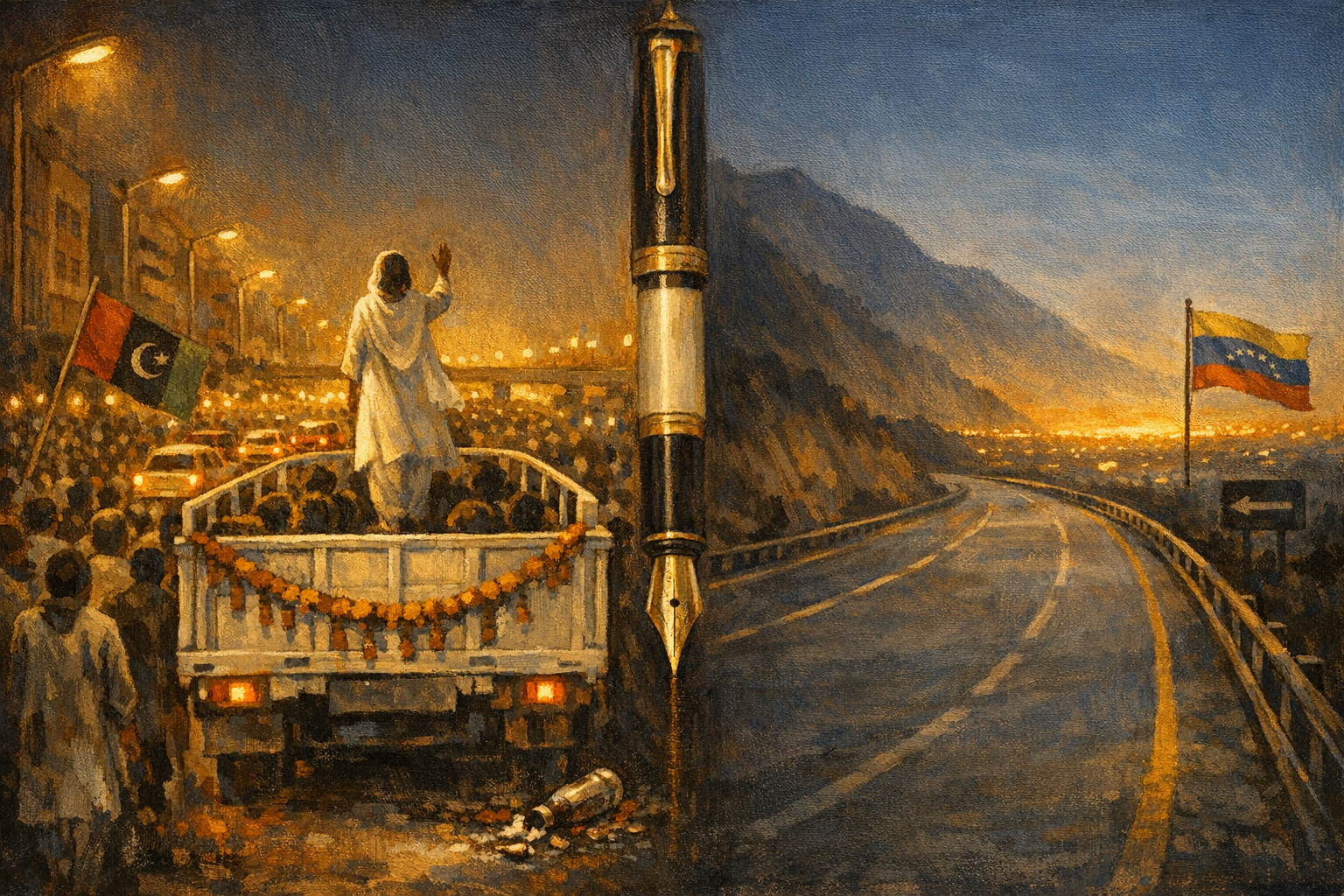
Just before midnight on 18 October 2007, a slow-moving truck inched along Sharae Faisal Road in Karachi, surrounded by the largest political welcome the city had ever seen. The truck carried Benazir Bhutto, twice-elected Pakistani prime minister, twice-deposed, eight and a half years gone. She had landed at Jinnah International Airport that afternoon to a sea of party flags, mango-tree garlands, and rosewater bottles smashed against the tarmac by jubilant supporters. The crush of the welcome had reduced the procession's progress to less than a kilometre an hour. She was standing in the painted custom enclosure at the top of the truck, waving to the crowd, when she went below to write a speech for the rally at the Mazar-e-Quaid. At 12:13 in the morning, the first suicide vest detonated beside the truck's front-left wheel. Twenty seconds later, a second blast went off at the rear. The official Sindh provincial tally listed 149 dead. The Pakistan Peoples Party counted 177. At least fifty of the dead were her own party's security volunteers, who had formed a human chain around the truck specifically to stop a bomber from reaching it. They did. She survived. She slept that night in a friend's house in Bilawal Town, and called her husband in Dubai.
Bhutto had been negotiating her return for the better part of a year, through Saudi and American intermediaries, with the man who held the presidency of Pakistan. Pervez Musharraf had seized power in a coup in October 1999. He had ruled for eight years. By 2007 his lawyers' movement was on fire, his Supreme Court was in revolt, and the American State Department under Condoleezza Rice had concluded that Musharraf alone could no longer hold the centre against the rising Pakistani Taliban. Washington wanted a civilian counterweight with electoral legitimacy. Riyadh wanted to retire its own ward Nawaz Sharif from the field. The compromise that Rice and the Saudi ambassador to the United States, Adel al-Jubeir, helped to broker was the National Reconciliation Ordinance, an executive instrument Musharraf promulgated on 5 October 2007, which extinguished a category of corruption and criminal cases against politicians who had held office between 1986 and 1999. The Ordinance was tailored to fit one returning exile. Bhutto's name had been on the corruption files for a decade. Now the files were closed. She booked her ticket to Karachi for 18 October.
She was returning to a country at the edge. Three months earlier, the Pakistani army had stormed the Lal Masjid in Islamabad to dislodge an armed Deobandi cleric and his followers from a mosque-and-madrasa complex one mile from the headquarters of Inter-Services Intelligence. More than a hundred people died inside the mosque. The Pakistani Taliban, formed three months after that operation under Baitullah Mehsud, declared Musharraf and any politician who returned under his protection a legitimate target. Bhutto knew this when she boarded the Emirates flight from Dubai. She told a CNN reporter at the airport that she had given Musharraf a list of names of individuals inside Pakistan's security services whom she believed would attempt to kill her. She said she had asked him to investigate them. She said she did not expect him to.
The Karsaz bombing did not end her campaign. It accelerated it. She told her closest aides that she had been afraid only of being killed before she could face the voters; now she had survived the welcome, and she would not hide from the rallies that followed. She campaigned through November under house arrest after Musharraf declared a state of emergency on the third of that month, suspended the Constitution, and dismissed the Chief Justice for the second time. The emergency was lifted on 15 December. She drove to Lahore on the twentieth, to Multan on the twenty-second, to Peshawar on the twenty-fifth. On 27 December 2007 she addressed a rally at Liaquat Bagh in Rawalpindi, the same garden where the country's first prime minister Liaquat Ali Khan had been assassinated fifty-six years earlier. Leaving the rally in her white Toyota Land Cruiser, she stood up through the sunroof to wave one last time to the crowd. A young man in dark sunglasses fired three shots. A suicide vest detonated less than a second later. She was pronounced dead at Rawalpindi General Hospital at 18:16. She was fifty-four years old. The Pakistani Taliban under Baitullah Mehsud was named the principal suspect. Her husband Asif Ali Zardari, in Dubai with their three children, refused permission for an autopsy and flew with her body to her family's ancestral burial ground in Larkana.
The election that Musharraf had postponed to 18 February 2008 was held on schedule. Bhutto's Pakistan Peoples Party won the largest bloc in the National Assembly. Zardari, now co-chair of the party with their nineteen-year-old son Bilawal, formed a coalition government with Sharif's Pakistan Muslim League and elected Yousaf Raza Gillani prime minister. On 18 August 2008, threatened with impeachment by his own Assembly, Pervez Musharraf resigned the presidency in a televised address from the official residence at Aiwan-e-Sadr. He left Pakistan for London the following spring. Three weeks after his resignation, Zardari was elected to succeed him as the eleventh president of the Islamic Republic of Pakistan. The transition Bhutto had returned to negotiate was completed. She had not lived to see it.
This is the geometry of an exiled opposition leader returning to challenge a regime. The exile is long enough that the regime believes she has been forgotten. The welcome at the airport proves otherwise. The regime cannot move openly against the welcome, because the airport is watched by foreign cameras and foreign embassies; instead, the bomb arrives on the road. If the bomb fails, the second attempt comes at a rally. If the second attempt succeeds, the political system the returning exile activated does not switch off. It carries her name through the election anyway, and the regime that survived her, briefly, does not survive the vote that follows.
María Corina Machado is six months into her own exile. She left Caracas in December 2025 after eleven months of hiding, travelled to Oslo to accept the Nobel Peace Prize she had been awarded in October 2024 for organising the Venezuelan opposition primary that won her ninety per cent of its vote and gave her opposition coalition the documented tally that showed Edmundo González Urrutia winning the July 2024 presidential election by a margin of more than two to one. In January 2026 a United States special forces team operating out of the Joint Special Operations Command's task force in Curaçao captured Nicolás Maduro at a private finca in Aragua state and rendered him to the Southern District of Florida, where he is being held pending trial on the narco-trafficking charges first filed against him in March 2020. The post-Maduro transition that Machado spent two years organising the moral case for was handed, in the four months that followed, to a designated successor from the United Socialist Party of Venezuela whom the Trump administration determined to be a more manageable partner. Machado was sidelined.
On the morning of Friday 23 May 2026, Machado held a press conference in Panama City. She announced that she would return to Venezuela by the end of the year and that she would run, again, for the presidency. She told the assembled reporters that the transition would require seven to nine months of work to establish the conditions for a free election, and that she could not do that work from abroad. She did not name a date for her flight. She did not name a city.
What Bhutto's October showed is that the most dangerous moment for the returning exile is not the flight. It is the road from the airport to the first rally. The regime that the exile is returning to challenge cannot stop her boarding the plane, because the plane is in international airspace, and cannot stop her landing, because the airport is watched, and cannot move against her at the rally itself, because the rally is hers. The window the regime can use is the slow procession through its own streets. Bhutto's truck moved at less than a kilometre an hour because the welcome was that thick. The bomber walked up to the wheel arch because the truck could not outrun him.
Machado has been writing the question of how to land for six months. The Pakistani precedent is the one she has, in private, asked her security advisers to study. The procession through Karachi did not save Benazir Bhutto. It did, eventually, end the regime that killed her.
The next president of Venezuela may have to ride the same road.