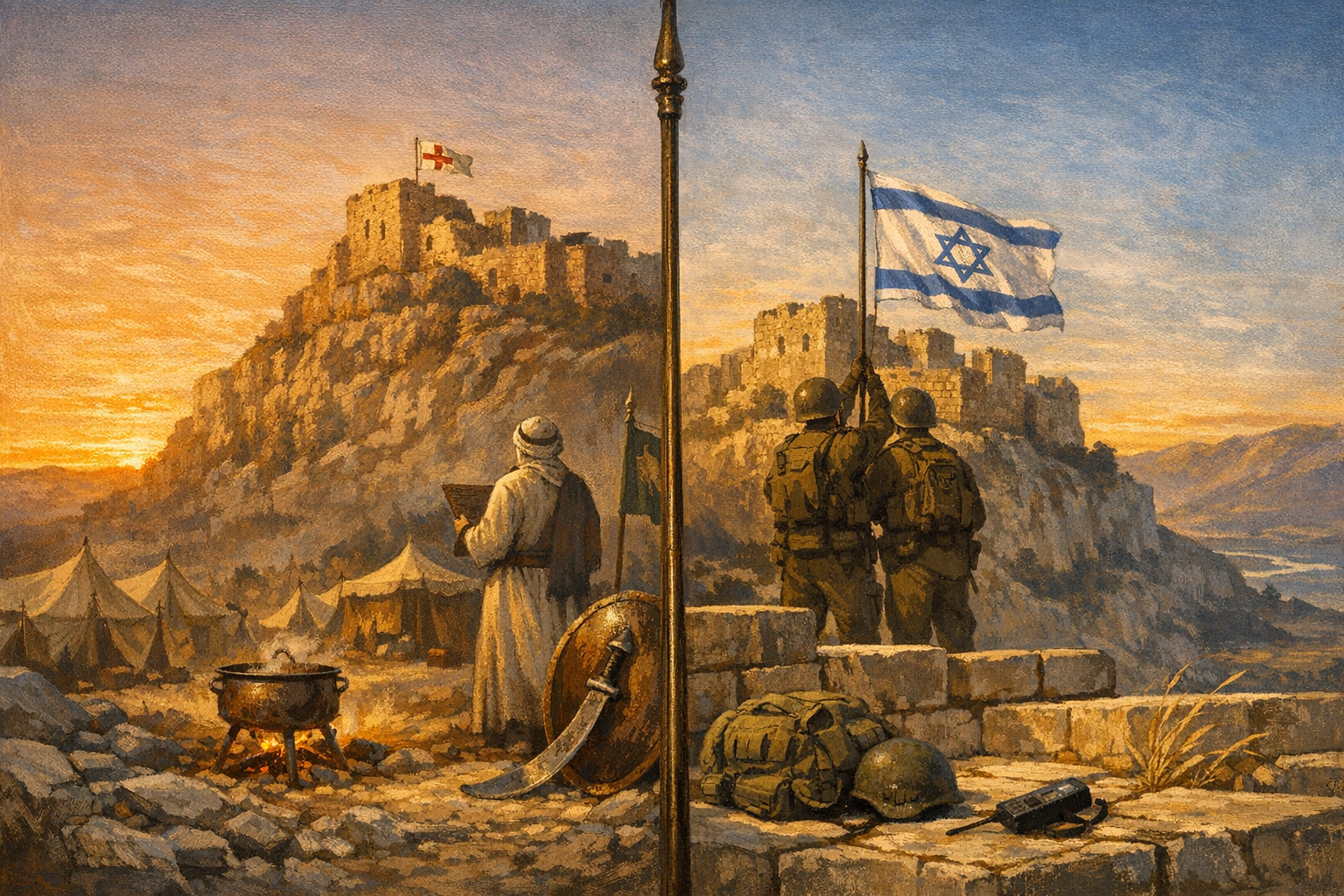
There is a limestone escarpment 700 metres above the Litani River in southern Lebanon. From its eastern edge, on a clear day, you can see the Bekaa Valley, the foothills of Mount Hermon, the coastal road from Tyre to Sidon, and the northern fringe of the Galilee. Whoever holds it can see almost everything they would need to see in order to fight a war in either direction. It has therefore been continuously fortified for 850 years. The medieval Crusaders called it Belfort, the Beautiful Stronghold. The Arabs called it Qalaat al-Shaqif, the Castle of the High Rock. The Israeli army called it Beaufort, in the French transliteration that English-language atlases prefer. On Sunday morning the Israeli Golani Brigade raised a flag over its ruined keep for the second time in forty-four years.
In April 1189, eighteen months after the Battle of Hattin had destroyed the Latin Kingdom of Jerusalem and Saladin's army had retaken almost every Crusader fortress in the Levant, Salah ad-Din Yusuf ibn Ayyub set camp at the foot of the same escarpment and looked up at the same castle. The castellan was a man named Reginald of Sidon. Reginald had survived Hattin. He was a known Arabist who had translated Arabic poetry into Old French, who spoke Saladin's language with a fluency that startled the camp scribes, and who had served his apprenticeship in the Frankish art of negotiating from a position of military weakness. He walked out of the gates of Beaufort and into Saladin's tent. He told Saladin that he had been considering the truth of Islam for some years. He told Saladin that he was prepared to convert, and to surrender the castle, but that his wife and children were in Tyre, and that he could not in conscience hand over the castle until they were safely outside the Christian-held city. He asked Saladin for three months to extract his family. Saladin, whose chivalric reputation was the single most important strategic asset of his late career, agreed.
Reginald used the three months to repair the castle and stockpile food. When Saladin's emissaries returned in July they found Beaufort better-defended than it had been in April. Reginald was arrested, tortured in Saladin's camp for the better part of a year, and finally exchanged for the castle's surrender in April 1190. The garrison handed Beaufort over to Saladin's lieutenants and Reginald walked out a free man. He died, eventually, of natural causes, having outlived Saladin himself by some years. The siege of Beaufort, one of the documented set-pieces of the post-Hattin reconquest, is the moment Arabic chroniclers established the literary trope of the wily Frank who outwits the chivalric Saracen by appealing to the Saracen's better nature. It is the kind of small irony that survives 800 years because the people writing it down knew that the castle, in the end, fell anyway.
The castle then began to change hands at the pace its geography required. The Mamluk Sultan al-Zahir Baybars arrived at the foot of the escarpment on 4 April 1268, eight days into his campaign to expel the remnant Crusader presence from the Levant. The Templars who were holding Beaufort by then surrendered after eleven days on terms that allowed the women and children safe passage to Tyre while enslaving the four hundred and eighty male defenders. Baybars demolished part of the inner keep and incorporated the rest into the Mamluk defensive system that held the Levant until the Ottoman conquest of 1516. The Ottomans inherited the castle and let it slowly decay. The French Mandate authorities surveyed it in 1924, recorded it as a medieval ruin, and posted a small garrison. The Palestinian Liberation Organisation took it in 1976 during the disintegration of the Lebanese state and used it as a forward observation post for rocket fire into northern Israel. The Israeli army captured Beaufort on the third day of Operation Peace for Galilee, on 6 June 1982, after a single overnight assault by Golani paratroopers that left six Israeli dead and several hundred PLO defenders killed or captured. The Israeli army then held Beaufort for eighteen years, fortified it as the northernmost anchor of its self-declared southern Lebanon security zone, and withdrew on 24 May 2000 in the closing hours of Ehud Barak's unilateral pullout from southern Lebanon. Hezbollah occupied the castle the same afternoon. Hassan Nasrallah gave his famous "weaker than a spider's web" victory speech on the road below it. For the next twenty-six years Hezbollah kept Beaufort as a strategic observation post and political shrine, opened it to Lebanese visitors as a victory monument, hung the yellow-and-green party banner from its tallest turret, and used the surrounding ridge as the position from which to fire rockets and observe Israeli army movements in northern Galilee. The castle became, in the slow accretion of Lebanese memory, the symbol both of the Israeli occupation that ended in 2000 and of the deterrent the Hezbollah movement claimed to have established. The 2006 Lebanon war did not touch the castle. The 2024 war did not touch the castle. Israel has now retaken it.
On the morning of Sunday 31 May 2026, after seventy-two hours of fighting in the surrounding terrain that the Israel Defense Forces designated the "Beaufort ridge offensive," elements of the Golani Brigade reoccupied the castle's medieval inner walls and raised the Israeli flag from its tallest surviving turret. Prime Minister Benjamin Netanyahu announced the seizure from the prime minister's residence in Jerusalem on Sunday afternoon in language that would have been recognisable to Saladin's camp scribes. "We returned stronger than ever," he said. "This is a dramatic shift in Israeli policy. Hezbollah will not be permitted to return here." The IDF press office released a photograph of the flag being raised. Foreign journalists in Beirut reported simultaneous Israeli air strikes on Nabatieh nine miles to the north and on a corridor along the western flank of the ridge. The April 2026 ceasefire that the United States and France had brokered between Israel and Hezbollah, and which had held in some form for seven weeks, is now effectively suspended.
The castle that Saladin spent a year taking from Reginald of Sidon, and that Baybars took from the Templars in eleven days in 1268, and that the PLO took from the Lebanese state in the late 1970s, and that Israel took from the PLO in 1982, and that Hezbollah took from Israel in 2000, has now been taken by Israel again, in the spring of 2026, in the same week that Lebanon's parliamentary elections were due to be held and were not. The castle has not changed. The wars at its foot have.
What the castle proves is simple. There is a limited list of geographical positions in southern Lebanon from which a military force can see and reach far enough to control the southern Litani basin. Beaufort is at the top of the list. Every regional power that has wanted to control southern Lebanon, from the Crusaders to the Mamluks to the French to the PLO to Israel to Hezbollah and now to Israel again, has captured or recaptured Beaufort within months of arriving in the country with that intention. None of them has held it for more than a few decades. The longest continuous holders were the Ottomans, who treated the castle as a quiet ruin for almost four hundred years because they had no Mediterranean adversary capable of contesting it. The current holders, like every modern holder, have an adversary capable of contesting it. They will not hold it long.
The fight at the foot of the limestone escarpment will continue. The flag at the top of the keep will change again. The 850-year average suggests that the next change is somewhere between five and forty years away.
The castle does not care.